
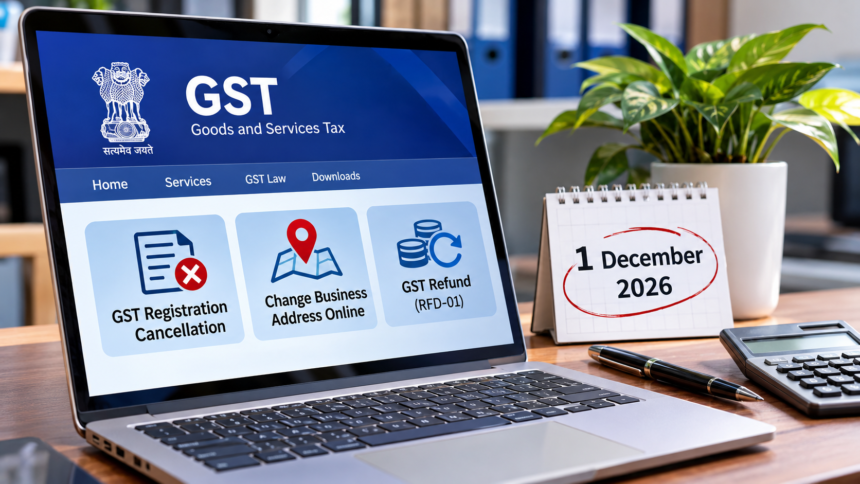
Businesses registered under the Goods and Services Tax (GST) system will see several procedural changes from December 1, 2026. The revised rules are expected to make GST registration cancellation easier, allow eligible small businesses to update their principal business address online and introduce a modified refund application form.
The changes are intended to simplify compliance, improve online services and reduce the need for businesses to visit tax offices. However, companies will still need to maintain accurate records, clear outstanding dues and follow all applicable GST requirements.
Enforcement measures will also continue against businesses involved in issuing fake invoices through bogus registrations or reporting supplies that never took place. Further changes related to e-invoicing and GST returns are scheduled to take effect from January 1, 2027.
GST Registration Cancellation Process to Become Easier
From December 1, eligible businesses will be able to apply for GST registration cancellation through a simplified online process.
Under the revised system, applications submitted by businesses that have completed their pending GST returns and cleared all outstanding liabilities will be processed automatically through the GST portal. At present, cancellation requests often require approval from a tax officer.
To qualify for the simplified process, businesses must fulfil the following requirements:
- File all pending GST returns.
- Pay any outstanding tax liabilities.
- Clear applicable interest, late fees and penalties.
Applications that fail to meet these conditions will be sent to a tax officer for further verification and examination.
GST REG-16 Form Updated for Cancellation Applications
The GST REG-16 form, used for requesting cancellation of GST registration, has also been revised.
Under the updated form, applicants will be able to provide details of Input Tax Credit (ITC) reversals related to stock, semi-finished goods and finished products. The revised application will also include provisions for reporting ITC reversals involving capital goods.
Businesses will additionally be able to disclose NIL returns for the period between their last filed return and the date of cancellation.
However, cancelling GST registration will not eliminate any previous tax liabilities. Businesses must still settle outstanding dues relating to earlier tax periods.
Small Businesses Can Update Their Address Online
Another important change will benefit smaller businesses registered through the simplified procedure under Rule 14A.
Eligible taxpayers will be allowed to change their Principal Place of Business address online without having to follow the earlier in-person process.
The facility is expected to make compliance easier for small enterprises that may have limited resources to manage administrative procedures. However, businesses must ensure that the updated address information is accurate and that all required supporting documents are submitted.
New GST RFD-01 Refund Form From December 1
Businesses applying for GST refunds will have to use the revised Form GST RFD-01 from December 1, 2026.
The updated application will collect more detailed information and introduce two additional refund categories:
- Refunds relating to certain specified supplies made to merchant exporters.
- Refund of additional IGST paid when the price of exported goods is increased after export.
Applicants will need to provide more comprehensive information about invoices, supplies and other relevant transactions, along with the necessary supporting documents.
According to MS Mani, Partner at Deloitte India, collecting clearer information and additional documentation at the initial application stage could help tax officials examine refund claims more efficiently. It may also reduce the need for repeated requests for additional records.
What Businesses Should Check Before Applying
Before submitting a GST refund application, businesses should review their invoices, HSN codes, ITC records and other supporting paperwork. Missing information or incomplete documentation could delay the refund process.
Another important point concerns applications saved as drafts. Any draft refund application that has not received an ARN (Application Reference Number) by December 1 will need to be submitted again using the revised form.
GST E-Invoicing Changes Scheduled for January 1, 2027
The December updates will be followed by further changes to e-invoicing and GST returns from January 1, 2027.
These upcoming amendments may require businesses to modify their accounting software, billing systems and internal compliance procedures.
Companies that depend on software-based invoicing and accounting should review their existing systems in advance to ensure they are prepared for the revised requirements.
What Should Businesses Do Before the New GST Rules Begin?
With several changes approaching, businesses should review their GST records and complete pending compliance work before the new procedures take effect.
Taxpayers should file outstanding returns, clear unpaid taxes and other dues, reconcile invoices and organise the documents required for refund applications. Businesses planning to cancel their GST registration should also familiarise themselves with the revised REG-16 procedure.
Small enterprises should check whether they qualify for the online address-update facility. Companies should also coordinate with their accounting and software providers to prepare for the e-invoicing changes scheduled for January 2027.
Although the revised procedures are expected to simplify several GST-related activities, maintaining accurate records and meeting statutory requirements will remain essential.
Disclaimer: This article is intended for general informational purposes and is based on the GST changes described in the source material. Implementation details, eligibility conditions and compliance requirements may be subject to official notifications or subsequent amendments. Businesses should consult the latest GST notifications, the official GST portal or a qualified tax professional before making compliance-related decisions.