
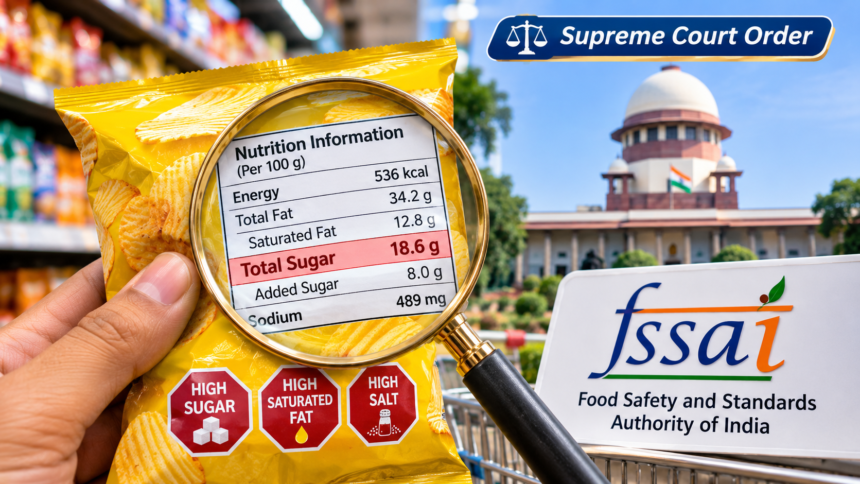
Packaged Food Labels: The Supreme Court has directed the Food Safety and Standards Authority of India (FSSAI) to introduce clearer warning standards for packaged food products, focusing on total sugar rather than only added sugar. The move could change how consumers understand nutritional information on products such as biscuits, chips, snacks and soft drinks.
New Delhi: Many consumers check food packaging before making a purchase, but their attention often remains limited to calories, fat and added sugar. However, the total sugar content of a product is equally important when evaluating its nutritional value.
Taking note of concerns surrounding existing food labelling practices, the Supreme Court has asked FSSAI to establish new standards covering total sugar, saturated fat and salt. The authority has been given approximately four months to finalise the regulations.
The proposed changes are intended to make nutritional warnings more informative and help consumers understand what they are actually consuming.
Supreme Court’s Decision on FSSAI Food Labelling Rules
Until now, existing warning standards have primarily considered added sugar and added fat. The Supreme Court has directed that the revised framework should also account for total sugar and saturated fat.
FSSAI will be responsible for determining the appropriate thresholds for sugar, fat and salt content in packaged food products.
The issue has gained attention because some food products carry claims such as ‘no added sugar’ despite containing considerable amounts of naturally occurring or processing-related sugars.
Under the proposed framework, front-of-pack warnings will depend on the total sugar and saturated fat levels in a product. If the sugar content crosses the limits established by FSSAI, the packaging could carry a ‘high sugar level’ warning.
However, these requirements will become applicable only after the authority finalises the limits and the revised regulations come into force.
Added Sugar vs Total Sugar: What Is the Difference?
Understanding the difference between added sugar and total sugar is important when reading food labels.
Added sugar refers to sugar introduced during the preparation or manufacturing of a product. Total sugar includes both added sugar and naturally occurring sugars already present in the ingredients.
For example, consider a cup of tea prepared with milk. The two teaspoons of sugar added while making the tea count as added sugar. However, milk naturally contains lactose, which is also included in the total sugar content.
Therefore, the combined amount of naturally occurring and added sugars represents the total sugar in the beverage.
This distinction matters because a product may contain no added sugar but can still have a considerable amount of total sugar.
Existing FSSAI Sugar and Fat Standards Explained
FSSAI had previously established certain nutritional standards based on the 2024 dietary guidelines issued by the Indian Council of Medical Research’s National Institute of Nutrition (ICMR-NIN).
According to the figures mentioned in the source material, the standards include:
- Solid foods: 3 grams of added sugar and 4.2 grams of added fat per 100 grams.
- Beverages: The stated criteria include 2 grams of added sugar and 1.5 grams of added fat per 100 ml.
The petitioner argued that focusing only on added sugar does not provide consumers with a complete picture because naturally occurring sugars may also contribute significantly to a product’s total sugar content.
The proposed changes aim to address this gap by making total sugar a key consideration in nutritional warning labels.
How Can New Sugar Warning Labels Benefit Consumers?
High sugar consumption is associated with several health concerns. Regularly consuming excessive amounts of sugar can contribute to weight gain and obesity, increase the risk of type 2 diabetes and raise the chances of tooth decay and heart disease over time.
According to Dr. Arun Gupta, nutrition policy expert and convener of Nutrition Advocacy in the Public Interest, including total sugar in warning labels is a positive step.
He believes that displaying total sugar information will help consumers understand how much sugar they are actually consuming through packaged foods and beverages.
Information about added sugar alone does not provide the complete picture, as it excludes naturally occurring sugars present in food ingredients.
The proposed labelling changes could therefore help people make more informed food choices by providing a clearer understanding of the nutritional content of packaged products.
Disclaimer: This article is intended for general informational purposes and is based on the information provided in the source material. The proposed food labelling requirements, nutritional thresholds and implementation timelines are subject to official FSSAI regulations and government notifications. This article should not be considered medical or dietary advice. Consult a qualified healthcare or nutrition professional for personalised guidance.