
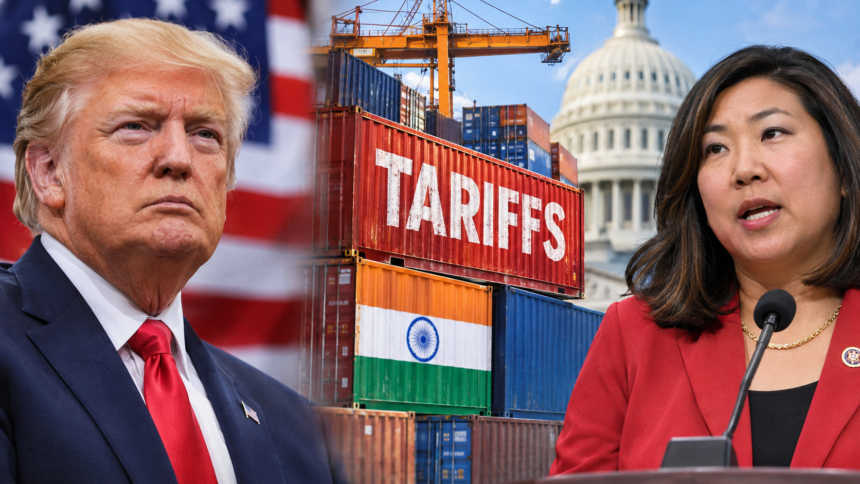
US lawmaker Grace Meng has criticised President Donald Trump’s latest round of tariffs targeting 14 economies, including India, describing them as costly measures that could be rolled back when Democrats regain control of the US Congress next year.
Meng, who chairs the Congressional Asian Pacific American Caucus (CAPAC), pointed out that most of the economies affected by the latest tariffs are in Asia. She said the additional duties have increased financial pressure on Asian Americans, Native Hawaiians and Pacific Islanders (AANHPIs).
In a statement, Meng said Trump’s trade policies had particularly affected the nearly three million businesses owned by AANHPI communities across the United States. Many of these businesses depend on imported ethnic and cultural products that are difficult to manufacture domestically.
Meng is a Democratic member of the US House of Representatives and the first Asian American elected to Congress from New York State. She is also involved in appropriations, Asian American advocacy and social policy.
Trump Tariffs Have Increased Costs for American Consumers
Grace Meng said the latest tariff measures have contributed to higher prices for everyday products, groceries and other essential goods in the United States. The additional costs have placed pressure on households, consumers and small businesses.
Economists have also identified tariffs as one of the factors contributing to inflationary pressures in the US economy.
Meng said CAPAC members would work to restore Congress’s constitutional authority over trade policy under Article I of the US Constitution if Democrats regain control of Congress next year.
“Next year, CAPAC members will reclaim Congress’s constitutional authority under Article I to regulate trade and work to end these costly tariffs once and for all,” Meng said.
She also highlighted the economic difficulties faced by Asian American communities in several parts of the country, including Chinatown in New York City, Little India in Chicago and Little Saigon in Orange County.
US Households Face Additional Financial Pressure
Data cited in the report showed that the average American household was paying approximately $4,700 more for goods and services as of September 2026 due to rising costs.
While President Donald Trump has presented tariffs as a source of additional government revenue, the increased import costs are also being passed on to businesses and consumers. As a result, ordinary Americans purchasing imported products are facing higher expenses.
These rising costs have become a major concern for families and small businesses that depend on goods sourced from international markets.
India Rejects US Allegations Over Manufacturing Capacity
India has rejected allegations from the Trump administration that its trade policies have contributed to structural excess manufacturing capacity. New Delhi maintains that the country does not have surplus production in any particular sector.
The Indian government has also stressed that trade-related disagreements should be addressed through ongoing bilateral negotiations rather than through unilateral tariff measures.
Meanwhile, the US Trade Representative (USTR) has proposed a 25% tariff on imports from India. However, the proposed duty could be reduced to 17% if the two countries successfully conclude a trade agreement.
The proposed measures are linked to a Section 301 investigation examining structural overcapacity and excess production across several major economies. The investigation focuses on concerns raised by the US regarding manufacturing capacity and what it considers unfair trade practices.
India’s position remains that these concerns should be resolved through discussions between the two governments rather than additional trade restrictions.
Disclaimer
This article is intended solely for general informational and news purposes. The statements and positions mentioned are attributed to the respective individuals and governments. Trade policies, proposed tariffs and ongoing investigations may change as negotiations and official decisions progress. Readers should refer to official government announcements and reliable sources for the latest updates. This content should not be considered financial, legal or investment advice.