
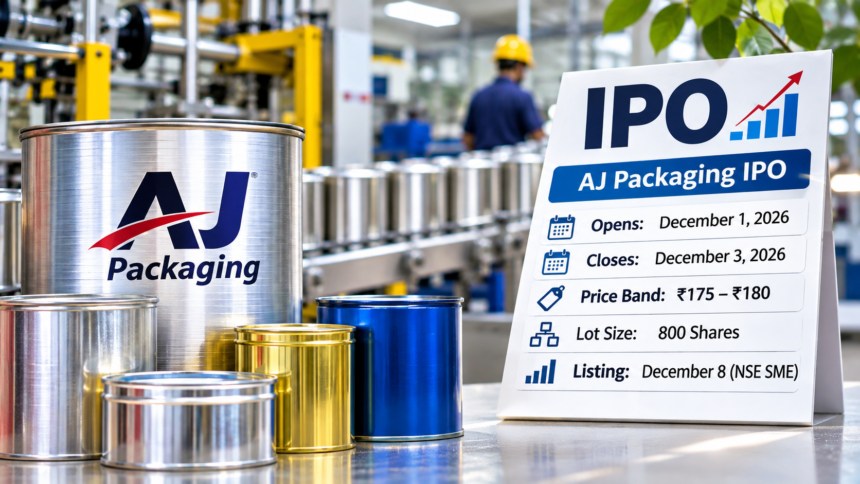
New Delhi: AJ Packaging is preparing to enter the stock market with its upcoming SME initial public offering (IPO) worth Rs 54 crore. The public issue will open for subscription on December 1, 2026, and remain open until December 3. The company has fixed its price band at Rs 175 to Rs 180 per share.
AJ Packaging operates in the packaging industry and manufactures printed and customised metal tin containers for well-known paint and FMCG brands. Its customer base includes companies such as Asian Paints and Haldiram.
The IPO consists of a fresh issue worth Rs 49.5 crore and an offer for sale (OFS) of Rs 4.5 crore by existing shareholders. The company was established in Hyderabad in 1995 and specialises in manufacturing metal packaging products for major brands.
Investors are also keeping an eye on the IPO’s grey market premium (GMP), which currently stands at Rs 20. Based on this indication, the shares could potentially list at Rs 200, although actual listing prices may differ.
AJ Packaging IPO: Important Dates and Key Details
The AJ Packaging IPO will be launched through the book-building process and listed on the NSE SME platform. Here are the important details investors should know before applying.
| IPO Details | Information |
|---|---|
| IPO Opening Date | December 1, 2026 |
| IPO Closing Date | December 3, 2026 |
| Tentative Listing Date | December 8, 2026 |
| Face Value | Rs 10 per share |
| Price Band | Rs 175–180 |
| Lot Size | 800 shares |
| Issue Size | Rs 54 crore |
| Fresh Issue | Rs 49.5 crore |
| Offer for Sale | Rs 4.5 crore |
| Issue Type | Book Building IPO |
| Listing Platform | NSE SME |
AJ Packaging IPO GMP and Expected Listing Price
The grey market premium of AJ Packaging shares is currently reported at Rs 20. This represents an indicative premium of approximately 11.11% over the upper end of the IPO price band of Rs 180.
Based on the latest GMP, the estimated listing price could reach Rs 200 per share. Since each lot contains 800 shares, the potential listing gain can be calculated as follows:
| Investment Details | Estimated Amount |
|---|---|
| Upper IPO Price | Rs 180 |
| Current GMP | Rs 20 |
| Expected Listing Price | Rs 200 |
| Shares in One Lot | 800 |
| Potential Gain Per Lot | Rs 16,000 |
| Potential Gain on Two Lots | Rs 32,000 |
These figures are only indicative. The grey market is unofficial, and its premium can change before listing. There is no guarantee that the shares will list at the estimated price or generate the projected profit.
AJ Packaging IPO: Minimum Investment Required
Investors should carefully check the minimum application requirements before participating in the issue. The minimum investment differs depending on the investor category.
For retail investors, the minimum application requirement is two lots, equivalent to 1,600 shares. At the upper price band of Rs 180, the total investment required will be Rs 2,88,000.
Small High Net-worth Individual (S-HNI) investors must apply for a minimum of three lots, or 2,400 shares. This requires an investment of Rs 4,32,000.
For Big High Net-worth Individual (B-HNI) investors, the minimum application is seven lots, representing 5,600 shares. The corresponding investment amount will be Rs 10,08,000.
| Investor Category | Minimum Lots | Shares | Investment at Rs 180 |
|---|---|---|---|
| Retail | 2 | 1,600 | Rs 2,88,000 |
| S-HNI | 3 | 2,400 | Rs 4,32,000 |
| B-HNI | 7 | 5,600 | Rs 10,08,000 |
Investors interested in the AJ Packaging IPO should review the company’s financial details, issue documents and associated risks before making an application. The GMP-based listing expectations should not be treated as guaranteed returns.
Disclaimer: This article is intended for informational and educational purposes only and does not constitute investment advice. IPO details, grey market premiums and expected listing prices may change. GMP is an unofficial market indicator and does not guarantee listing gains. Investors should carefully read the company’s offer documents, assess the associated risks and consult a qualified financial adviser before investing.