
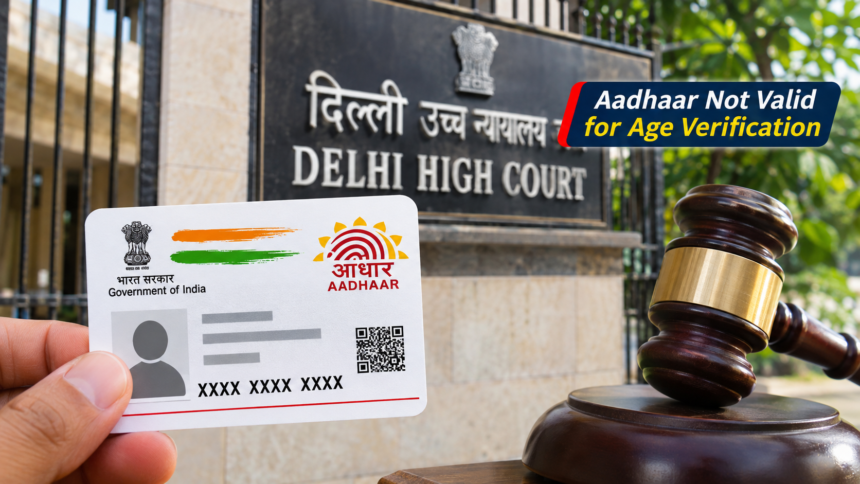
New Delhi: The Delhi High Court has made an important observation regarding the use of Aadhaar cards as proof of date of birth. The court has clarified that an Aadhaar card alone cannot be treated as conclusive evidence of a person’s age. It has also ruled that an employer cannot prematurely retire an employee solely on the basis of the date of birth mentioned on their Aadhaar card.
The decision is particularly important for employees, pensioners and individuals who need to establish their age for official purposes. Although Aadhaar is widely accepted as an identity document for banking, KYC verification and various government services, its date of birth details do not automatically qualify as verified age proof.
The court’s observation highlights the importance of using authentic documents, such as birth certificates, school records and official employment records, whenever a person’s age becomes a legal or administrative issue.
Delhi High Court Aadhaar Ruling: What Is the Case?
The matter involved a factory employee whose employer attempted to retire her before the expected date of retirement by relying on the date of birth recorded on her Aadhaar card.
However, the employee’s earlier records with the Employees’ State Insurance Corporation (ESIC) mentioned her date of birth as May 20, 1960. According to these records, she was entitled to continue working for another year.
While hearing the matter, Justice Manoj Kumar Ohri delivered a ruling on November 13, 2026, stating that an employer cannot use an Aadhaar card alone as the basis for prematurely retiring an employee.
The court also observed that the employer had obtained the employee’s Aadhaar card in March 2017, only a few months before the employment termination. No supporting documents had been provided to establish the correctness of the date of birth mentioned in the Aadhaar record.
The ruling therefore underlined that an employer must consider reliable and properly documented evidence before making retirement-related decisions based on an employee’s age.
Why Did the Court Give More Importance to ESIC Records?
One of the important aspects of the case was the difference between the date of birth recorded in the employee’s ESIC documents and the details mentioned on her Aadhaar card.
The ESIC records were considered more reliable because they were based on official documentation submitted by the employer at the time of the employee’s appointment.
In comparison, the Aadhaar details had been recorded at a later stage without verification against supporting documents such as a birth certificate or school records.
The court also pointed out that the employer had not contacted UIDAI officials to establish the source or verification process behind the date of birth mentioned on the Aadhaar card.
The judgment reinforces the distinction between identity verification and age verification. While Aadhaar can establish a person’s identity, documents specifically recognised for confirming date of birth should be given greater importance in such disputes.
Aadhaar Card Is Not Proof of Date of Birth: Previous Court Observations
The Delhi High Court’s observation is consistent with earlier government and judicial positions on the use of Aadhaar as proof of age.
An Office Memorandum issued in August 2023 clarified that Aadhaar should not be treated as proof of nationality, residential address or date of birth.
The Bombay High Court has also previously observed that an Aadhaar card does not establish a person’s date of birth.
Similarly, the Uttar Pradesh government stopped accepting Aadhaar cards as proof of date of birth from November 2025.
These developments highlight why individuals should maintain separate and valid documents for establishing their age instead of depending entirely on Aadhaar details.
Which Documents Are Accepted as Date of Birth Proof?
Individuals who need to establish their date of birth for employment, pension or other official requirements should maintain appropriate supporting documents.
Some commonly used documents for age verification include:
- Birth Certificate: An official record issued by the relevant registration authority.
- School Leaving Certificate: A document issued by the school containing the student’s date of birth.
- Matriculation Certificate: Educational records that mention the date of birth.
- Passport: An official travel document containing date of birth details.
- Government Employment Records: Relevant records maintained by government organisations, including ESIC and EPFO.
It is also important to ensure that the date of birth remains consistent across different official documents. If there are differences between records, individuals should take steps to correct inaccurate information through the appropriate authorities.
Conclusion: Do Not Depend Only on Aadhaar for Age Verification
The Delhi High Court’s ruling serves as an important reminder that Aadhaar and date of birth certificates serve different purposes. Although Aadhaar is widely used for establishing identity and accessing government and financial services, it should not automatically replace documents specifically intended to verify age.
Employers must examine reliable official records before taking decisions related to an employee’s retirement. Similarly, individuals should keep their birth certificates, educational documents and employment records accurate and properly maintained.
Having the correct supporting documents can help prevent unnecessary complications in employment, pension and other age-related matters.
Disclaimer
This article is based on the court ruling and legal information described in the source material and is intended for general news and informational purposes. Legal interpretations, documentary requirements and government policies may vary depending on the circumstances and applicable regulations. Readers should refer to the original court judgment and consult a qualified legal professional before taking action in any employment or date-of-birth dispute. This article does not constitute legal advice.