
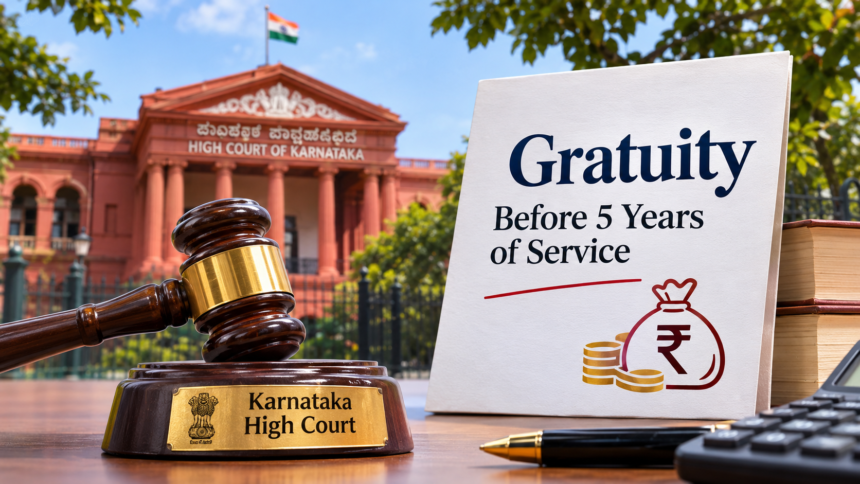
Many employees believe that completing five years of continuous service is compulsory to receive gratuity. However, a recent ruling by the Karnataka High Court has brought attention to situations in which an employee may qualify for gratuity even before completing five full years.
In this case, the court directed Bangalore Metro Rail Corporation Limited (BMRCL) to pay ₹1.75 lakh in gratuity to a former employee who had worked for four years, nine months and 12 days. The organisation was also instructed to pay 10% annual interest on the amount.
The court observed that gratuity eligibility should not be decided only by comparing joining and relieving dates. The actual number of days worked and the legal provisions governing continuous service must also be considered.
What Was the Bengaluru Metro Gratuity Case?
The matter involved a former assistant engineer working with Bangalore Metro Rail Corporation Limited. He joined the organisation on July 6, 2017, and resigned on March 19, 2022. His official release from service took place on April 18, 2022.
His total period of service was four years, nine months and 12 days.
After leaving the organisation, the employee requested gratuity based on his last monthly salary of ₹64,210. He claimed an amount of approximately ₹1.85 lakh.
However, BMRCL rejected his request, stating that he had not completed the required five years of service. The employee then approached the court, arguing that he had completed more than 240 working days during his fifth year and should therefore be considered eligible under the applicable provisions.
Why Did the Karnataka High Court Order Gratuity Payment?
On September 26, 2026, a division bench of the Karnataka High Court allowed the employee’s appeal. The bench comprised Justice D.K. Singh and Justice H. Shanti Bhushan.
The court held that gratuity eligibility should not be determined simply by counting five calendar years between an employee’s joining and leaving dates. The actual days worked and the provisions relating to continuous service under the law must also be examined.
Following its decision, the court directed Bengaluru Metro to pay ₹1.75 lakh as gratuity, along with interest at 10% per annum from May 18, 2022.
The ruling highlights that employees who have not completed five calendar years may still qualify for gratuity in certain circumstances. However, it does not mean that every employee leaving a job before completing five years automatically becomes eligible.
What Does the Payment of Gratuity Act Say?
Gratuity in India is primarily governed by the Payment of Gratuity Act, 1972. The law provides a financial benefit to eligible employees in recognition of their service.
Under Section 4(1), an employee generally needs to complete at least five years of continuous service to qualify for gratuity. This requirement does not apply in cases involving death or disablement.
Section 2A of the Act is also important because it explains what constitutes continuous service. The Karnataka High Court’s decision highlighted the importance of considering this provision while examining an employee’s eligibility.
How Does the 240-Day Rule Work?
The 240-day rule is relevant when determining whether an employee has completed one year of continuous service in certain circumstances, even without working for the entire 12-month period.
For employees working in establishments following a six-day workweek, completing at least 240 days of work during the relevant period may be treated as one year of continuous service.
For employees working in establishments following a five-day workweek, the corresponding threshold referred to in this context is 190 days.
However, these provisions should not be understood as an automatic exemption from the general five-year gratuity requirement. Their application depends on the definition of continuous service, the relevant legal provisions and the individual circumstances of the employee’s case.
What Should Employees Check Before Leaving a Job?
Employees planning to resign before completing five years with an organisation should carefully review their employment records and working days.
It is important to retain appointment letters, salary slips, attendance records and documents confirming the resignation and official relieving date. These records may help establish the actual period of service and the number of days worked.
Employees should also remember that the resignation date and the date of release from employment may be different. Both dates, along with the working days completed during the relevant period, can be important when assessing gratuity eligibility.
If an employer rejects a gratuity claim solely because five calendar years have not been completed, employees can examine the applicable legal provisions and seek guidance from the relevant labour authority or a legal professional.
Will This Karnataka High Court Decision Benefit All Employees?
The judgment may be particularly relevant to employees who have served for slightly less than five years but believe they meet the legal requirements for continuous service.
However, the ruling was delivered in connection with a specific case. It does not establish that every employee with less than five years of service is entitled to gratuity.
Eligibility will depend on factors such as the actual number of days worked, the nature of employment, the organisation and the applicable legal provisions. Employees should therefore assess their individual circumstances before making a gratuity claim.
Disclaimer: This article is intended for general informational purposes only and should not be treated as legal advice. Gratuity eligibility depends on the applicable law, employment conditions and individual circumstances. The Karnataka High Court ruling discussed here relates to a specific case and does not automatically guarantee gratuity to every employee leaving before completing five years. Employees should consult the relevant labour authority or a qualified legal professional for advice on their individual claims.