
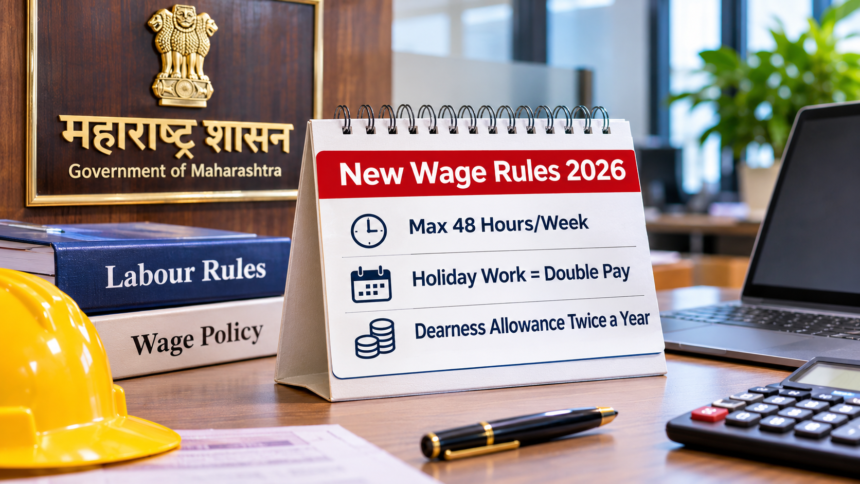
Amid ongoing discussions about the 8th Pay Commission among central government employees and pensioners, the Maharashtra government has introduced new wage regulations for workers across the state. The Maharashtra New Wage Rules 2026 bring several changes related to working hours, minimum wages, overtime payments, dearness allowance (DA) and salary deductions.
Under the revised provisions, employees cannot be required to work more than 48 hours a week. Those asked to work on holidays will be entitled to double their regular wages. The government has also decided to revise dearness allowance twice every year.
The Maharashtra government notified the new rules on November 5, 2026, as announced by State Labour Minister Akash Fundkar on Wednesday. The regulations became applicable across Maharashtra from the date of their publication in the official gazette.
The new framework replaces the Maharashtra Minimum Wages Rules and Payment of Wages Rules, 1963. However, these provisions will not govern the fixation of minimum wages for Maharashtra state government employees.
48-Hour Work Week and 8-Hour Daily Duty
The revised rules clearly define the normal working hours for employees. Workers paid on a daily basis will have a standard working day of eight hours, while employees under other wage arrangements cannot be required to work beyond 48 hours in a week.
Employers will therefore have to keep track of employees’ working schedules and ensure that the prescribed limits are followed.
Every employee must also receive one weekly rest day or holiday. If an employer requires someone to work on that day, a substitute holiday must be provided. In addition, the employee must receive at least twice the normal wage for working on the holiday.
Salary Calculation and DA Revision Twice a Year
The new regulations also explain which components will be considered part of an employee’s wages. Basic pay, dearness allowance (DA) and retaining allowance will be included in the wage calculation.
If other allowances and benefits together exceed 50% of an employee’s total remuneration, the amount exceeding that limit will also be counted as wages. This change may influence the calculation of statutory benefits, including gratuity.
The government will determine minimum wage rates on a daily basis. For calculating hourly wages, the daily rate will be divided by eight. Monthly wages will be calculated by multiplying the daily rate by 26.
Employees will be classified into four categories according to their skill levels: highly skilled, skilled, semi-skilled and unskilled.
Another important provision concerns dearness allowance. DA will now be revised twice annually, with changes scheduled before April 1 and October 1. The revisions will be based on the average Consumer Price Index for Industrial Workers (CPI-IW) published by the Labour Bureau.
Salary Deductions Cannot Exceed 50%
The new wage rules also introduce a limit on deductions from employees’ salaries. Employers cannot deduct more than 50% of an employee’s wages during a single pay period.
If a deduction exceeds this limit, the remaining amount must be recovered in instalments during subsequent pay periods.
The regulations also establish procedures for imposing penalties or recovering money from employees for losses caused to a company. Before making such deductions, employers must issue a written or electronic notice to the employee.
Employees must also be given an opportunity to explain their position and present their side of the matter before the deduction is imposed.
Companies Must Maintain Employee Records for Five Years
The revised framework makes it compulsory for companies and employers to maintain proper records relating to employees, salary payments, overtime and attendance.
These records can be maintained either digitally or in physical form. However, employers must preserve them for at least five years from the date of the last entry.
Companies will also be required to provide salary slips to employees on or before the date their wages are paid.
In cases where an employee dies or is otherwise unable to collect their salary, the unpaid amount must be deposited with the concerned Assistant Labour Commissioner under the applicable circumstances. Employees can also nominate another person to receive the amount payable to them if required.
Disclaimer: This article is intended for general informational purposes only. The Maharashtra New Wage Rules 2026 are subject to the provisions and conditions notified by the state government. Employees and employers should refer to the official Maharashtra government gazette or consult the relevant labour department for complete details and clarification regarding the applicability of these rules.