
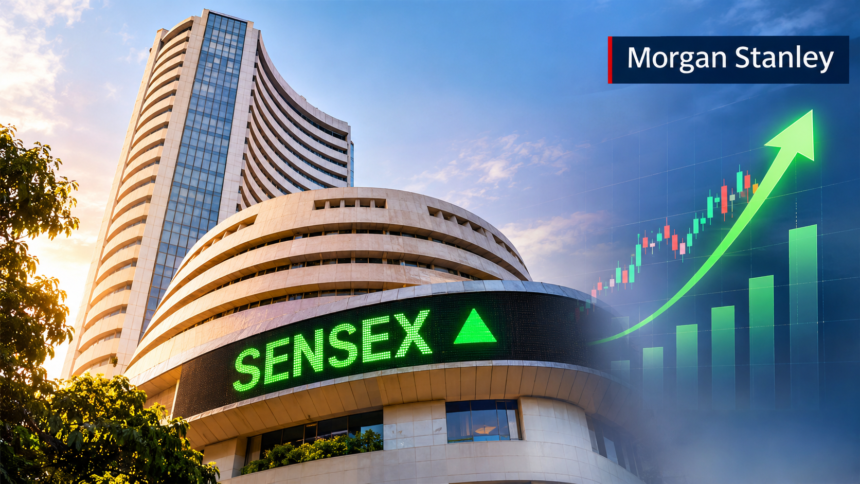
The Indian stock market could witness further gains over the coming years, with global brokerage firm Morgan Stanley projecting that the BSE Sensex may reach 95,000 by December 2027 under its base-case scenario. In a more optimistic market environment, the benchmark index could climb to 1,05,000. However, the brokerage has also warned that unfavourable global conditions could pull the Sensex down to 68,000.
According to Morgan Stanley, improving corporate earnings, strong domestic investments and favourable economic conditions could support the Indian equity market. The brokerage has outlined three possible market scenarios based on economic growth, crude oil prices and global developments.
Morgan Stanley’s Sensex Targets for 2027
Morgan Stanley has identified three potential outcomes for the Sensex by December 2027, each carrying a different probability.
Under the base-case scenario, which has a 50% probability, the index could reach 95,000, representing an estimated upside of around 16% from the current reference level.
In the bullish scenario, there is a 30% probability that the Sensex could advance to 1,05,000. Meanwhile, the bearish outlook carries a 20% probability, with the index potentially declining to 68,000.
The brokerage’s three projections are:
- Base Case: 95,000 (50% probability)
- Bull Case: 1,05,000 (30% probability)
- Bear Case: 68,000 (20% probability)
What Could Drive the Sensex Towards 95,000?
Morgan Stanley believes India’s domestic economic strength could play an important role in supporting the stock market. The brokerage describes the country’s competitive advantages as its “3D Edge”, referring to sustainable domestic growth, expansion across different economic sectors and relatively lower dependence on external factors.
Higher investment activity, supportive monetary policies and strong consumer demand could improve the earnings outlook for Indian companies. The investment-to-GDP ratio is expected to rise to 37.5% over the next five years.
Other supporting factors include fresh capacity expansion by private companies, healthy corporate balance sheets and stability in the banking system.
Morgan Stanley also expects companies included in the Sensex to deliver earnings growth at a compound annual growth rate (CAGR) of 18.1% between FY26 and FY29. Stronger earnings could provide further support to market valuations.
Conditions That Could Push Sensex to 1,05,000 or Drag It to 68,000
For the Sensex to achieve Morgan Stanley’s bullish target of 1,05,000, several favourable developments would be necessary. Crude oil prices would need to stay below $75 per barrel, helping reduce inflationary pressure. Reforms that encourage investment and greater participation from investors could provide additional momentum to the market.
In its base-case outlook, the brokerage expects global economic growth to remain stable, Brent crude prices to stay below $100 per barrel and the India-US trade deal to reach a resolution. A favourable liquidity environment would also be important.
However, the market could face significant challenges if these conditions deteriorate. Morgan Stanley estimates a 20% probability of the Sensex falling to 68,000 by December 2027.
A prolonged rise in Brent crude prices above $100 per barrel could increase economic pressure and affect corporate profitability. Additional risks include tighter monetary policy by the Reserve Bank of India to control inflation and a sharp slowdown in global economic growth. These developments could increase selling pressure in the equity market.
Which Sectors Does Morgan Stanley Prefer?
Morgan Stanley is favouring sectors that are closely linked to India’s domestic economic activity. Its overweight preferences include financials, consumer discretionary and industrials.
Financial companies could benefit from rising credit demand and the strength of the banking system. Consumer discretionary businesses may gain from higher domestic spending, while industrial companies could receive support from increasing investments and infrastructure development.
In contrast, the brokerage has an underweight view on energy, materials, utilities and healthcare.
However, Morgan Stanley sees potential in the IT services sector, particularly because of increasing global demand for artificial intelligence (AI) applications and related solutions. This could create growth opportunities for Indian IT companies in the coming years.
Disclaimer: This article is intended solely for informational and educational purposes. The Sensex targets and market scenarios mentioned are based on Morgan Stanley’s projections and are not guaranteed outcomes. Stock market investments involve risks, and investors should conduct their own research or consult a qualified financial adviser before making investment decisions.