
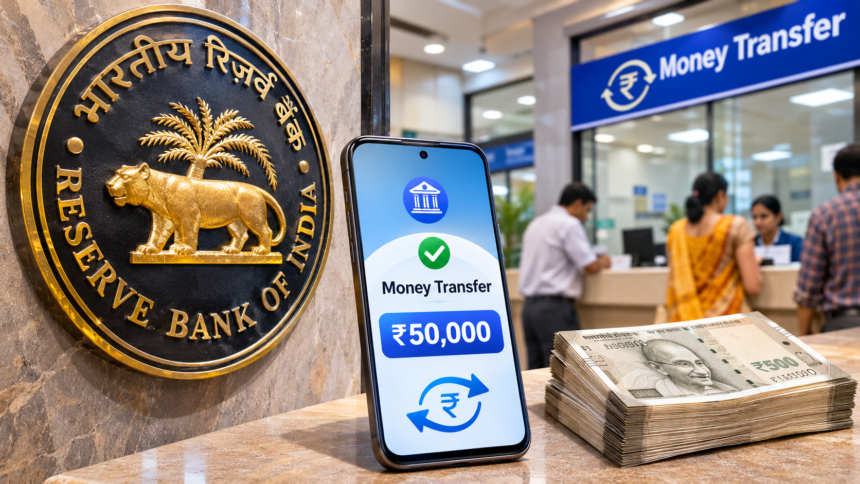
New Delhi: The Reserve Bank of India (RBI) has introduced revised guidelines for domestic money transfers, making it easier for people to send and receive money through banking channels. The updated rules came into effect on November 11, 2026, and allow individuals to transfer up to Rs 50,000 to another bank account without necessarily being an existing customer of the bank.
Under the new framework, money transfers can be carried out through cash pay-in facilities at bank branches and National Electronic Funds Transfer (NEFT). Customers can also access money transfer services through Business Correspondents (BCs) and ATMs, although transaction limits vary depending on the channel.
The RBI has brought different domestic money transfer regulations together under a simplified framework. The move aims to improve access to banking services, particularly for migrant workers, labourers and people who may not have all the necessary identity or address documents.
Send Up to Rs 50,000 Through a Bank Branch
One of the major changes under the revised RBI guidelines is that individuals can visit a bank branch and transfer money to another person’s bank account using the cash pay-in facility.
Under this arrangement, a person can deposit up to Rs 50,000 in a single transaction through NEFT. Importantly, the sender does not need to hold an existing account with the bank where the transfer is being made.
This provision can make domestic money transfers more convenient for people who need to send money to family members or other beneficiaries in different parts of the country.
People Without Bank Accounts Can Also Receive Money
The RBI has also introduced provisions to make cash withdrawal services accessible to individuals who do not have their own bank accounts.
Under the Cash Pay-Out Service, banks can facilitate cash payments to such individuals by transferring funds from a customer’s bank account. The service can be accessed through ATMs, Business Correspondents and other authorised payment channels.
However, specific withdrawal limits will apply. The maximum amount that can be withdrawn is Rs 10,000 per transaction, while the total monthly withdrawal limit is Rs 25,000 per person.
Why Has the RBI Revised Domestic Money Transfer Rules?
The revised framework is intended to simplify existing domestic money transfer regulations and make banking services more accessible.
Migrant workers and labourers who move to different cities for employment often need reliable ways to send money to their families. However, the lack of proper identity or address documentation can sometimes create difficulties when accessing banking services.
By allowing certain transactions without requiring the sender to be an existing customer of the bank, the RBI aims to make money transfers easier and improve financial access for a wider section of the population.
The updated rules provide additional flexibility for sending and receiving money through authorised banking channels, while maintaining transaction limits for different services.
Disclaimer: This article is intended for general informational purposes and is based on the RBI domestic money transfer guidelines described above. Transaction limits, eligibility requirements and available services may vary depending on the authorised banking channel. Customers should refer to the official RBI notification or contact their respective banks for complete details before carrying out transactions.