
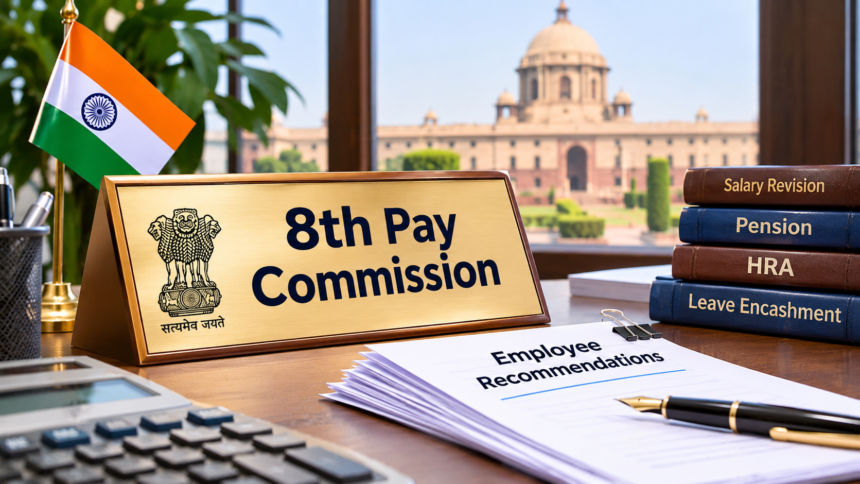
Discussions surrounding the 8th Pay Commission are continuing with employee unions and pensioners’ associations putting forward their demands. Meanwhile, the National Council of Joint Consultative Machinery (NC-JCM) has submitted a series of recommendations to the Commission, covering salary increments, pensions, House Rent Allowance (HRA) and retirement benefits.
The proposals include increasing the annual increment from 3% to 6%, raising pensions, doubling the leave encashment limit and revising HRA rates. If these demands are accepted, they could bring significant changes to the salary structure and retirement benefits of central government employees.
Pension and Family Pension Hike Proposed
The NC-JCM has recommended increasing the pension for retired central government employees from the existing 50% to 67% of their last-drawn salary.
The employee body has also proposed raising the family pension rate from 30% to 50%. If approved, these changes would increase the pension benefits available to retired employees and their eligible family members.
Annual Increment May Increase from 3% to 6%
At present, central government employees receive an annual increment of 3% of their basic pay. The NC-JCM wants the rate to be doubled to 6%.
According to the employee union, the existing increment is insufficient amid rising inflation. It has therefore requested the Commission to consider a higher annual increase in basic salary.
NC-JCM Seeks Higher HRA Rates
The union has also recommended revising House Rent Allowance rates across different city categories.
Currently, employees receive HRA at the following rates:
- Metropolitan cities: 30% of basic pay
- Medium-sized cities: 20% of basic pay
- Other cities: 10% of basic pay
The NC-JCM has proposed increasing these rates to 40%, 35% and 30%, respectively.
If the recommendation is accepted, employees could receive higher HRA depending on their place of posting.
Leave Encashment Limit and Pay Matrix Changes
Another major proposal concerns the leave encashment limit at retirement. Currently, central government employees can encash up to 300 days of accumulated earned leave. The NC-JCM has requested that this limit be increased to 600 days.
The amount payable for leave encashment is calculated using eligible salary components, including basic pay and dearness allowance (DA).
The union has also recommended changes to the existing pay matrix by merging certain pay levels. Its proposal involves combining the minimum basic pay of Pay Level 2 and Pay Level 3 to establish a uniform pay scale of ₹83,200. If accepted, this recommendation could change the pay structure for employees covered by these levels.
When Will the 8th Pay Commission Submit Its Report?
The 8th Pay Commission is expected to examine the recommendations submitted by employee organisations and pensioners’ associations before preparing its report.
According to the information provided, the Commission is expected to submit its report to the government by May next year. After receiving the recommendations, the government will review them and take the final decision.
If the report is submitted by May, the government could make a decision by the end of next year. However, the proposed salary and pension changes will depend on the Commission’s recommendations and the government’s final approval.
Disclaimer: This article covers proposals submitted by the NC-JCM and does not represent approved changes to central government salaries or pensions. The recommendations may be modified or rejected. Employees and pensioners should refer to official government announcements for confirmed decisions and implementation details.