
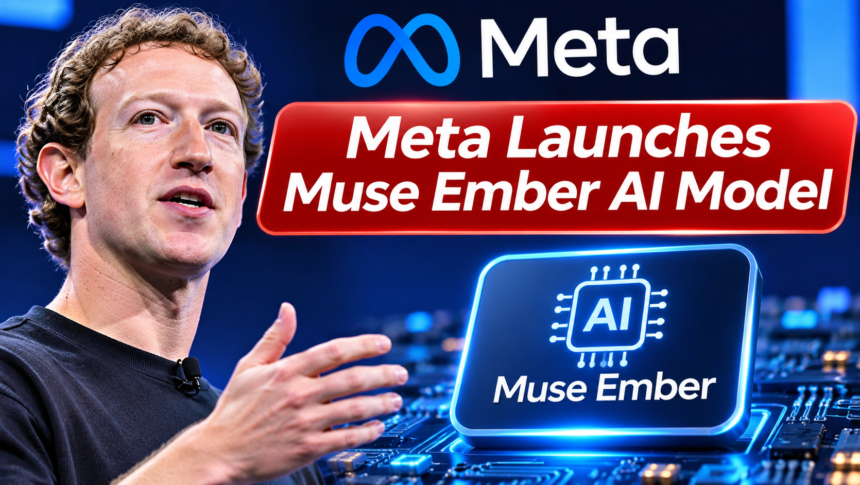
Meta has unveiled Muse Ember, the smallest model in its Muse AI family, with a strong focus on delivering advanced artificial intelligence capabilities at a lower operating cost. Announced by Meta CEO Mark Zuckerberg on November 9, 2026, the new model is designed primarily for developers and businesses that use AI systems to handle large volumes of repetitive tasks.
The company is promoting Muse Ember as a cost-efficient alternative to competing models from OpenAI and Anthropic, including GPT-6 Luna and Claude Haiku 5.5. Its key selling points include competitive benchmark performance, lower pricing and the ability to process large amounts of information.
Announcing the launch on X, Zuckerberg described Muse Ember as the company’s smallest model, offering higher intelligence per dollar than other models in its category.
What Is Meta Muse Ember AI and What Can It Do?
Muse Ember is a compact reasoning model developed by Meta Superintelligence Labs. It is designed to handle everyday AI operations, including document analysis, coding assistance, information extraction and software tool usage.
The model can perform tasks such as identifying information in lengthy documents, correcting programming errors, analysing reports and processing customer feedback. It is particularly suited to AI agents that repeatedly perform smaller tasks as part of larger workflows.
One of its notable features is a context window of approximately one million tokens, allowing it to process extensive information within a single request.
Muse Ember also supports multiple input formats, including text, images, audio, video and PDF files.
According to Meta, the model can manage workflows across applications, execute multiple tool calls, run software tests and make targeted code corrections. These capabilities make it suitable for businesses and developers looking to automate routine operations.
Meta Muse Ember Benchmarks: How Does It Compare With OpenAI and Anthropic?
Meta is positioning Muse Ember as a competitive option in the smaller AI model category. Its published benchmark results show strong performance in several areas, although competing models perform better in certain coding-related tests.
On the Artificial Analysis Intelligence Index, Muse Ember received 36 points, matching Anthropic’s Claude Haiku 5.5. OpenAI’s GPT-6 Luna scored 28 points.
In Meta’s AutomationBench evaluation, Ember achieved 37.8 points, compared with 20.2 for GPT-6 Luna and 13.9 for Claude Haiku 5.5.
On Terminal-Bench 4.0, which evaluates coding and terminal-based capabilities, Ember scored 40.9, slightly ahead of Haiku’s 39.2.
However, the results were not uniformly in Meta’s favour. On FrontierCode 2.0, Claude Haiku 5.5 achieved 34.9 points, while Muse Ember scored 27.2.
These results are based on specific testing environments and reasoning configurations. Actual performance may vary depending on the application and workload.
Meta Muse Ember Pricing: How Much Does It Cost?
Affordable pricing is one of the main features Meta is highlighting with Muse Ember. The company has introduced relatively low token-based rates, particularly for developers processing large volumes of AI requests.
For requests containing up to 200,000 input tokens, the pricing is:
| Usage Type | Price per Million Tokens |
|---|---|
| Input tokens | $0.10 |
| Output tokens | $0.50 |
| Cached input tokens | $0.004 |
For longer requests, the charges increase to $0.30 per million input tokens and $1.50 per million output tokens.
Artificial Analysis estimates that Muse Ember costs approximately $0.14 per benchmark task. By comparison, Claude Haiku 5.5 costs around $0.41 per task at its highest reasoning setting.
This pricing difference could make Ember an attractive option for organisations that need to run thousands of AI operations regularly.
Where Can Developers Access Meta Muse Ember?
Meta has made Muse Ember available through its Meta Model API under the model identifier muse-ember-1.0. Developers can access it through a pay-as-you-go pricing structure.
The model is also available through Muse Code subscription plans, providing another option for users who want to integrate AI capabilities into coding and development workflows.
Despite its competitive pricing and performance in selected tests, Muse Ember does not lead every independent evaluation. Vals AI placed the model 12th among 35 models in its overall index.
The launch reflects the growing competition among AI companies to develop models that balance intelligence, performance and operating costs.
With its large context window, support for multiple input formats and low token pricing, Meta Muse Ember is targeting businesses and developers that need affordable AI automation at scale.