
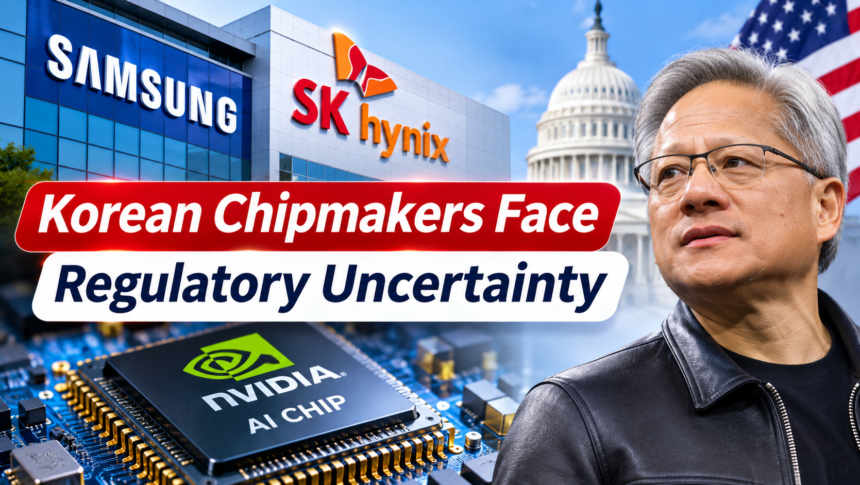
South Korean semiconductor giants Samsung Electronics and SK hynix could face additional export compliance requirements following increased scrutiny of Nvidia’s artificial intelligence (AI) chip distribution channels connected to China, according to a report by The Korea Herald.
The developments follow reports concerning Nvidia CEO Jensen Huang’s personal relationship with a businesswoman suspected of having connections to Chinese intelligence services. The issue has drawn attention to potential security risks involving advanced semiconductor technology, international trade and the possible diversion of restricted computing hardware.
Although the matter has prompted fresh scrutiny of corporate security practices, US authorities have not announced any new export restrictions related to the case.
Nvidia CEO’s Personal Connections Under Investigation
The reported investigation involves Alice Huang, a Chinese businesswoman and former executive at Singapore-based data company Megaspeed.
US authorities began examining Megaspeed in 2024 over allegations that restricted hardware had been transferred to China. Investigators also looked into possible recruitment activities involving Chinese intelligence agencies. However, no conclusive findings were established, while Nvidia maintained that its previous interactions were part of normal business activities.
In an internal communication to employees, Jensen Huang addressed the personal matter, stating, “I was unfaithful to my wife.” He also apologised to his family and committed to cooperating fully with the ongoing internal review.
According to The Korea Herald, independent members of Nvidia’s board appointed external legal advisers to examine whether foreign intelligence organisations had attempted to target the company’s chief executive.
The board stated that there was no evidence indicating that national security information or confidential company data had been compromised. It also expressed continued confidence in Huang’s leadership.
Meanwhile, three chairs of US House committees scheduled a closed-door hearing for November 18 to examine the reported contacts and related security arrangements.
Potential Impact on Samsung and SK hynix
The developments could have implications for South Korean semiconductor manufacturers, particularly companies supplying high-bandwidth memory (HBM) chips used in Nvidia’s AI accelerators.
Any decision by the United States to strengthen monitoring of semiconductor exports through third-party countries could increase compliance requirements for Korean suppliers.
Companies may be required to conduct more detailed checks on product destinations, end users and distribution channels. Such measures could increase operational expenses and create additional delays across international semiconductor supply chains.
Restrictions affecting the distribution of AI accelerators to China could also indirectly influence demand for HBM chips. However, the overall impact would depend on whether demand from other markets could compensate for any reduction in Chinese orders.
An industry official quoted by The Korea Herald said tighter US restrictions on semiconductor exports to China would require Korean manufacturers to strengthen their monitoring of where their products are shipped and how they reach their final destinations.
Growing AI Chip Competition Could Create New Opportunities
Despite the potential short-term challenges, South Korean memory manufacturers could benefit from changing demand patterns in the global AI semiconductor industry.
Major technology companies are increasingly developing their own customised processors and AI chips alongside products supplied by external manufacturers.
According to the industry official, this trend could eventually create additional opportunities for Korean memory suppliers by expanding the number of potential HBM customers.
The official emphasised that manufacturers would need to manage the immediate compliance requirements while continuing to prepare for future opportunities in the AI semiconductor market.
South Korean Government Says Existing Chip Deliveries Remain on Track
The South Korean government has indicated that processor shipments covered under previously agreed procurement arrangements are continuing as scheduled.
Vice Science Minister Ryu Je-myung told a parliamentary budget committee that the government expected deliveries to proceed without disruption.
He also acknowledged that the broader regulatory situation would depend on how developments surrounding Nvidia evolve.
Separately, Madison Huang, a senior Nvidia executive and daughter of Jensen Huang, cancelled a planned visit to Seoul. The trip had included discussions with government representatives and local AI chip startup Rebellions.
The situation continues to draw attention to the relationship between semiconductor supply chains, international trade regulations and national security. For South Korean manufacturers, the key concern is managing any additional US export compliance requirements while maintaining their position in the rapidly expanding global AI chip market.