
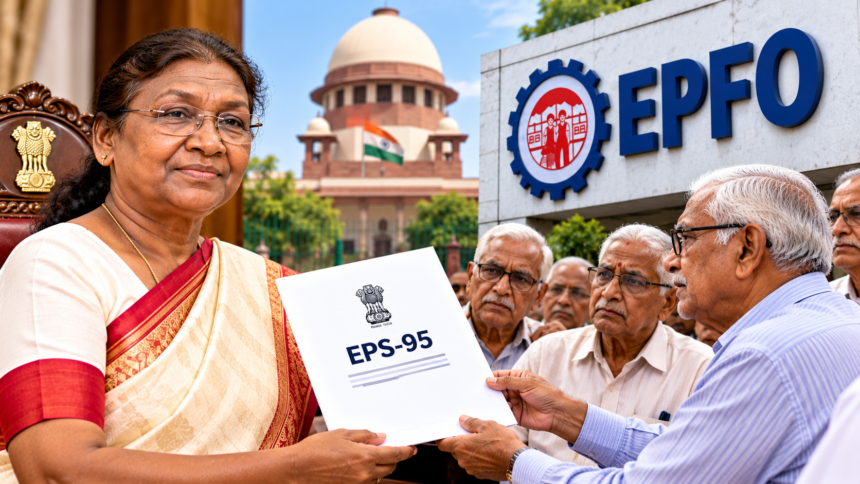
The National Confederation of Pensioners’ Associations (NCPA), which represents more than one million pensioners from public sector undertakings (PSUs) and exempted provident fund establishments, has appealed to President Droupadi Murmu to intervene in the ongoing dispute over higher pensions under the Employees’ Pension Scheme, 1995 (EPS-95).
In a memorandum dated October 23, 2026, the association urged the President to direct the Employees’ Provident Fund Organisation (EPFO) to withdraw its circular issued on January 18, 2025. The NCPA claims that the directive is creating difficulties for eligible retirees seeking pension benefits calculated on higher wages.
Why Is the NCPA Opposing the January 2025 EPFO Circular?
According to the association’s memorandum, EPS-95 was introduced under Section 6A of the Employees’ Provident Funds and Miscellaneous Provisions Act, 1952. The scheme is funded through the diversion of 8.33% of employers’ contributions, subject to historical wage ceilings of ₹5,000, ₹6,500 and, subsequently, ₹15,000.
The NCPA states that these ceilings restricted pension calculations for employees earning higher salaries. It points to Ministry of Labour Notification No. 134, issued on February 28, 1996, and effective from March 16, 1996, as establishing a framework for pension benefits based on actual wages for eligible higher-wage earners.
The association alleges that the EPFO’s January 18, 2025, circular relies on provisions in the internal rules of exempted provident fund trusts. According to the NCPA, these rules historically reflected statutory wage ceilings, and using them to assess higher pension applications could result in the rejection of otherwise eligible claims.
The organisation has also referred to a Madras High Court Division Bench ruling dated July 9, 2026. It interprets the ruling as supporting the position that internal provident fund trust rules are administrative arrangements and cannot override the governing legislation under EPS-95.
NCPA Cites Supreme Court Judgments and Pending Pension Cases
The association has referred to the Supreme Court’s decisions in R.C. Gupta (2016) and Employees’ Provident Fund Organisation vs. Sunil Kumar B. (2022). It argues that these judgments provide an established legal framework for higher pension claims under EPS-95.
According to the NCPA, higher pension orders have been issued to eligible retirees from both exempted and unexempted establishments, while some pensioners from exempted establishments continue to face rejections.
Citing a parliamentary disclosure dated August 10, 2026, the association said that more than 1,49,806 higher pension orders had been issued. It also reported that over 400 writ petitions and appeals were pending across 18 High Courts, while 26 judgments covering more than 200 petitions had favoured pensioners.
The NCPA has further alleged that employees from the same public sector organisations—including SAIL, HAL, BHEL, IOCL, HMT, BEL and ITI—are receiving different outcomes depending on their units and geographical postings.
The association also cited a Ministry of Labour and Employment communication dated May 31, 2023, which it says attributed confusion surrounding higher pension claims to EPFO’s administrative handling of the matter.
What Relief Has the Pensioners’ Association Requested?
The NCPA has asked the President to consider three principal measures to address the dispute.
First, it wants the EPFO circular dated January 18, 2025, withdrawn unconditionally. The association describes the directive as legally unsustainable and unfair to eligible pensioners.
Second, it has called for a review of ongoing litigation relating to higher pension claims. It wants the authorities to examine pending cases and, where appropriate, withdraw appeals against High Court judgments that have settled the relevant legal issues. The stated objective is to ensure consistent treatment of pensioners from exempted establishments.
Third, the association has requested that eligible joint options for higher pension be accepted without punitive interest arising solely from administrative delays. It has also called for a time-bound process to resolve outstanding applications.
The NCPA says some elderly pensioners receive monthly pensions of only ₹2,000 to ₹5,000. It warns that delays and accumulating interest charges could create a substantial financial burden, claiming that penalties could reach as much as ₹40,000 per month in certain cases.
The association has also argued that restrictive interpretations of higher pension eligibility raise constitutional concerns involving Article 14, which concerns equality before the law; Article 21, which protects life and personal liberty; Article 300A, which concerns the right to property; and Articles 141 and 144, relating to the binding effect of Supreme Court law and the duty to act in aid of the Court.
What Happens Next for EPS-95 Pensioners?
The memorandum represents the NCPA’s demands and interpretation of the legal position. Sending the letter does not, by itself, withdraw the EPFO circular, resolve pending applications or change existing pension rules.
Any further action will depend on decisions by the relevant authorities and applicable legal proceedings. Pensioners awaiting higher pension decisions should refer to official EPFO communications and relevant court orders for information about their individual cases.
Disclaimer: This article is intended for general informational purposes only and summarises claims and requests made by the National Confederation of Pensioners’ Associations. The association’s interpretations and allegations should not be treated as final legal findings or government decisions. Pension eligibility, interest liabilities and application status depend on the applicable rules, official directions and relevant court orders. Readers should consult official EPFO notifications or qualified legal advisers for guidance on individual claims.