
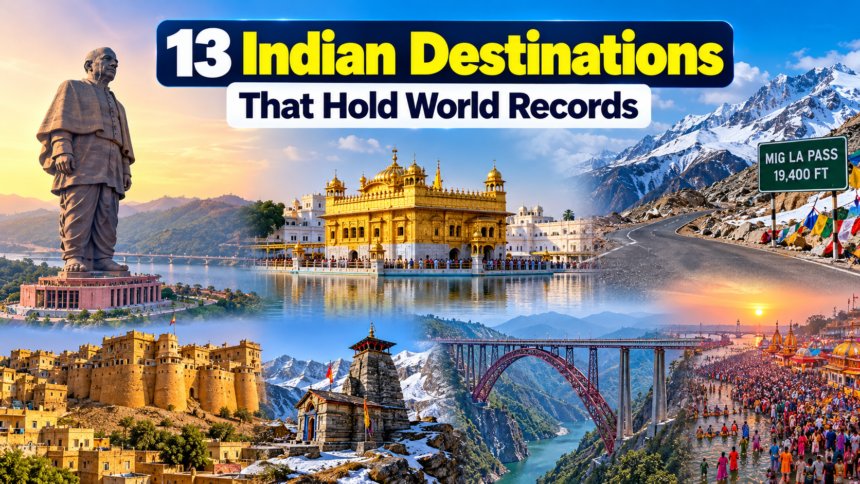
New Delhi: India is famous for its rich cultural heritage, historic landmarks and diverse landscapes. The country is also home to several destinations recognised for remarkable achievements in architecture, engineering, spirituality and nature. From the world’s tallest statue to a national park that floats on a lake, these places offer travellers a chance to explore some of India’s most unusual attractions.
Whether it is the grand scale of the Kumbh Mela, the remarkable Chenab Bridge or the historic streets of Rajasthan, each destination has a distinctive story. For travellers interested in history, adventure and unique experiences, these record-associated landmarks offer plenty to discover.
1. Jatayu Earth’s Centre, Kerala
<text preserveWhitespace={true}>Jatayu Earth’s Centre in Kerala is known for its enormous bird sculpture, inspired by Jatayu from the Hindu epic Ramayana. Measuring around 200 feet in length, the sculpture is recognised as the world’s largest bird sculpture and is a major attraction for visitors interested in mythology and art.</text>
2. Golden Temple, Amritsar
The Golden Temple in Amritsar is renowned for its community kitchen, known as the langar, which provides free meals to visitors regardless of their background. The kitchen serves tens of thousands of people daily, with the number often exceeding 100,000 on busy days. Its tradition of serving everyone reflects the Sikh principles of equality and community service.
3. Mig La Pass, Ladakh
Located in Ladakh, Mig La Pass has attracted attention for its extreme altitude and challenging mountain terrain. At approximately 19,400 feet, it is associated with claims of being the world’s highest motorable road. Its remote location and high-altitude conditions make it a notable destination for adventure and road-trip enthusiasts.
4. Tungnath, Uttarakhand
Situated in the Himalayan region of Uttarakhand, Tungnath is widely recognised as the highest Shiva temple in the world. Located at an altitude of around 12,000 feet, it is one of the five sacred temples that form the Panch Kedar pilgrimage circuit. The temple also attracts trekkers who visit for its mountain scenery and spiritual significance.
5. Jaisalmer Fort, Rajasthan
Jaisalmer Fort is a historic sandstone fortress that rises above the golden landscape of Rajasthan’s Thar Desert. Unlike many forts that function primarily as monuments, it continues to be home to thousands of residents, with shops, houses and temples within its walls. Its living heritage and distinctive architecture make it one of the region’s best-known landmarks.
6. Pushkar Fair, Rajasthan
The Pushkar Fair is a major annual event in Rajasthan, famous for its camel trading, cultural activities and traditional festivities. The fair brings together traders, tourists and visitors from different regions. Camel trading has long been an important part of the event, making it a distinctive attraction for those interested in rural traditions and desert culture.
7. Keibul Lamjao National Park, Manipur
Keibul Lamjao National Park in Manipur is recognised as the world’s only floating national park. It is located on Loktak Lake, where thick floating masses of vegetation, locally known as phumdis, form its unusual landscape. The park is especially important for the endangered Sangai deer, a rare species found in this region.
8. Komic, Spiti Valley, Himachal Pradesh
Komic is a high-altitude village in Himachal Pradesh’s Spiti Valley, situated at approximately 15,200 feet. Surrounded by rugged mountains and dramatic Himalayan scenery, it is often promoted as one of the world’s highest motorable villages. Its remote setting and distinctive landscape attract travellers looking for an experience away from crowded tourist destinations.
9. Varanasi, Uttar Pradesh
Varanasi is among India’s most historically significant cities and is closely associated with Hindu spirituality. Located along the River Ganga, it is known for its ancient temples, traditional rituals and riverside ghats. The city is often described as one of the world’s oldest continuously inhabited urban settlements and continues to draw pilgrims and international visitors.
10. Chenab Bridge, Jammu and Kashmir
The Chenab Bridge is a major engineering achievement in Jammu and Kashmir. Rising approximately 359 metres above the Chenab River, the railway bridge is taller than the Eiffel Tower when measured by height above its surroundings. Its impressive scale and location in the Himalayan landscape have made it a prominent infrastructure landmark.
11. Kumbh Mela, India
The Kumbh Mela is one of the largest religious gatherings in the world. It takes place at Prayagraj, Haridwar, Ujjain and Nashik according to the traditional religious calendar. Millions of devotees travel to these locations to participate in sacred bathing rituals and other religious activities. The gathering at Prayagraj has drawn exceptionally large crowds, placing the event among the most significant mass gatherings ever recorded.
12. Statue of Unity, Gujarat
Located in Gujarat, the Statue of Unity is the world’s tallest statue, standing 182 metres high. It commemorates Sardar Vallabhbhai Patel, one of the key figures in India’s independence movement and national integration. The monument is nearly twice the height of the Statue of Liberty and has become a major tourist attraction.
13. Chail, Himachal Pradesh
Chail in Himachal Pradesh is known for its historic cricket ground, built at an elevation of approximately 2,444 metres above sea level. The ground was established under the patronage of the Maharaja of Patiala and is widely recognised as the world’s highest cricket ground. Surrounded by forested hills, it offers a distinctive setting for cricket and tourism.
Explore India’s Remarkable Record-Holding Destinations
From high-altitude mountain villages and extraordinary engineering projects to historic cities and unique natural landscapes, India offers a wide variety of destinations with remarkable claims to fame. Each place reflects a different aspect of the country’s heritage, geography and achievements.
For travellers planning their next journey, these destinations provide opportunities to experience India’s diversity while discovering the stories behind its most notable landmarks.
Disclaimer: This article is intended for general informational and travel purposes only. Record titles, measurements and visitor figures may vary by source and over time. Travellers should check current local information, accessibility and travel conditions before planning a visit.