
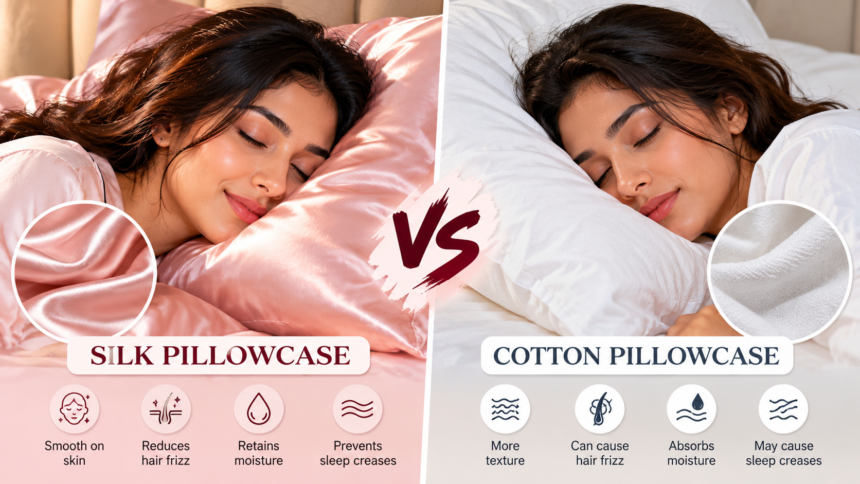
Your pillowcase plays a bigger role in your nighttime skincare and haircare routine than you might realise. While serums, moisturisers and hair oils are common bedtime essentials, the fabric you sleep on can also influence how your skin and hair respond to friction and moisture loss.
Cotton pillowcases have long been a household favourite because they are affordable, durable and easy to maintain. However, silk pillowcases have gained popularity among people looking to reduce hair frizz, minimise friction and maintain skin hydration.
Both fabrics have their advantages, but understanding their differences can help you choose the right pillowcase for your skin and hair needs.
Silk vs Cotton Pillowcases: How They Affect Skin and Hair
1. Friction and Sleep Creases
Cotton has a more textured surface than silk, which can create friction as you move your face against the pillow during sleep. This may contribute to temporary sleep creases, particularly if you frequently change sleeping positions.
Silk, especially mulberry silk, has a smooth surface that allows the skin to glide more easily. Its lower-friction texture may help reduce pulling on the skin and minimise friction-related creases. However, a silk pillowcase cannot prevent natural ageing or eliminate wrinkles.
2. Hair Frizz, Tangles and Breakage
Friction between hair and a pillowcase can contribute to tangling, frizz and breakage, particularly for curly, textured or fragile hair.
Cotton’s relatively rougher surface may increase friction as you move during sleep. It can also absorb some of the natural oils present on your hair, potentially leaving it feeling drier.
Silk provides a smoother surface that allows hair strands to move more freely. This can help reduce friction-related tangling and frizz while preserving natural curls and hairstyles. Although it cannot completely prevent split ends or breakage, it may be a useful addition to a haircare routine.
3. Moisture Retention and Skincare Products
Cotton is absorbent, allowing it to take up sweat, oils and some moisture from the skin. It may also absorb a portion of skincare products transferred to the pillowcase during sleep.
Silk generally absorbs less moisture than cotton, helping limit the amount of skincare residue transferred to the fabric. This can be beneficial for people concerned about dryness, although the actual effect depends on the fabric, product formulation and sleeping habits.
A silk pillowcase does not guarantee that skincare products will remain entirely on the skin. Proper cleansing, moisturising and consistent skincare remain important for maintaining a healthy skin barrier.
Silk Pillowcase vs Cotton Pillowcase: Key Differences
| Feature | Silk Pillowcase | Cotton Pillowcase |
|---|---|---|
| Surface friction | Smooth surface with low friction | More textured surface that may create greater friction |
| Moisture absorption | Generally absorbs less moisture | Absorbs sweat, oils and moisture more readily |
| Hair care | May help reduce frizz, tangling and friction-related breakage | May contribute to tangling and friction, depending on hair type |
| Skin care | May reduce friction-related creases and moisture transfer | May absorb some skincare products and natural oils |
| Maintenance | Usually requires delicate washing and careful drying | Generally machine-washable and easy to maintain |
| Cost | More expensive, particularly pure mulberry silk | More affordable and widely available |
Which Pillowcase Should You Choose?
A silk pillowcase may be a worthwhile option if you have dry skin, experience frequent hair frizz or want to minimise friction while sleeping. Its smooth texture can be particularly helpful for people with curly, textured or breakage-prone hair.
Cotton remains a practical choice for those who prioritise affordability, durability and easy washing. It is widely available and can be maintained with relatively little effort.
Ultimately, both fabrics can work well, depending on your needs and budget. Silk offers an advantage in terms of surface smoothness and reduced moisture absorption, while cotton stands out for convenience and cost.
If your main concerns are hair frizz, tangling and friction-related skin creases, switching to a pure mulberry silk pillowcase may be worth considering. However, neither fabric alone can guarantee healthier skin or hair, and your overall skincare and haircare routine remains essential.