
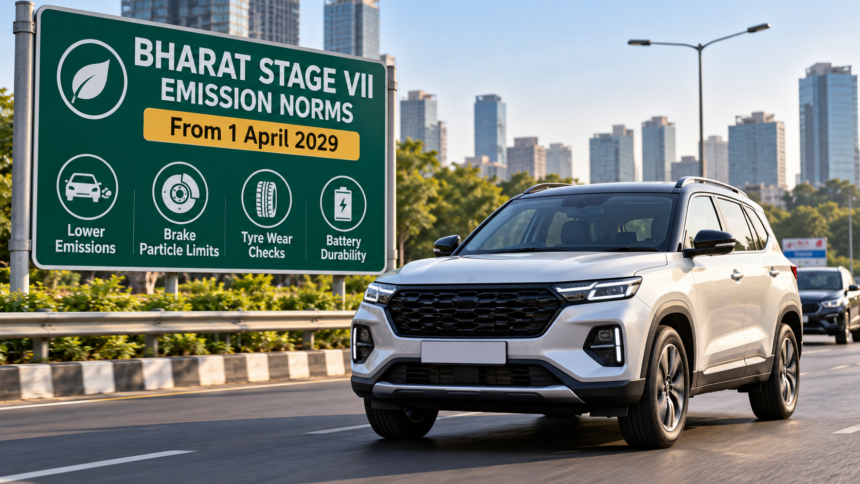
India’s road transport ministry has proposed introducing Bharat Stage VII (BS-VII) emission standards for new passenger cars and SUVs from April 1, 2029. The rules are still in draft form, and the government has invited public objections and suggestions for 30 days from the date the draft notification was made available in the Gazette.
The proposed framework goes beyond conventional exhaust emissions. It includes real-world driving tests, continuous onboard monitoring, brake-particle emissions, tyre wear and battery durability. The requirements would be introduced in phases, with some measures extending until 2035.
What the Proposed BS-VII Rules Mean From April 2029
Under the draft, Category M1 vehicles, which broadly include passenger cars and SUVs, would need to comply with new limits for carbon monoxide, hydrocarbons, nitrogen oxides, particulate matter and ultrafine particle numbers.
Vehicle certification would involve both laboratory testing and real-driving emissions assessments. Cars would also require onboard diagnostic and monitoring systems to identify faults and detect when nitrogen oxide or particulate emissions exceed the prescribed limits.
The proposal also introduces an Environmental Vehicle Passport. This would provide vehicle users with information about fuel consumption, battery health and pollutant emissions, offering greater visibility into a vehicle’s environmental performance.
New Limits Proposed for Brake and Tyre Emissions
The draft sets out a phased approach to controlling particles released through brake wear. From April 1, 2031, brake-particle emissions would be limited to 3 mg per kilometre for battery-electric cars and 7 mg per kilometre for plug-in hybrids, other hybrid vehicles, fuel-cell vehicles and conventional combustion-engine cars.
A uniform limit of 3 mg per kilometre is proposed for all these vehicle categories from April 1, 2035.
Tyre abrasion would also become part of the testing framework. However, specific numerical limits for tyre wear and brake-particle numbers are yet to be notified separately. These details will determine how the requirements are implemented in practice.
Battery Durability and Vehicle Data Requirements
Battery-electric cars and plug-in hybrid vehicles would have to meet minimum battery durability standards under the proposal. They would be required to retain at least 75% of their initial battery performance for five years or 100,000 km, whichever comes first. A minimum retention level of 67% is proposed for a period of up to eight years or 160,000 km.
The draft also outlines plans to make fuel and electric-energy consumption data available through vehicle systems from April 2030. From April 2032, additional monitoring information would be accessible through the diagnostic port and anonymously through over-the-air data transmission.
What the Proposed Rules Could Mean for Buyers and Automakers
If implemented, the standards could help reduce vehicle-related pollution while giving buyers clearer information about emissions and battery condition over a vehicle’s life. Manufacturers, meanwhile, may need to invest in additional sensors, testing procedures and calibration to meet the new requirements.
The proposal also addresses anti-tampering measures, cybersecurity, geofencing-ready vehicles and safety requirements for vehicles using CNG, hydrogen and high-ethanol fuels.
As the rules are still under consultation, the proposed implementation dates and technical limits may change before the final notification. The final requirements will depend on the outcome of the government’s review of public feedback.
Disclaimer: This article is based on the proposed draft emission standards. The rules have not been finalised, and the proposed dates, limits and requirements may be revised before official implementation. Readers should refer to the final government notification for confirmed details.