
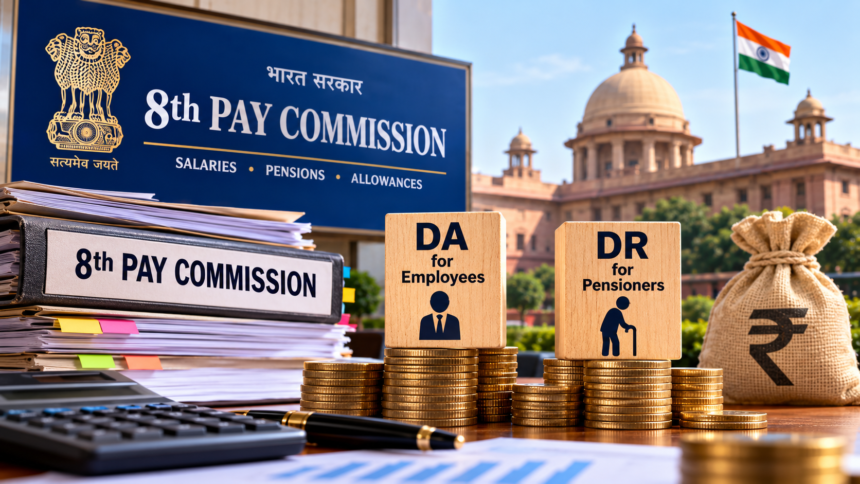
Dearness Allowance (DA) and Dearness Relief (DR) play an important role in the income of central government employees and pensioners. Both benefits are designed to help people manage rising living costs, but they apply to different groups. DA is paid to serving employees, while DR is provided to pensioners and family pension beneficiaries.
The 8th Pay Commission is scheduled to hold its next meeting in Mumbai on October 22 and 23, following its meeting in Bengaluru on October 8. As the commission considers possible changes to salaries, pensions and allowances, the future treatment of DA and DR remains an important issue for employees and retirees.
Several employee and pensioner organisations have submitted proposals covering minimum pay, fitment factors, increments, allowances and other service benefits. However, these proposals are demands from the respective organisations and should not be treated as approved changes.
8th Pay Commission: What Are Employee Unions Demanding?
Different organisations have put forward their expectations for the next pay revision.
The Confederation of Central Government Employees and Workers has demanded that 50% of DA and DR be merged with basic pay and pension. The National Council–Joint Consultative Machinery (NC-JCM) has proposed a minimum basic pay of ₹69,000, along with a fitment factor of 3.833.
Meanwhile, the Bharatiya Pratiraksha Mazdoor Sangh (BPMS) has called for minimum pay of ₹72,000 and a fitment factor of 4.0. Other organisations, including the Federation of National Postal Organisations (FNPO), have also raised demands concerning salaries and service benefits.
These proposals reflect the expectations of employee and pensioner groups, but the commission and the central government have not officially confirmed any of these demands as final decisions.
What Is the Difference Between DA and DR?
DA and DR serve a similar purpose but are paid to different categories of beneficiaries. DA is calculated as a percentage of the basic pay of serving government employees. DR is calculated on the basic pension of eligible pensioners and family pension beneficiaries.
Adhil Shetty, CEO of BankBazaar, explained that both benefits are linked to inflation and are generally revised twice a year based on the Consumer Price Index. He also noted that when a new Pay Commission is implemented, the accumulated DA and DR rates are typically reset as they are absorbed into the revised basic pay and pension structure.
In simple terms, DA helps serving employees cope with rising prices, while DR provides similar support to pensioners and family pension recipients.
Employee organisations are seeking changes to these components as part of the 8th Pay Commission process. Their aim is to strengthen financial support for employees and retirees as living costs rise. However, the final structure will depend on the commission’s recommendations and the government’s decision.
When Will the 8th Pay Commission Decide on DA and DR?
The 8th Pay Commission was constituted on November 3, 2025. Under its Terms of Reference, the commission has approximately 18 months from its formation to submit its final report.
The three-member panel is headed by Justice Ranjana Prakash Desai. Based on the stated timeline, the report is tentatively expected around May or June 2027, leaving roughly six to seven months from the period described in the article.
The commission’s recommendations will help determine how salaries, pensions and allowances may change under the next pay revision. However, the precise treatment of DA and DR will only become clear after the recommendations are submitted and the government announces its decisions.
What Should Central Government Employees and Pensioners Expect?
For now, employees and pensioners should distinguish between proposals submitted by unions and changes officially approved by the government. Demands such as merging 50% DA and DR with basic pay and pension, or revising minimum pay and fitment factors, remain unconfirmed.
The outcome of the 8th Pay Commission is expected to affect more than 1.1 crore serving employees and pensioners. As the commission continues its meetings across the country, its recommendations on pay, pensions and inflation-linked benefits will be closely watched.
Until an official decision is announced, no proposed change to DA, DR or the wider pay structure should be considered final.
Disclaimer: This article is for general informational purposes only. The demands and proposals mentioned are not confirmed government decisions or final recommendations of the 8th Pay Commission. The actual changes to salaries, pensions, DA and DR will depend on the commission’s report and the central government’s official approval. Readers should refer to authorised government notifications for confirmed updates.