
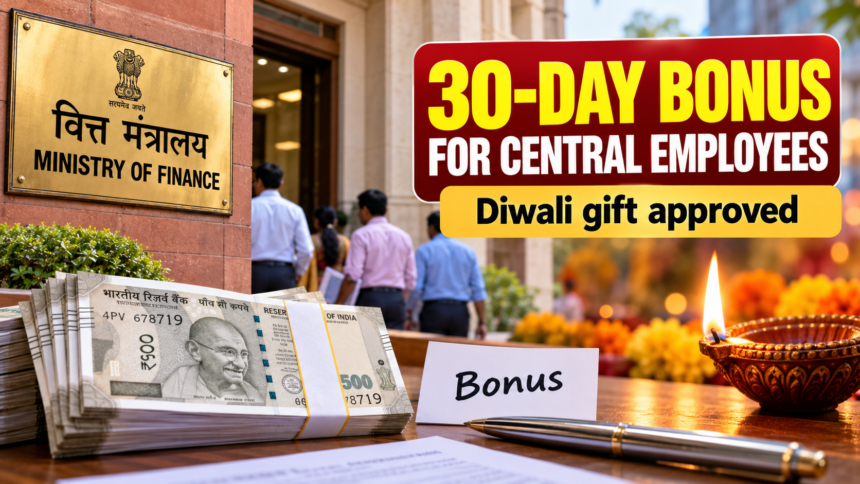
The Central Government has approved a 30-day non-productivity-linked bonus for eligible employees for the accounting year 2025-26, offering financial support ahead of Diwali. The approval was communicated through a memorandum issued by the Department of Expenditure under the Finance Ministry on October 15, 2026.
The bonus will be paid from the approved budget allocations of the respective ministries and departments for the financial year 2026-27. Payments will be rounded to the nearest whole rupee.
Who Is Eligible for the 30-Day Bonus?
The ad-hoc bonus is available to eligible Group C employees and non-gazetted Group B employees who are not covered by the Productivity-Linked Bonus Scheme. Eligible personnel serving in the Central Armed Police Forces (CAPFs) and Armed Forces are also included.
Employees of Union Territory administrations who follow the Central Government’s salary structure may qualify if they are not covered by another bonus or ex-gratia scheme.
To receive the bonus, employees generally need to have completed at least six months of continuous service during 2025-26. Employees who were in service on March 31, 2026, can qualify if they meet the prescribed conditions. Those who worked for at least six months but less than a full year will receive a proportionate amount, calculated according to their eligible service period.
How Much Bonus Will Employees Receive?
The bonus calculation uses a maximum monthly salary of ₹7,000. An employee’s actual average monthly salary will be considered if it is lower than this ceiling.
For a full 30-day bonus, the maximum amount is ₹6,908. The calculation is based on dividing the eligible monthly salary by 30.4 and multiplying the result by 30.
Example:
₹7,000 × 30 ÷ 30.4 = ₹6,907.89
After rounding, the maximum bonus comes to ₹6,908. Employees whose average monthly salary is below ₹7,000 will receive a lower amount based on the applicable calculation.
Bonus Rules for Retired Employees, Death Cases and Deputation
Certain employees who retired after reaching the age of superannuation, retired due to medical invalidity, or died before March 31, 2026, may also qualify. They must have completed at least six months of regular service during the accounting year.
Employees deputed to a state government, Union Territory administration or public sector undertaking will not receive the bonus from their parent Central Government department.
In cases where an employee transfers between Central Government offices without a break in service, the qualifying service period may be combined to determine eligibility.
What Bonus Will Eligible Casual Workers Receive?
Casual labourers must meet specific service requirements to qualify for the bonus. Those working in offices with a six-day working week must have completed at least 240 days of work annually for three or more years. For employees in offices following a five-day working week, the requirement is at least 206 working days annually for three or more years.
For eligible casual labourers, the monthly salary ceiling is ₹1,200. Based on this limit, the maximum bonus for 30 days is calculated as follows:
₹1,200 × 30 ÷ 30.4 = ₹1,184.21
After rounding, the bonus amount is ₹1,184. If a worker’s actual monthly salary is below ₹1,200, the calculation will use that lower amount.
Eligible working days across multiple Central Government offices may be combined, provided the employee has not already received a bonus, ex-gratia payment or incentive for those days. Casual labourers who were regularised during the accounting year may also qualify if they fulfil the applicable conditions.
Disclaimer: This article is intended for general informational purposes only. Eligibility, bonus amounts and payment conditions are subject to the official government memorandum and applicable rules. Employees should consult their respective departments or the official notification to confirm their eligibility and final payable amount.