
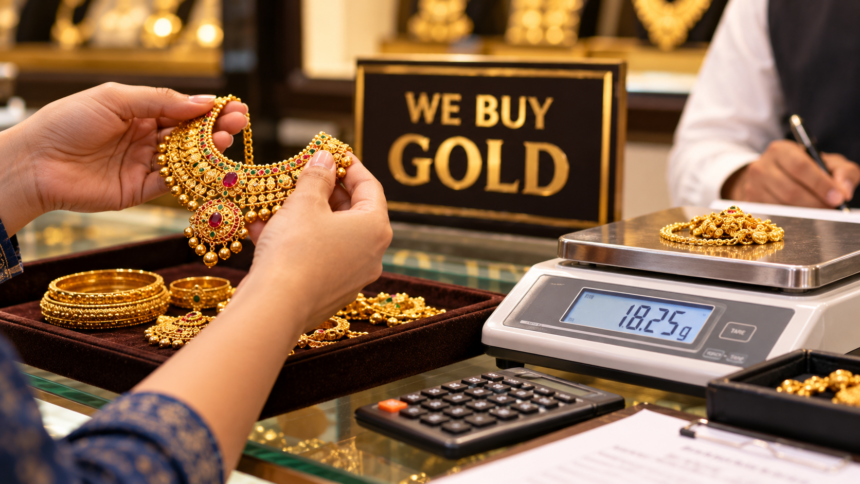
Gold prices have risen significantly in recent years, making it an attractive time for some people to consider selling old jewellery. According to data compiled by Bankbazaar, the price of 24-carat gold per 10 grams has increased by 46.98% since the beginning of 2026.
However, a higher market price does not necessarily mean you will receive the same increase when selling your jewellery. The final amount depends on several factors, including gold purity, the actual weight of gold in the item, the rate offered by the buyer and any applicable deductions.
Checking the latest gold price is a useful first step, but understanding how jewellers assess old jewellery can help you evaluate offers more effectively.
7 Factors That Affect the Resale Value of Gold Jewellery
The amount a jeweller offers for your old gold depends on the following factors.
| Factor | How it affects your resale value |
|---|---|
| 1. Gold purity | Jewellery may contain 14K, 18K or 22K gold. Higher purity generally means more gold content per gram and a higher value for the same net weight. |
| 2. Net gold weight | Stones, beads and other non-gold materials are generally excluded from the gold valuation. The buyer calculates the value using the actual gold content rather than the jewellery’s total weight. |
| 3. Applicable buying rate | The rate a jeweller offers when purchasing old gold may differ from its displayed selling price. Confirm which rate applies to your jewellery’s purity. |
| 4. Making charges | Making charges paid when purchasing jewellery are generally not recovered when it is resold. The resale offer usually focuses on the value of the gold itself. |
| 5. Purity testing and deductions | Jewellers may test the gold and apply deductions under their valuation policies. Ask for a clear explanation of all deductions before accepting an offer. |
| 6. Hallmark verification | BIS-hallmarked jewellery carries a six-digit Hallmark Unique Identification (HUID), which can be checked using the BIS Care app. Verification helps establish the recorded purity but does not guarantee a particular resale price. |
| 7. Buyback policy | Some jewellers offer different rates or impose conditions depending on where the jewellery was purchased. An original invoice or other documents may be required. |
These are the main factors that influence resale value, although a jeweller’s assessment may also depend on the specific item and the terms of the transaction.
How Is the Value of Old Gold Jewellery Calculated?
To understand the calculation, consider an example in which you want to sell 20 grams of 22-carat gold jewellery. Suppose 2 grams of the total weight consists of stones and other non-gold materials.
In this case, the net gold weight would be 18 grams.
If the jeweller’s applicable buying rate is ₹10,000 per gram, the preliminary valuation would be:
- Total jewellery weight: 20 grams
- Non-gold material: 2 grams
- Net gold weight: 18 grams
- Assumed buying rate: ₹10,000 per gram
- Preliminary gold value: ₹1,80,000
This amount is calculated before any applicable deductions. The final payment could be lower depending on the jeweller’s testing method, valuation policy and transaction terms.
It is also important to remember that 24-carat gold is rarely used for everyday jewellery because pure gold is relatively soft and can be scratched or deformed more easily than gold mixed with other metals.
How to Get a Better Price When Selling Old Gold
Before selling your jewellery, obtain quotations from more than one jeweller. Comparing offers can help you understand whether the proposed valuation is reasonable for your item’s purity and net gold weight.
Ask each buyer to explain the calculation, including the gold rate used, purity assessment, weight of non-gold materials and any deductions. Request a written breakdown so that you can compare offers on the same basis.
You can also approach a BIS-recognised assaying and hallmarking centre for gold testing if you need help verifying the purity of your jewellery.
Keep any original invoice and hallmark-related information available, as these may help with verification or satisfy a jeweller’s buyback requirements.
What to Check Before Selling Your Jewellery
A rise in gold prices can improve the potential resale value of old jewellery, but the market rate alone does not determine the amount you receive. Purity, net gold weight, the buyer’s rate and deductions all play an important role.
Taking time to verify these details and compare itemised quotations can help you make a more informed decision before selling your gold.
Disclaimer: This article is for general informational purposes only. The example valuation uses an assumed gold buying rate and does not represent a guaranteed resale offer. Actual payments depend on prevailing market rates, jewellery purity, net gold weight, testing results, deductions and the buyer’s terms. Confirm the final valuation with the jeweller before completing a transaction.