
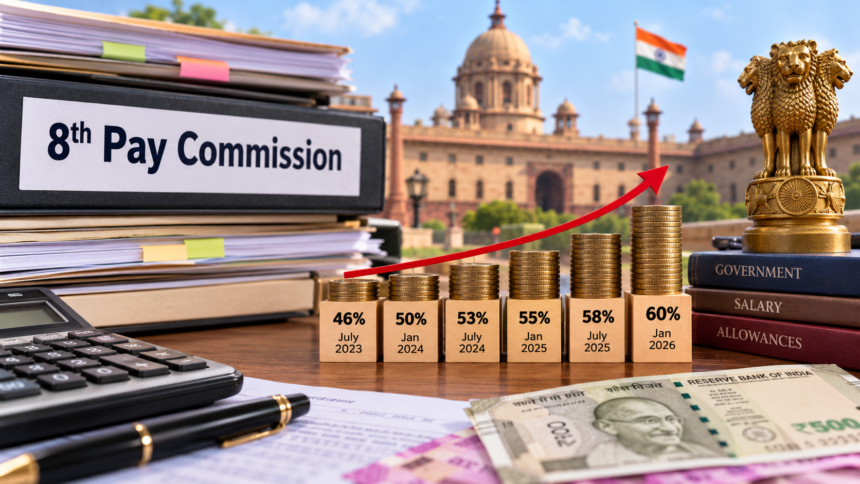
The increase in Dearness Allowance (DA) from 46% in July 2023 to 60% in January 2026 has brought renewed attention to salary revision demands under the 8th Central Pay Commission. The 14-percentage-point rise over 30 months has become an important consideration in discussions about the fitment factor, which will determine how existing basic pay is converted into revised pay under the next pay structure.
The three-member 8th Pay Commission, headed by Justice Ranjana Prakash Desai, held a consultative meeting in Bengaluru on October 8. The panel is scheduled to conduct further discussions in Mumbai on October 22 and 23.
Since its constitution on November 3, 2025, the Commission has held several meetings across the country, including in Delhi, Ladakh, West Bengal and Puducherry, as it gathers views on pay-related issues.
DA Increased From 46% to 60% Between 2023 and 2026
The Confederation of Central Government Employees and Workers (CCGEW) recently informed the Department of Expenditure that DA is revised twice a year under the established formula based on Pay Commission recommendations.
In its communication, the organisation outlined the successive increases in DA over the period:
- July 2023: 46%
- January 2024: 50%
- July 2024: 53%
- January 2025: 55%
- July 2025: 58%
- January 2026: 60%
According to the CCGEW, this increase reflects the cumulative effect of price movements over the period. The allowance is intended to help central government employees and pensioners cope with rising living costs between major pay revisions.
However, employee organisations argue that regular DA increases do not necessarily prevent the purchasing power of salaries and pensions from declining over longer periods.
What Is the Fitment Factor Under the 8th Pay Commission?
The fitment factor is a multiplier applied to an employee’s existing basic pay to determine the revised basic pay under a new pay structure. Its value is therefore a key consideration for employees awaiting the 8th Pay Commission’s recommendations.
Under the 7th Pay Commission, the recommended fitment factor was 2.57. The 6th Pay Commission had adopted a factor of 1.86.
Several employee organisations have now put forward higher figures for the upcoming revision. The National Council-Joint Consultative Machinery (NC-JCM) staff side has sought a fitment factor of 3.833, along with minimum basic pay of ₹69,000.
Bharat Pensioners Samaj has proposed a factor of 3.83, while the Ministerial Staff Association, Survey of India, has demanded a factor of 3.61.
These figures represent proposals from employee and pensioner organisations; they are not approved fitment factors. The final decision will depend on the recommendations and subsequent government action.
Employee Unions Seek DA Merger and Regular Pay Revisions
Alongside their demands for a higher fitment factor, employee groups have called for changes to the broader pay revision system. Their concerns include the possible merger of DA with basic pay and the long intervals between successive Pay Commission revisions.
The Railway Senior Citizens Welfare Society (RSCWS), in its memorandum, said that DA provides only partial protection against inflation. It argued that the gap between periodic pay revisions and the continuing increase in living costs can reduce the real value of wages and pensions.
The Ministerial Staff Association has also questioned whether the current DA calculation adequately reflects the essential expenses of a modern family. It said the existing mechanism does not fully account for need-based requirements.
The Indian Railways Technical Supervisors Association (IRTSA) has raised similar concerns about the effect of lengthy revision cycles. According to the association, revising salaries after a gap of 10 years has eroded their real value.
What Happens Next for 8th Pay Commission Salary Expectations?
The rise in DA to 60% has added to the discussion about how the next pay structure should account for inflation and household expenses. Employee organisations are seeking changes that they believe would better protect the purchasing power of salaries and pensions.
The Commission’s ongoing consultations are part of the process of gathering views on pay, allowances and related matters. However, the fitment factor figures and minimum basic pay amounts proposed by unions remain demands rather than confirmed decisions.
Central government employees and pensioners will need to wait for the Commission’s recommendations and the government’s subsequent decisions to know the final fitment factor, revised pay scales and other benefits.
Disclaimer: This article summarises the DA figures, consultation details and proposals attributed to employee organisations in the supplied information. The fitment factors and minimum basic pay figures mentioned are demands, not confirmed government decisions. Employees should refer to official notifications from the 8th Central Pay Commission and the Government of India for authoritative updates on pay revision and allowances.