
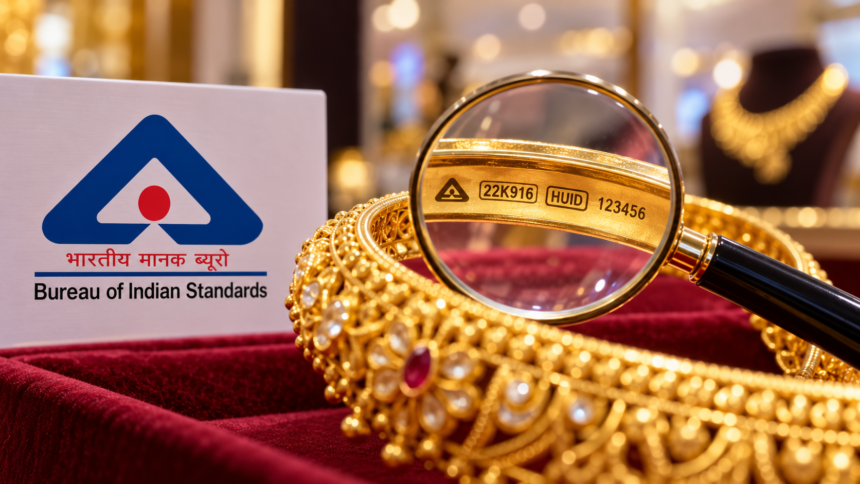
Kolkata: Buying gold jewellery could become more expensive for consumers following a sharp increase in hallmarking charges announced by the Bureau of Indian Standards (BIS). The fee for hallmarking a gold jewellery article has risen from ₹45 to ₹75, an increase of more than 66%. However, the hallmarking charge for silver jewellery remains unchanged at ₹35.
The revised charges follow amendments to the BIS (Hallmarking) Amendment Regulations, 2026, notified on September 14, 2026. The increase has prompted concerns within the jewellery industry about higher compliance costs and the possibility that some traders may attempt to avoid genuine hallmarking by using counterfeit stamps.
The All India Gem and Jewellery Domestic Council (GJC) has warned that higher costs could place additional pressure on jewellers who follow the prescribed rules. According to the industry body, the increased financial burden could create incentives for dishonest traders to mislead customers with fake hallmark markings.
Why the Hallmarking Fee Hike Is Raising Concerns
The increase in hallmarking charges has drawn particular attention because of its potential impact on smaller jewellery businesses and consumers. The GJC argues that compliant jewellers will have to absorb higher costs, while unscrupulous traders could try to bypass the system.
The concern is especially significant in Tier-2, Tier-3 and Tier-4 cities, where awareness about hallmark verification and the Hallmark Unique Identification (HUID) system remains limited.
According to the GJC, adequate awareness of the BIS Care App exists in only around 10% of India’s 800 districts. The organisation has urged the BIS to withdraw the increase and restore the earlier fee of ₹45 per gold jewellery article.
The GJC has also called on the BIS to explain the additional expenditure on equipment, staff, processing and storage that has led to the revised charges.
How to Identify Genuine Hallmarked Gold Jewellery
Consumers should not rely solely on the presence of a hallmark symbol when purchasing gold jewellery. Genuine hallmarked articles carry three key details: the BIS logo, the purity or fineness grade, and a six-digit HUID number.
Buyers can use the BIS Care App and its “Verify HUID” feature to check the identification number and confirm the jewellery’s hallmark details.
Understanding the purity marking is also important. For example, 22K916 indicates 22-carat gold with 91.6% gold content, while 18K750 represents 18-carat gold containing 75% gold.
Customers should verify these markings and the HUID number and ensure that the purchase bill clearly records the relevant jewellery details. Checking these details can help reduce the risk of buying jewellery carrying misleading or counterfeit markings.
India’s Hallmarking Network Continues to Expand
Government data shows that the number of recognised Assaying and Hallmarking Centres increased from 1,220 in July 2022 to 1,577 in July 2026.
The scale of hallmarking activity has also grown. During the 2025–26 period, approximately 13.22 crore jewellery articles underwent hallmarking across the country.
Despite this expansion, the GJC estimates that the revised fee structure could place an additional financial burden of around ₹400 crore on the overall jewellery industry ecosystem. It has also estimated a potential GST impact of approximately ₹80 crore.
The industry body’s concerns centre on the balance between the cost of regulatory compliance and consumer protection. For jewellery buyers, verifying the BIS logo, purity grade and HUID remains an important step when purchasing gold.
Disclaimer: This article is intended for general informational purposes and is based on the details provided about the revised hallmarking charges and the jewellery industry’s response. Fee changes, regulatory requirements and verification procedures should be confirmed through official BIS notifications and resources. Consumers should independently verify hallmark details before purchasing jewellery.