
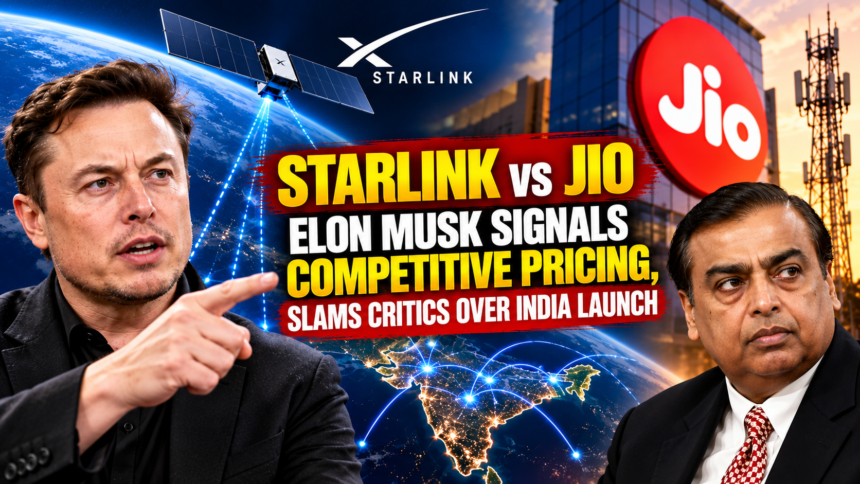
New Delhi: SpaceX and Tesla CEO Elon Musk has renewed his criticism of Reliance Industries chairman Mukesh Ambani and supporters of Reliance Jio amid continuing delays in Starlink’s commercial launch in India. In a post on X, Musk accused people defending the country’s existing telecom market of making contradictory arguments about Starlink’s ability to compete with Jio.
Musk argued that some critics claim Starlink cannot match Jio’s low prices while simultaneously suggesting that the satellite internet service could pose a serious competitive threat. He described these arguments as “absurd hypocrisy and hyperbole” and referred to the supporters as “Ambani’s army of Internet shills.”
“The ridiculous arguments by Ambani’s army of Internet shills make no sense,” Musk wrote, questioning how Starlink could be considered both unable to compete on price and too strong a competitor.
Musk Says Competition Could Benefit Indian Consumers
Musk maintained that allowing Starlink to enter the Indian market would give consumers more choices and encourage competition among internet service providers. He argued that established telecom companies might see lower profit margins but would not necessarily lose their businesses.
According to Musk, market competition would also put pressure on Starlink to make its service more affordable if consumers considered its pricing too high.
“The reality is that competition would greatly benefit the average citizen in India by giving them more choices, as it always does,” Musk said, adding that Ambani’s profits could decline without threatening the continued operation of his business.
His latest comments followed a post by Aaron Burnett, CEO of Mach33 Financial Group, who questioned the assumption that broadband connectivity is widely available and inexpensive throughout India.
Burnett pointed out that monthly mobile data consumption remains high, at around 30 to 40 GB, while home fibre penetration is comparatively low despite average monthly usage approaching 300 GB. He suggested that an affordable alternative could encourage more households to adopt fixed broadband services.
Musk’s Earlier Remarks on Reliance Jio and Starlink
Musk’s latest criticism follows a series of public comments about the delays affecting Starlink’s commercial launch in India.
On Friday, he sarcastically addressed Ambani as “Prime Minister Ambani” and suggested that the industrialist was using corporate influence to protect an existing market position.
“Dear Prime Minister Ambani, Please accept my humble apologies for not realizing that you are the real boss of India,” Musk wrote. He also questioned whether Starlink would be allowed to compete in the Indian market.
Musk has linked the debate to India’s wider connectivity needs, arguing that many areas still lack reliable internet access. He said limited connectivity can restrict educational opportunities for children and make it harder for small businesses to participate in international trade.
He also highlighted the potential role of satellite internet during natural disasters, when conventional communication infrastructure may be damaged or disrupted. According to Musk, Starlink could help maintain connectivity and support emergency communication in such situations.
The dispute intensified further on October 10, when Musk shared news reports alleging financial and political connections involving Reliance-backed entities. Reliance had not issued a public response to Musk’s allegations at the time covered by the source material.
Government Says Satellite Internet Operators Face the Same Rules
The Indian government has maintained that it does not favour any particular technology or company in the telecommunications sector.
On October 9, Union Communications Minister Jyotiraditya Scindia said India does not permit monopolies in any sector. Speaking at the India Mobile Congress in Delhi, he explained that the Department of Telecommunications follows a technology-neutral approach intended to give consumers the freedom to choose their preferred services and providers.
“Let me set the record straight. For us, the Department of Telecommunications, we are technology agnostic,” Scindia said, explaining that the government’s responsibility is to make a range of services available so customers can decide which provider best suits their needs.
Scindia confirmed that satellite communication licences had been granted to three operators: Elon Musk’s Starlink, Reliance Jio’s Jio Satcom and Bharti-backed Eutelsat OneWeb. Amazon’s Project Kuiper has also expressed interest in entering the market.
However, licences alone do not allow operators to begin commercial services immediately. The Department of Telecommunications and the Telecom Regulatory Authority of India are working on satellite spectrum pricing, while operators must also complete the required security clearances and regulatory procedures.
The Ministry of Communications has rejected suggestions that commercial interests are deliberately delaying Starlink’s entry. It has stated that all three licensed operators are progressing through the same regulatory process and are subject to security assessments.
The timing of Starlink’s commercial launch in India therefore remains linked to the completion of spectrum-related decisions and other mandatory approvals.
Disclaimer
This article is based on the information and statements provided in the source material. Allegations and opinions attributed to individuals are presented as their claims and should not be interpreted as independently established facts. Regulatory requirements, licensing status and commercial launch timelines may change as official decisions are announced. Readers should consult official government statements and company announcements for the latest verified information.