
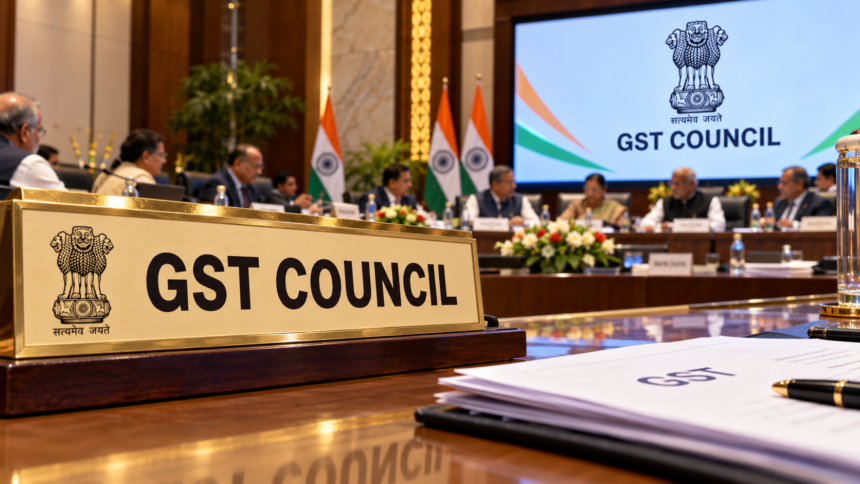
The 57th GST Council meeting has been postponed and will now take place on October 8, according to an office memorandum issued by the GST Council Secretariat on Monday. The meeting was rescheduled due to “unavoidable circumstances.”
The Council will meet from 11 am onwards at the Summit Room, Bharat Mandapam, New Delhi.
The meeting is expected to take up a range of proposals related to GST enforcement, prosecution and compliance as part of the government’s broader Next-Generation GST reform agenda.
GST Prosecution Rules May See Major Changes
One of the key proposals before the Council is a possible change in the rules governing arrests under the GST law. The proposed framework could remove the power of GST officers to directly arrest taxpayers and instead require judicial authorisation before an arrest is made.
The Council may also consider increasing the threshold for initiating criminal prosecution from the existing ₹1 crore to ₹5 crore.
The proposed changes are aimed at reducing the use of criminal proceedings in routine tax disputes involving issues such as classification, valuation and input tax credit, according to people familiar with the proposals.
The government is also considering changes to the prosecution provisions covering 24 offences. Under the proposal, nine offences could be removed, while 11 offences would remain unchanged.
Another proposed change involves the minimum sentence. The provision requiring a minimum prison term could be removed, allowing courts to impose a fine instead. The maximum punishment under the middle category could also be reduced from three years to two years.
Tax Recovery Powers to Remain
The proposed reforms would not take away the government’s authority to recover unpaid taxes or impose financial penalties.
Taxpayers found to have paid less tax than required or claimed input tax credit incorrectly would continue to face tax recovery proceedings and other consequences under the law.
Serious cases involving intentional tax evasion or fraud could still be prosecuted before the courts, according to sources cited by news agency PTI.
At present, GST officers can make arrests after obtaining prior approval from a Commissioner-level officer in major cases where tax evasion, fraudulent input tax credit or wrongful refunds exceed ₹1 crore.
Under the proposed system, judicial approval would be required before an arrest, while tax authorities would continue to focus on recovering tax, interest and applicable penalties.
The Council may also consider waiving late fees for small taxpayers and rationalising penalties as part of the proposed reforms.
Gold, Silver and Platinum Import Exemption Under Review
The GST Council is also expected to examine the existing IGST exemption available to banks and nominated agencies importing gold, silver and platinum, according to PTI.
These precious metal imports currently attract 3% IGST. However, the tax is exempt when the metals are imported by banks and nominated agencies included in the government’s periodic list.
The exemption was introduced in 2017. The proposal under consideration seeks to withdraw this benefit.
Beyond prosecution and precious metal imports, the Council is expected to discuss several other GST reforms, including simpler GST registration, faster refunds, easier input tax credit procedures and changes to show-cause notices and penalties.
GST on Employee Insurance and ITC Proposal
Another proposal likely to come before the Council concerns input tax credit on insurance premiums paid by employers for coverage provided to their employees.
Under the current system, GST is exempt when individuals purchase life or health insurance for themselves or their families. However, businesses purchasing insurance coverage for employees are subject to GST on such policies and have so far been unable to claim input tax credit.
At present, 18% GST is charged on group life and health insurance policies purchased by businesses for employees.
The GST Council is expected to consider whether companies should be permitted to claim input tax credit on premiums paid for employee insurance coverage.
The final decisions on these proposals will be taken by the GST Council during its rescheduled meeting on October 8.
Disclaimer
This article is intended for general informational purposes and is based on the proposals and information available regarding the 57th GST Council meeting. The measures discussed are proposals under consideration and should not be treated as final decisions unless officially approved and notified. Readers should refer to official GST Council and government notifications for the latest rules and applicable provisions.