
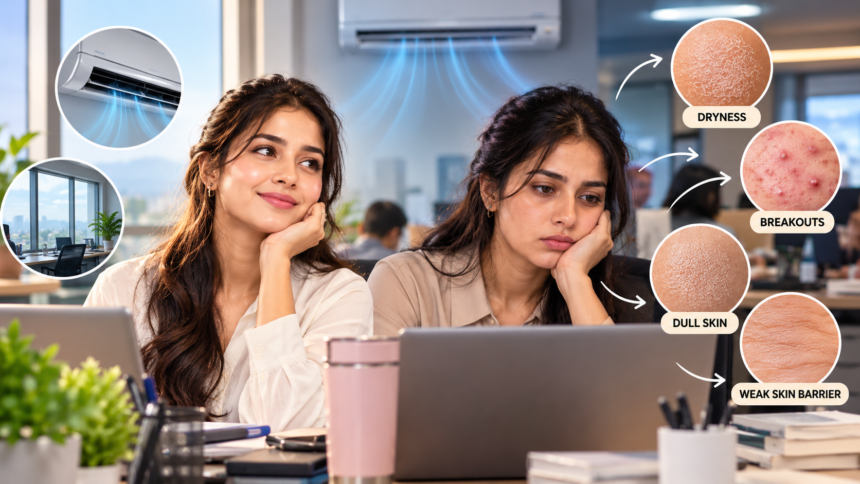
Ever noticed that your skin looks fresh when you arrive at work but appears dull, dry or uneven by the end of the day? For many people who spend long hours at a desk, the difference may be linked to their indoor environment.
The term “office air” has recently gained attention in beauty and skincare conversations, particularly around the effects of air conditioning, low humidity, limited sunlight and indoor pollutants on the skin. Common complaints include dehydration, flaky patches, uneven makeup, excess oil and breakouts.
While “office air” is not a medically recognised condition, dermatologists say workplace environments can influence the skin, particularly when someone spends several hours in air-conditioned or low-humidity surroundings.
How Office Air Conditioning Can Affect Your Skin
Air-conditioned and heated environments can reduce humidity levels, which may affect the skin’s moisture content and surface condition. Research has indicated that exposure to dry environments can influence transepidermal water loss (TEWL) and skin texture.
However, spending time in an air-conditioned office does not automatically mean that your skin will become damaged or develop breakouts. The effect can vary depending on skin type, existing skin conditions, skincare habits, ventilation and exposure to indoor pollution.
The skin’s outermost layer, known as the stratum corneum, plays an important role in maintaining moisture and protecting the skin from external factors. Prolonged exposure to low-humidity environments can increase moisture loss.
Dr. TK Sumathy, Senior Consultant, Department of Dermatology, Ramaiah Memorial Hospital, explains that spending around 8–10 hours in an air-conditioned or low-humidity workplace can contribute to increased TEWL. This may leave the skin feeling dry, tight and less resilient, and can sometimes cause flaking.
She also notes that prolonged exposure to air-conditioned environments may contribute to premature skin ageing and can aggravate existing conditions such as psoriasis, eczema and rosacea.
A healthy skin barrier helps retain moisture and protect the skin, while a disrupted barrier can lead to greater moisture loss, sensitivity and irritation. This is also why simply spraying water or facial mist onto the skin does not necessarily restore a damaged or stressed barrier.
5 Signs Your Skin May Be Stressed at Work
Your skin can show several signs when exposed to dry or low-humidity office conditions for extended periods.
1. Your skin feels tight by lunchtime
Tightness, particularly around the cheeks and forehead, can be associated with dehydration.
2. Your makeup becomes patchy
Foundation that looked smooth in the morning may begin settling into dry areas as the day progresses.
3. Fine lines appear more noticeable
Dehydrated skin can temporarily make fine lines look more prominent. This does not mean that a few hours in an office have suddenly caused new wrinkles.
4. Flaky patches develop
Dry or flaky areas may become visible around the nose, cheeks and mouth.
5. Your skin appears oily but still feels dehydrated
A shiny forehead does not necessarily indicate that the skin has sufficient moisture.
If these concerns persist or become severe, seeking advice from a dermatologist can help identify the underlying cause.
What Should You Keep in Your Desk Drawer?
For people who spend several hours working at a desk, maintaining a simple skincare routine can help support the skin barrier.
Dr. Shivam, Consultant Dermatologist at Kailash Hospital, Greater Noida, recommends keeping three basic products at work.
The first is a fragrance-free moisturiser containing ingredients such as ceramides, glycerin or hyaluronic acid, which can support skin hydration and barrier function.
The second is sunscreen with SPF 30 or higher, particularly for people exposed to sunlight through office windows or during their commute.
The third is an occlusive lip balm, which can help reduce moisture loss from the lips.
The focus, according to the dermatologist, should not be on creating a complicated skincare routine but on maintaining hydration, protecting the skin barrier and providing adequate sun protection throughout the day.
Dermatologist-Recommended Ingredients for Office Skincare
Choosing skincare ingredients according to your skin type can be more useful than following every viral skincare trend. A lengthy 10-step routine is not necessarily required.
Dr. Radhika Raheja, Dermatologist at Asian Hospital, recommends looking for ingredients that support the skin barrier and help minimise moisture loss.
Ceramides, fatty acids and cholesterol can help replenish barrier lipids. Humectants such as hyaluronic acid, glycerin and panthenol help attract and retain water in the skin. Niacinamide may also support barrier function while addressing inflammation and uneven skin tone.
A Simple Office Skincare Routine
A basic morning routine can include:
Gentle cleanser → hydrating serum → ceramide-rich moisturiser → broad-spectrum sunscreen
If your skin begins feeling tight during the afternoon, a lightweight moisturiser or hydrating mist can provide additional comfort. However, a facial mist alone may not be enough to prevent moisture loss, so applying moisturiser afterward can help.
Sunscreen should also remain part of the routine when indoors, particularly if you sit close to windows or receive significant daylight exposure during your commute.
Ultimately, facial mists can provide an additional layer of hydration, but they should not be considered a complete solution for moisture loss caused by dry indoor conditions. Understanding your skin type and choosing suitable ingredients can be more useful than simply following products that are trending on TikTok or Instagram Reels.