
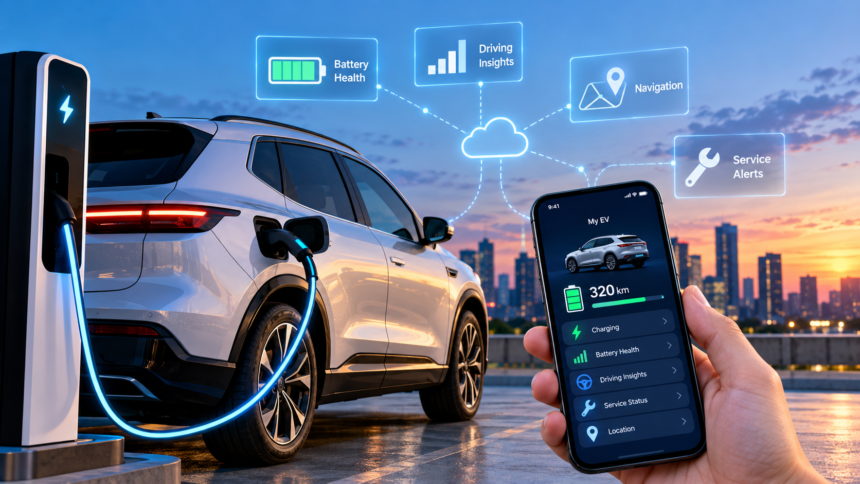
Electric vehicle ownership is increasingly becoming about more than the vehicle itself. Unlike conventional cars, EVs continuously generate data related to battery condition, charging habits, driving patterns, thermal performance, navigation and service diagnostics.
This constant flow of information is helping automakers move from traditional ownership models towards connected ecosystems that can learn from real-world usage and improve over time.
For EV owners, expectations are also changing. Customers increasingly want their vehicles to become more useful and efficient as they use them, rather than delivering their best experience only when they leave the showroom. Software updates and data-driven improvements are therefore becoming an important part of modern EV ownership.
Real-World Data Is Improving Battery Performance
Battery performance remains one of the most important aspects of EV ownership, and manufacturers are using real-world data to continuously improve Battery Management Systems.
EV batteries can behave differently depending on traffic conditions, highway speeds, weather, road gradients and charging patterns. These differences become particularly important in markets such as India, where varied climates, road conditions and driving behaviour can create situations that are difficult to reproduce completely in laboratory testing.
Connected vehicle data allows automakers to refine charging curves, thermal management, range calculations and battery-balancing algorithms. By studying usage patterns across vehicle fleets, manufacturers can adjust charging behaviour at different speeds, manage battery temperatures during extreme conditions, improve range estimates and balance charging across individual cells.
Many of these improvements can be delivered through over-the-air software updates, allowing battery performance to evolve even after the vehicle has been purchased.
This data-led approach can also help address one of the most common concerns among EV owners: range anxiety. More accurate range estimates and better battery management can make vehicle performance more predictable across different driving conditions.
Data Is Making Vehicle Servicing More Efficient
The role of data extends beyond battery management and is also changing how EVs are serviced.
Traditional vehicle servicing has often been reactive, with workshops diagnosing problems after an issue becomes noticeable. Connected vehicle data is helping shift this approach towards better-prepared service visits.
Information such as battery temperature, motor efficiency and system logs can provide technicians with a clearer picture of a vehicle’s condition before it reaches the workshop. For example, data showing unusually high battery temperatures after repeated driving in hot weather or irregular motor performance after driving on demanding terrain can help service teams prepare in advance.
Owners can also receive information through connected applications before a service appointment, including details about potential requirements and expected turnaround times. This can make the process more transparent while reducing unnecessary diagnostic work and downtime.
The result is a service experience that is more informed, efficient and focused on the actual condition of the vehicle.
Driving Data Is Influencing Future EV Development
EVs are also creating a continuous feedback loop between manufacturers and customers. Information about charging behaviour, drive modes, infotainment usage, navigation and other vehicle features can help automakers understand how vehicles are actually being used.
This provides a different kind of insight compared with traditional surveys and focus groups because it reflects real-world customer behaviour.
During the early years of EV adoption, telematics data showed that customers frequently used Level 2 and Level 3 regenerative braking in dense urban traffic. This led to calibration improvements aimed at making performance smoother in frequent start-stop conditions.
The same analysis found that Economy mode was used mainly during city commutes rather than highway journeys. This encouraged further optimisation of the mode for predictable urban driving.
Insights from charging habits and feature usage can similarly help manufacturers identify which improvements should be prioritised. Combined with over-the-air updates, this allows vehicles to receive meaningful software improvements after purchase and reduces the time required to develop and introduce certain enhancements.
In this respect, modern EVs are increasingly becoming software-driven platforms that can continue evolving throughout their ownership lifecycle.
Personalisation Is Becoming Part of EV Ownership
Data analytics is also allowing automakers to move away from a one-size-fits-all ownership experience. Vehicle features can increasingly be tailored to individual driving and usage patterns.
Charging reminders, route planning, cabin pre-conditioning, driving modes and service alerts can be adapted according to how a vehicle is used. For example, a regular city commuter may receive information about nearby fast-charging options during busy periods, while a long-distance driver may benefit from cabin pre-conditioning designed around highway travel.
Different users have different requirements. City commuters, long-distance drivers and fleet operators may use the same EV in very different ways. Data analytics can help manufacturers respond to these differences and make vehicle features more relevant to each user.
As expectations around connected vehicles continue to grow, convenience and personalisation are becoming increasingly important alongside traditional factors such as range and performance. The ability to use real-world data effectively is therefore becoming an important part of the evolving EV ownership experience.
Authored by: Anand Kulkarni, Chief Products Officer, HV Engineering, TMPV & TPEM
Disclaimer: This article is based on the views and information provided by the author and is intended for general informational purposes. References to EV technology, data analytics and connected vehicle features describe industry developments and should not be interpreted as a guarantee of performance, savings or outcomes for every vehicle or user.