
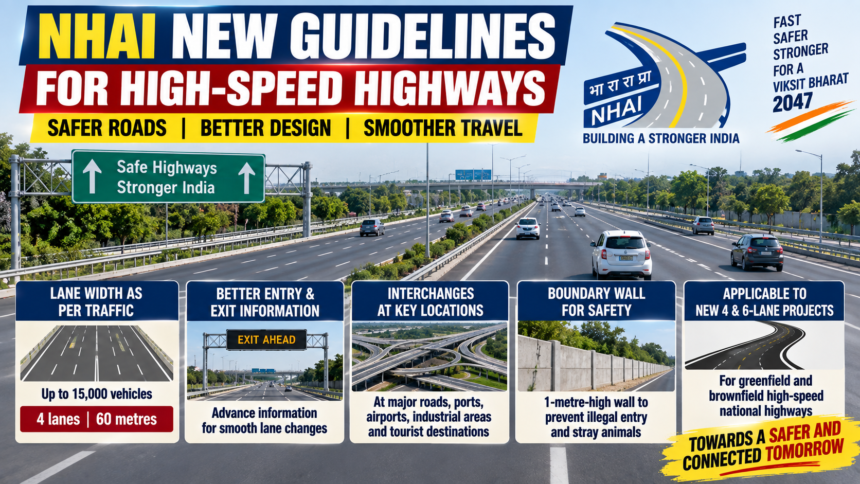
India’s high-speed road network is expanding rapidly, and the National Highways Authority of India (NHAI) has introduced updated guidelines for the design and development of access-controlled high-speed national highways.
The revised framework aims to bring greater uniformity to highway design, improve road safety and support smoother movement of high-speed traffic. The changes are also linked to the Government of India’s broader Viksit Bharat 2047 roadmap.
New Rules for 4-Lane and 6-Lane Highways
The updated guidelines will apply to upcoming 4-lane and 6-lane greenfield as well as brownfield high-speed national highway projects.
Under the new framework, the number of lanes and the overall road width will be decided according to projected traffic levels. NHAI has established a common design structure based on the expected number of vehicles using a corridor.
Corridors expected to carry up to 15,000 vehicles will have a 4-lane highway and a 4-lane structure, with a total width of 60 metres.
For corridors with traffic between 15,000 and 25,000 vehicles, the highway will have 4 lanes with a 6-lane structure and a width of 70 metres.
Where projected traffic is between 25,000 and 40,000 vehicles, a 6-lane highway with a 6-lane structure will be provided. These corridors will also have a width of 70 metres.
Advance Information for Highway Entry and Exit
Road safety has been given particular importance under the revised guidelines. Since these corridors are designed for high-speed traffic, motorists will receive advance information about upcoming entry and exit points.
This will give drivers enough time to change lanes or adjust their direction before reaching the relevant point. The objective is to reduce sudden braking and last-minute lane changes that could create safety risks.
Interchanges with ramps will also be developed at important crossings involving expressways, national highways, state highways and other major roads carrying significant traffic.
Such interchanges will also be provided on routes connecting important traffic-generating locations, including ports, airports, multi-modal logistics parks (MMLPs), industrial areas and major tourist destinations.
Boundary Walls to Restrict Unauthorised Entry
The new design framework also includes measures aimed at controlling access to high-speed corridors.
A 1-metre-high boundary wall will be provided along the outer edge of the corridor. The provision is intended to restrict unauthorised access and help prevent people from entering the highway illegally.
The boundary is also designed to reduce the possibility of stray cattle and other animals entering the high-speed road, thereby supporting safer traffic movement.