
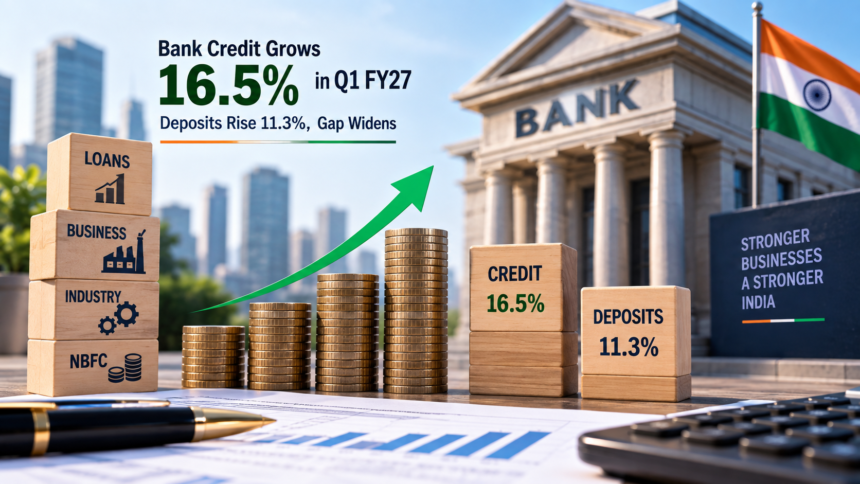
India’s banking sector began FY27 with a sharp rise in credit growth, but deposits failed to keep pace. Bank credit expanded 16.5% year-on-year in Q1 FY27, reaching an eight-quarter high, while deposits increased by 11.3%, according to a CareEdge Ratings assessment reported on September 19, 2026.
The faster growth in lending has widened the gap between credit and deposits. The difference stood at 512 basis points, while the banking system’s loan-to-deposit ratio rose to 83.3%. Credit outstanding reached ₹213.6 lakh crore as of June 30, 2026, compared with deposits of ₹256.5 lakh crore.
Finance-sector lending, including funding to NBFCs, was one of the major contributors to the increase. Industrial and trade credit also recorded strong growth, indicating that businesses are playing a larger role in the current lending cycle.
NBFCs, Industry and Trade Drive Credit Growth
Finance-sector credit grew 22.4%, while industrial credit increased 15.5%. Trade credit also expanded by 18.1%, according to the latest data.
A significant part of the finance-sector increase came from bank lending to NBFCs. NBFC credit reached ₹25.3 lakh crore, with companies and NBFCs shifting more borrowing towards banks while bond yields remained elevated.
Personal loans grew at a slower pace of 12.7%, showing that the latest expansion in bank credit is increasingly being supported by finance, industrial and trade-related borrowing rather than personal lending alone.
| Banking indicator | Q1 FY27 reading |
|---|---|
| Bank credit growth | 16.5% |
| Deposit growth | 11.3% |
| Finance-sector credit growth | 22.4% |
| Industrial credit growth | 15.5% |
| Trade credit growth | 18.1% |
| Loan-to-deposit ratio | 83.3% |
| Credit-deposit growth gap | 512 basis points |
For borrowers, stronger bank credit can improve access to formal financing. However, faster system-wide lending does not automatically mean that every borrower will receive a lower interest rate. Loan pricing continues to depend on factors such as the lender’s funding cost, borrower profile, loan category and repayment record.
Why the Deposit-Credit Gap Matters
The main concern for banks is that loan growth is running significantly faster than deposit growth. With deposits increasing by 11.3% against 16.5% credit growth, banks need to ensure that sufficient funding is available to support continued lending.
The loan-to-deposit ratio reaching 83.3% highlights this pressure. CareEdge noted that the latest high came in June, when seasonal factors would not normally push the ratio higher, indicating that the elevated level reflects an underlying funding gap.
Deposit mobilisation could therefore become increasingly important for banks. If lenders compete more aggressively for household savings, they may use deposit rates and other products to attract funds. Higher funding costs could eventually influence lending rates and the pace at which banks expand their loan books.
For savers, stronger competition for deposits could create more opportunities to compare fixed-deposit rates and other deposit products. However, there is no automatic increase in rates across all banks or tenures.
Credit Growth Was Already Strong in FY26
The stronger lending trend was visible before the start of FY27. According to Finance Ministry data released on May 5, 2026, scheduled commercial banks recorded 15.9% growth in non-food credit during FY2025-26, compared with 10.9% a year earlier.
Industrial credit grew 15% during FY26, while services-sector credit increased 19%. The Finance Ministry said the rise in lending was broad-based, with agriculture, industry, services and personal loans all recording growth.
The earlier trend provides context for the latest Q1 FY27 numbers. Credit demand had already been strengthening across several parts of the economy before bank lending reached the eight-quarter high recorded in June.
For businesses, increased availability of bank finance can support working capital, inventories, supplier payments and other operating requirements. However, borrowers still need to compare the complete cost of a loan, including interest rates, processing fees, prepayment terms and other applicable charges.
Public Sector Banks Also See Strong Credit Growth
Public sector banks recorded 17.3% credit growth in Q1 FY27, compared with 14.8% for private sector banks, according to the CareEdge assessment.
The stronger expansion across banks reflects wider credit demand, but it also increases the importance of maintaining a stable funding base. Banks need sufficient deposits and other funding sources to support additional lending without allowing funding costs to rise sharply.
For ordinary borrowers, the latest figures suggest that formal credit remains active across business and other segments. However, a rise in overall bank credit should not be interpreted as a guarantee of cheaper loans. Borrowers should compare the total repayment cost and terms offered by different lenders before taking a loan.
What the Latest Bank Credit Data Means
The 16.5% growth in bank credit during Q1 FY27 shows that India’s lending cycle has entered a stronger phase. Finance-sector lending, NBFC borrowing, industrial credit and trade finance have all contributed to the expansion.
The slower 11.3% growth in deposits remains the key issue for banks. The wider gap means lenders will need to focus on deposit mobilisation and funding management if strong credit demand continues.
For businesses and individuals, the increase in credit availability can provide more financing options. At the same time, borrowers should continue to compare interest rates and loan conditions rather than assuming that stronger credit growth automatically means cheaper borrowing.
FAQs
What does 16.5% bank credit growth mean?
It means outstanding bank credit was 16.5% higher year-on-year during Q1 FY27. The increase was supported by lending to finance companies, industry, trade and other sectors.
Why is deposit growth important for banks?
Deposits are an important source of funding for bank lending. When loans grow considerably faster than deposits, banks may need to work harder to attract deposits or use other funding sources.
Will faster credit growth automatically make loans cheaper?
No. Loan rates depend on several factors, including funding costs, borrower risk, loan type and the lender’s pricing policy.
Why did NBFC lending increase?
CareEdge reported stronger bank funding to NBFCs, with companies and NBFCs shifting towards bank borrowing while bond yields remained elevated.
Could faster credit growth affect FD rates?
Banks may adjust deposit rates when they need to attract additional funding, but any change depends on the individual bank’s funding requirements and deposit strategy.
Disclaimer: This article is provided solely for general awareness and educational purposes and should not be taken as personalised financial, banking or investment advice. Credit data, interest rates, lending conditions and banking policies can change. Readers should check the latest information with the relevant bank or a qualified financial professional before making borrowing, saving or investment decisions.