
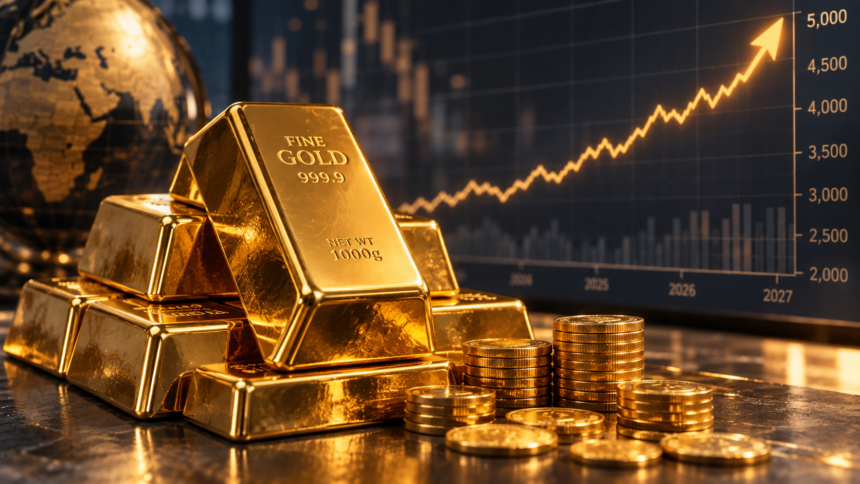
Gold’s strong rally has lost some momentum after a sharp rise in August, but J.P. Morgan remains positive on the precious metal’s medium-term outlook. The bank expects gold prices to reach $4,500 per ounce by the end of 2026 and climb further to $5,000 per ounce by mid-2027.
According to J.P. Morgan strategists, several factors could influence gold’s next major move. These include real interest rates, the direction of the US dollar, continued purchases by central banks and concerns surrounding government debt and fiscal sustainability.
Real Yields and Fed Policy Remain Important
Real yields, which represent interest rates after adjusting for inflation, remain one of the key factors influencing gold prices. Since gold does not provide interest or dividend income, its appeal can change depending on the returns available from interest-bearing investments.
When real yields decline or are expected to remain relatively contained, the opportunity cost of holding gold can fall, potentially supporting demand for the metal.
Expectations surrounding US Federal Reserve policy can therefore have a major impact. Recent signs of weakness in the US labour market have helped limit real yields, while changing expectations about future interest rates have provided support to gold.
The US dollar is another important factor. A weaker dollar can make gold more attractive to buyers and has contributed to the metal’s recent gains. Gold can also rise at the same time as equities when both markets are reacting to different broader economic conditions.
Central Banks Continue to Support Gold Demand
Central-bank purchases have become an important part of the longer-term outlook for gold. Unlike short-term investment flows, central-bank reserve purchases can reflect longer-term efforts to diversify foreign-exchange holdings.
China has been particularly active. The People’s Bank of China purchased 20 tonnes of gold in July, marking its largest monthly purchase since October 2023. The purchase also extended China’s gold-buying streak to 21 consecutive months.
J.P. Morgan’s outlook also takes into account concerns surrounding US government debt and the possibility of currency debasement. The bank’s strategists said momentum-driven buying, weaker labour-market data and renewed concerns over currency debasement have helped push gold above $4,400 per ounce.
August Rally Followed by September Correction
Gold’s recent performance shows that the path toward higher prices may not be steady. Data from the World Gold Council showed that the LBMA Gold Price PM increased 13% in August to reach $4,386 per ounce. It was among the metal’s strongest monthly gains in almost three decades.
Strong investment flows and a weaker US dollar were key factors behind the August rally. However, gold prices have pulled back in September as expectations around Federal Reserve policy changed and global gold ETF flows softened.
According to the World Gold Council, international gold prices declined 3.9% in September, while domestic prices in India fell 4.6%.
India has also seen gold trade below import parity. The discount increased from $34 per ounce in July to $51 in August and reached $78 as of September 11. The World Gold Council attributed the widening discount partly to increased supply through old-gold-for-new-jewellery exchanges, along with unofficial supply.
What Could Determine Gold’s $5,000 Target?
J.P. Morgan’s projection of $5,000 per ounce by mid-2027 will depend on how several key market factors develop. Lower or capped real yields could continue to support gold by reducing the opportunity cost of holding the non-yielding asset. A weaker US dollar could provide another positive factor.
At the same time, continued central-bank accumulation and investment demand could provide structural support. Concerns about rising US government debt and currency debasement could also influence investor demand for gold.
The September correction highlights the volatility that can occur even during a longer-term uptrend. For gold to reach the $5,000 level projected by J.P. Morgan, the interaction between real yields, Federal Reserve policy, the US dollar, central-bank buying and investment flows will remain important.
Disclaimer: This article is for informational purposes only and should not be considered investment advice. Gold prices can change significantly due to interest rates, currency movements, global economic conditions, investor demand and other market factors. Investors should conduct their own research and consider their fina