
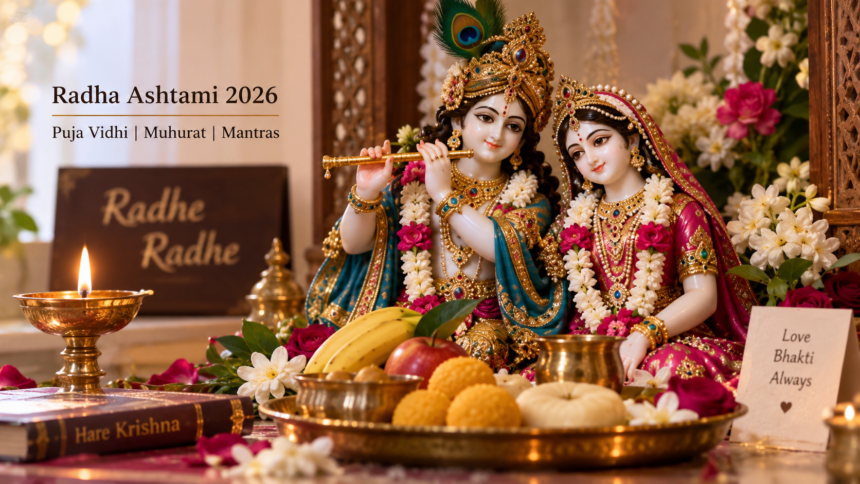
Radha Ashtami 2026 will be observed on Saturday, September 19, marking the appearance day of Shri Radha Rani. For devotees celebrating the occasion at home, the Madhyahna puja is an important part of the observance. Flowers, bhog, naam-japa and aarti are also included in the traditional worship.
Devotees can perform Radha Ashtami puja at home with a simple setup and sincere devotion. Here is the puja vidhi, auspicious timing and some commonly recited Radha-Krishna mantras for the occasion.
Radha Ashtami 2026 Puja Muhurat
The Ashtami Tithi begins on September 18 at 1:00 PM and ends on September 19 at 3:26 PM.
For New Delhi, the Madhyahna Puja Muhurat on September 19 is from 11:01 AM to 1:28 PM. Since the exact puja timing can vary from one location to another, devotees should check their local Panchang before beginning the worship.
Radha Ashtami Puja Vidhi at Home
Radha Ashtami worship does not require an elaborate arrangement. A clean puja space and devotion are considered central to the observance.
Begin the day with a bath and wear clean clothes. Clean the place where the puja will be performed and set up a chowki for the Radha-Krishna idol or image.
Decorate the altar with a clean cloth and fresh flowers. Place Radha Rani along with Shri Krishna and prepare the traditional puja items.
Light a diya and incense before beginning the worship. Those observing a vrat can take their sankalp according to their family tradition or sampradaya.
Next, offer fresh flowers, fruits, sweets and other traditional bhog. Tulsi may be offered according to the devotional tradition being followed.
After making the offerings, devotees can sit peacefully before the deity and begin Radha Rani’s naam-japa or recite a chosen mantra. The puja can be concluded with Radha-Krishna aarti, followed by distribution of prasad.
Traditional vrat practices place Radha Rani’s worship during the Madhyahna period, while fasting rules may differ depending on individual capacity and sampradaya.
Radha Ashtami Mantras to Chant
Devotees do not need to recite several mantras. A single mantra chanted with attention and devotion can be included in the puja.
1. Radha Rani Mantra
Om Hreem Shri Radhikayai Namah
This mantra is addressed to Shri Radhika and can be recited during Radha Ashtami puja or naam-japa.
2. Om Radhayai Namah
Om Radhayai Namah
This is a short mantra for remembering and offering prayers to Radha Rani. Its simple form makes it suitable for repeated naam-japa.
3. Radha Gayatri Mantra
Om Vrishabhanujayai Vidmahe,
Krishnapriyayai Dheemahi,
Tanno Radha Prachodayat.
This devotional prayer invokes Radha as the beloved of Krishna and is traditionally used for meditation.
4. Radha-Krishna Mantra
Om Radha-Krishnabhyam Namah
This mantra invokes Radha and Krishna together and can be included during worship and naam-japa.
5. Radhe Radhe
Radhe Radhe
The simple chant “Radhe Radhe” is closely associated with devotional culture in Braj. Devotees can repeat it during puja, meditation or throughout the day.
How Many Times Should You Chant?
The number of repetitions can be decided according to personal practice. Devotees may choose counts such as 11, 21 or 108 repetitions.
There is no need to force a particular number if it makes the worship feel mechanical. Devotional practices place importance on focused remembrance and sincerity rather than treating mantra repetition as a guaranteed way of achieving a particular result.
Radha Ashtami puja can therefore be kept simple by maintaining a clean altar, offering flowers and bhog, observing the vrat according to one’s tradition, chanting Radha Rani’s name and completing the worship with aarti.
Whether devotees choose Om Hreem Shri Radhikayai Namah, the Radha Gayatri Mantra, Om Radha-Krishnabhyam Namah or simply Radhe Radhe, the central focus of the observance remains remembrance and devotion to Shri Radha and Krishna.
Disclaimer
This article is intended for general informational and devotional purposes. Puja timings, vrat practices and rituals may vary according to location, family traditions, sampradaya and local Panchang. Devotees are advised to follow the practices and timings traditionally observed in their respective families and communities.