
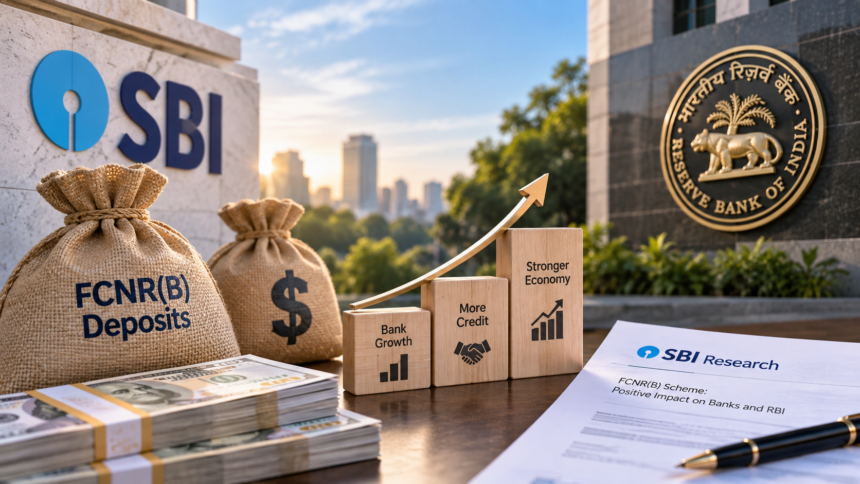
The Reserve Bank of India’s special FCNR(B) deposit scheme could generate a notional profit of around ₹5 trillion for banks over five years, according to an assessment by SBI Research. The report also estimates that the arrangement could potentially add about ₹50,000 crore to the RBI’s balance sheet.
The assessment comes after banks mobilised around $127 billion through the special FCNR(B) swap facility. SBI Research said the funds could support additional bank lending and generate interest income that, on its calculations, would more than cover the interest paid on the deposits.
SBI Research Challenges ₹5 Trillion Loss Estimate
SBI Research has disputed estimates suggesting that the FCNR(B) scheme could result in a cost of around ₹5 trillion. According to the report, such calculations count the impact of the same foreign-exchange exposure more than once.
The report said the ₹5 trillion loss estimate combines roughly ₹1.75 trillion in additional interest costs with about ₹3.18 trillion in foreign-exchange depreciation costs. However, SBI Research argued that the currency exposure on the deposits has already been hedged through the special USD-INR swap facility.
Once the exchange-rate risk on the principal is hedged, the report said, further depreciation of the rupee would not create an additional contractual loss on the principal for either banks or the RBI.
How Banks Could Earn ₹5 Trillion
According to SBI Research, the $127 billion raised through FCNR(B) deposits could support around ₹25 trillion in additional bank credit using a conservative, time-lagged credit multiplier of about 2.5.
At an effective lending yield of around 7.5%, this additional credit could generate approximately ₹1.8 trillion in annual interest income. Against this, banks would have to pay around ₹75,000 crore a year in interest on roughly ₹12 lakh crore of deposits.
This would leave an estimated net interest margin of around ₹1 trillion annually. Over five years, the resulting notional profit could reach approximately ₹5 trillion, according to the report.
RBI Could Also See Additional Earnings
SBI Research estimated the cumulative hedging cost for the $127 billion mobilisation at around $15 billion. Its calculation assumes an average annual USD-INR hedging cost of 3% and considers deposits across one-year, three-year and five-year maturity periods.
For the RBI, the report estimates that investing around $100 billion through globally investible avenues at a 4% yield over five years could generate nearly $20 billion. After accounting for the estimated $15 billion hedging cost, this could leave a surplus of about $5 billion, equivalent to roughly ₹50,000 crore, for the central bank’s balance sheet.
Rupee Depreciation Assumption Under Review
The report also questioned the assumption of a 5% annual depreciation in the rupee used in some estimates of the scheme’s potential losses.
Under a more moderate 3% annual depreciation assumption, SBI Research estimated that the rupee could reach around ₹110 per US dollar by 2030 from around ₹95 currently. Under the 5% depreciation scenario, the exchange rate could instead move towards ₹120–125 per dollar.
SBI Research also said the large liquidity inflow generated through the FCNR(B) mobilisation could gradually be absorbed by festive-season demand, fresh loan sanctions, credit disbursements and government-related outflows such as advance tax and GST payments. The FCNR(B) window mobilised $127.2 billion by August 31, 2026, before the deposit window closed.