
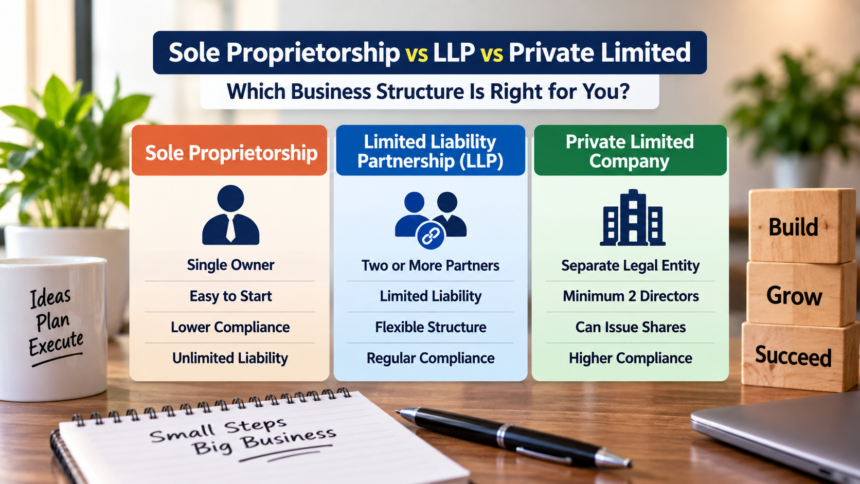
Starting a business requires more than just a good idea and sufficient capital. One of the first decisions an entrepreneur needs to make is choosing the right legal structure for the business.
In India, common options include a sole proprietorship, Limited Liability Partnership (LLP), and private limited company. Each structure has different requirements, levels of liability and compliance obligations. Understanding these differences can help entrepreneurs select a structure that matches their business plans.
What Is a Sole Proprietorship?
A sole proprietorship is a business owned and operated by one individual. The owner has complete control over the business and is directly responsible for its operations.
This structure is commonly used for small shops, freelancers, individual service providers and other businesses operating on a limited scale. One of its main advantages is the relatively simple setup process, with fewer formalities than those generally associated with companies.
Depending on the nature of the business, registrations such as GST, Udyam Registration and Shop & Establishment licences may be required.
However, sole proprietorships come with unlimited liability. This means the owner’s personal assets can potentially be used to meet business debts and liabilities.
What Is an LLP?
A Limited Liability Partnership, or LLP, is designed for businesses operated by two or more partners. The partners can divide responsibilities and manage the business according to the terms agreed upon in their LLP agreement.
LLPs are registered with the Ministry of Corporate Affairs (MCA). Unlike a sole proprietorship, an LLP provides limited liability to its partners, generally restricting their liability to their agreed contribution.
An LLP can therefore be considered by people who want to start a business with partners while also seeking protection from unlimited personal liability. Although its administrative requirements can be lower than those of a private limited company in some respects, LLPs still have regular filing and other legal compliance requirements.
What Is a Private Limited Company?
A private limited company is legally separate from its owners and shareholders. It is registered under the Ministry of Corporate Affairs and has its own distinct legal identity.
A private limited company requires at least two individuals and two directors. The structure also allows the company to issue shares, making it more organised for bringing in investors compared with a sole proprietorship.
Because of this, entrepreneurs planning significant expansion or looking to raise investment may consider a private limited company. However, it also involves greater legal and financial compliance. Requirements can include ROC filings, maintaining proper accounting records and audits where applicable.
How to Choose the Right Business Structure?
There is no single structure that suits every business. The decision generally depends on factors such as the size of the business, level of risk, expected growth, number of people involved and the need for external investment.
For an individual starting a small business and looking for fewer formalities, a sole proprietorship may be considered.
When two or more people are starting a business and limited liability is an important requirement, an LLP may be suitable.
For businesses planning to operate on a larger scale, issue shares or seek investment, a private limited company may be considered. Entrepreneurs should assess their current requirements as well as their future plans before selecting the legal structure.