
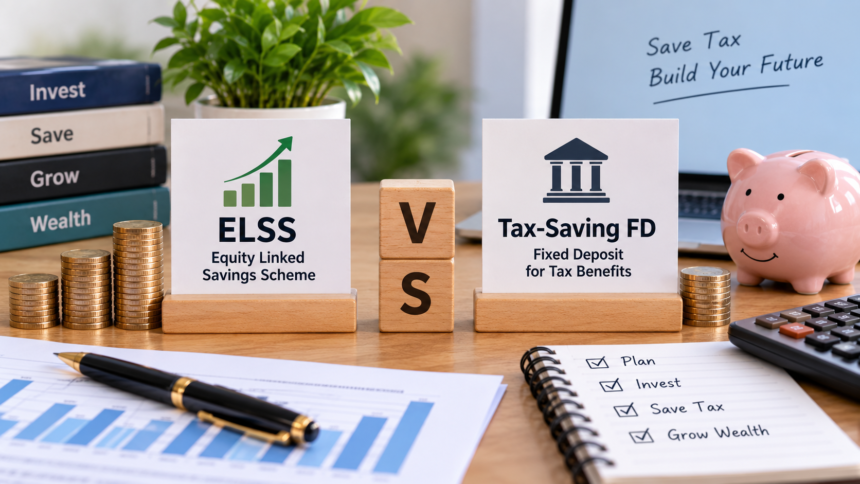
Tax-saving investments are an important part of financial planning for many taxpayers. Investors generally look for options that can provide tax benefits while also helping them grow their savings. Tax-Saving Fixed Deposits (FDs) and Equity Linked Savings Schemes (ELSS) are two widely used options available for this purpose.
Although both investments can provide tax benefits under Section 80C of the Income Tax Act, they differ considerably in terms of taxation, lock-in period, returns, liquidity and risk. Understanding these differences can help investors choose an option according to their financial requirements.
Tax Benefits of Tax-Saving FD and ELSS
Investments of up to ₹1.5 lakh in Tax-Saving FDs and ELSS are eligible for tax benefits under Section 80C of the Income Tax Act.
However, the taxation of returns is different for the two investment options. Interest earned from a Tax-Saving FD is taxable according to the investor’s applicable income tax slab. The provided rules also mention a deduction on interest income, with no tax payable on annual interest earnings of up to ₹10,000 for general investors and up to ₹40,000 for senior citizens.
ELSS, on the other hand, provides equity-linked returns. Gains of up to ₹1 lakh from ELSS investments are tax-free under the provisions stated in the original information. Gains above ₹1 lakh are subject to tax at 10 per cent.
Lock-In Period and Liquidity
The lock-in period is another major difference between Tax-Saving FDs and ELSS. A Tax-Saving FD comes with a mandatory five-year lock-in period. The investment generally cannot be withdrawn during this period if the tax-saving benefit is to be retained.
ELSS has a shorter lock-in period of three years, making it the shortest lock-in option among the Section 80C investment choices mentioned here.
However, the shorter lock-in period does not mean ELSS carries less risk. Since ELSS invests in equities, its value can rise or fall with market movements. Investors therefore cannot know in advance what their investment will be worth when the three-year lock-in ends.
Choose According to Goals and Risk Appetite
The choice between an FD and ELSS depends largely on an investor’s financial goals, investment period and ability to handle market fluctuations.
A Tax-Saving FD may suit investors who prefer predetermined returns and have a specific financial requirement at a fixed point in time. The maturity date and applicable returns are known in advance.
ELSS may be considered by investors with a longer investment horizon who are comfortable with market-linked returns and the possibility of fluctuations. Equity investments can potentially deliver stronger returns over longer periods, although such returns are not guaranteed.
Risk appetite is therefore an important consideration. Investors looking for comparatively lower-risk, fixed-return investments may consider Tax-Saving FDs offered by banks, financial institutions or the Post Office. Those willing to accept higher market risk for the possibility of higher returns may consider ELSS.
Why Portfolio Diversification Matters
Investors should also consider how their existing money is distributed across different asset classes before making a fresh investment.
For example, someone who already has a large portion of their savings in FDs may consider diversifying into ELSS after assessing the associated risks and other factors. Similarly, an investor with substantial exposure to equities or equity-linked investments may consider FDs to add a relatively stable component to the portfolio.
Diversification can help investors avoid putting most of their money into a single investment category.
Understand the Risks Before Investing
ELSS is an equity-based investment, so both the value of the investment and the returns can be affected by stock market movements. There is no guarantee of a particular return after the three-year lock-in period.
Tax-Saving FDs, in comparison, offer fixed returns and generally involve lower risk than equity-linked investments. However, their returns may be lower than the long-term returns that equity investments can potentially generate.
Investors should therefore consider their financial goals, investment horizon, existing portfolio and risk tolerance before choosing between ELSS and a Tax-Saving FD. If there is uncertainty about taxation, risk or the suitability of an investment, consulting a qualified investment advisor can help in making an informed decision.