
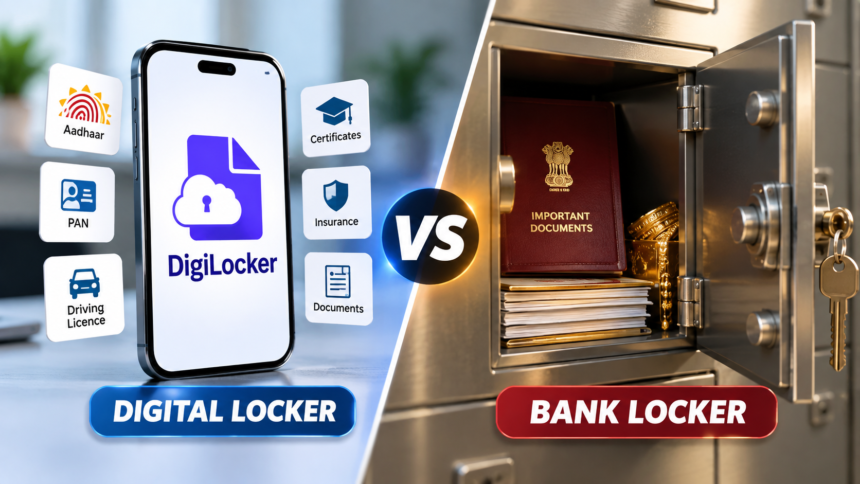
The meaning of a locker has changed significantly in the digital age. Earlier, the term usually referred to the secure metal lockers available inside bank branches, where people stored important papers, jewellery and other valuables.
Today, however, many essential documents are also available in digital form. Aadhaar cards, PAN cards, driving licences, insurance documents and educational certificates can be accessed electronically, reducing the need to carry physical copies everywhere.
This has created a common question among people: Should important documents be kept in a digital locker such as DigiLocker, or should their physical copies be stored in a bank locker?
The answer depends on the type of document, how frequently it is required and whether the original physical copy needs to be preserved.
What Are the Advantages of DigiLocker?
DigiLocker makes it possible to access important documents digitally without carrying physical files around.
One of its biggest benefits is that digital copies are not vulnerable to physical damage in the same way as paper documents. There is no need to worry about papers being torn, misplaced or damaged by incidents such as water leakage or fire.
Another major advantage is accessibility. Once the required documents are available in your DigiLocker account, they can be accessed whenever needed, provided you have the necessary account access and connectivity.
Documents issued through DigiLocker by participating government departments and authorised organisations can also be used for various official purposes. Depending on the document and the organisation accepting it, digitally issued or verified documents can be useful for KYC requirements, employment-related applications and visa or other official processes.
Are There Any Risks With Digital Documents?
Although digital storage removes many risks associated with physical paperwork, it does not eliminate every problem.
The main concern is access to the account. For example, difficulties may arise if you change your registered mobile number, cannot receive an OTP, forget your login credentials or face problems accessing your account when a document is urgently required.
In other words, with a digital locker, the primary concern is generally not physical damage to the document but maintaining secure and reliable access to the account.
DigiLocker vs Bank Locker: What’s the Difference?
DigiLocker and a bank locker are designed for completely different purposes.
A digital locker is primarily about convenient access to electronic documents, whereas a bank locker is intended for physically storing valuable items and original documents.
With DigiLocker, documents can be accessed remotely without visiting a bank branch. However, this convenience depends on factors such as your phone, internet connection and ability to access the account.
A bank locker provides a physical place to protect original documents and other valuables. However, accessing those items may require a visit to the bank and may not be as convenient for documents needed regularly.
Key Differences
| Feature | DigiLocker | Bank Locker |
|---|---|---|
| Storage format | Digital | Physical |
| Accessibility | Can be accessed remotely | Requires physical access |
| Protection | Protects against physical document damage | Protects physical originals and valuables |
| Internet/mobile requirement | Generally required for access | Not required to physically retrieve items |
| Best suited for | Digitally available official documents | Original papers and valuables |
| Convenience | High for everyday use | Better for long-term physical storage |
Where Should You Keep Important Documents?
There is no need to choose only one option. In many cases, using both DigiLocker and a bank locker together can provide better protection and convenience.
Documents that are available digitally and are frequently required can be maintained through DigiLocker. These may include Aadhaar, PAN and other eligible government-issued documents.
Meanwhile, physical originals and documents that need long-term safekeeping can be stored in a bank locker, particularly when losing or damaging the original would create significant difficulty.
What Is the Safest Approach?
The safest strategy is to use the right storage method for the right document.
Keep digitally issued or accessible documents in DigiLocker so that they are readily available whenever required. At the same time, preserve important physical originals in a secure location such as a bank locker when appropriate.
This approach provides both easy digital access and protection for important physical documents.
Ultimately, the biggest risk may not always be the locker itself. Problems can arise when a document is stored in a place that is unsuitable for the way it needs to be used. Some documents are frequently required for online verification, while others may need to be produced in their original physical form.
Therefore, understanding the purpose and usage requirements of each document is the key to deciding whether DigiLocker or a bank locker—or both—is the better option.