
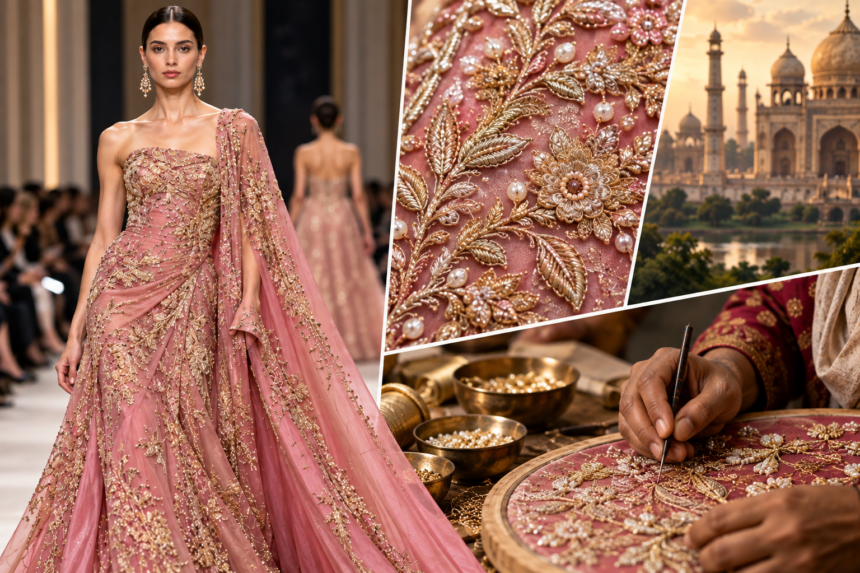
Luxury fashion labels have once again come under scrutiny on social media over the use of traditional Indian craftsmanship. This time, Ralph Lauren is facing criticism after a heavily embellished gown from its latest collection caught the attention of Indian fashion enthusiasts.
While the outfit featured intricate hand-applied embroidery and elaborate embellishments, critics online pointed out its similarities to Zardozi, a traditional Indian embroidery technique. The controversy has largely centred on the absence of any acknowledgement of the craft or the artisans associated with it.
Why Is Ralph Lauren’s Latest Gown Facing Criticism?
The American luxury fashion house presented its Spring 2027 collection during New York Fashion Week, where one particular pink evening gown quickly became a talking point.
The glamorous outfit featured extensive hand-applied embellishments over viscose silk, giving it an elaborate and luxurious appearance. However, social media users and fashion observers noticed similarities between the detailing on the gown and traditional Indian Zardozi embroidery.
The criticism is not necessarily about using an Indian craft technique itself. Instead, the debate focuses on whether the designers should acknowledge the cultural heritage, traditional technique and artisans behind the craftsmanship when incorporating such work into a global luxury collection.
What Is Zardozi Embroidery?
Zardozi, also spelled Zardosi, is a centuries-old metallic embroidery tradition with historical links to Persia. The craft later became closely associated with India, particularly during the Mughal period, when it received royal patronage.
The technique involves intricate decorative work using metallic threads and embellishments to create elaborate patterns on fabrics. It remains an important traditional craft and provides livelihoods to a large number of artisans.
The Lucknow Zardozi craft cluster has also received geographical recognition, with the craft associated with Lucknow and surrounding districts. Thousands of artisans and craftspeople continue to depend on this traditional art form.
Designer Prakhar Rao Singh Chandel Calls Out the Brand
Fashion designer Prakhar Rao Singh Chandel was among the first to publicly raise the issue. In an Instagram post, he highlighted the similarities between Ralph Lauren’s embellishment work and the traditional embroidery associated with Lucknow.
According to his criticism, the concern is not simply that an international fashion house has incorporated a traditional Indian technique. Rather, he questioned why the craft and the communities that have preserved it for generations were not acknowledged.
Chandel also pointed towards the wider network of artisans behind Zardozi and argued that their contribution deserves recognition when the craft is used in high-fashion collections.
‘Whose History and Whose Character?’
The designer’s criticism gained further attention because of a statement attributed to Ralph Lauren about wanting every piece to feel as though it carries its own history and character.
That sentiment prompted Chandel to raise a pointed question: whose history and whose character is being represented when traditional Indian craftsmanship is used without identifying its origins?
The discussion has consequently moved beyond a single garment, raising broader questions about cultural credit, artisan recognition and the relationship between global luxury fashion and traditional crafts.
Ralph Lauren Controversy Revives Debate Over Indian Crafts
The latest controversy also reminded many people of the previous debate surrounding Prada and Kolhapuri chappals, another instance that sparked conversations about the recognition of Indian craftsmanship by international fashion brands.
For critics, the recurring issue is not about preventing global designers from drawing inspiration from Indian crafts. Instead, they believe that traditional techniques should be properly identified and the communities responsible for preserving them should receive visibility and credit.
Chandel summed up his argument with a line that has resonated strongly among social media users:
“Name it when you use it. Not when you get caught.”
The Ralph Lauren controversy has once again highlighted the importance of cultural attribution in fashion and the need to recognise the artisans and traditional communities behind the techniques that inspire global luxury design.