
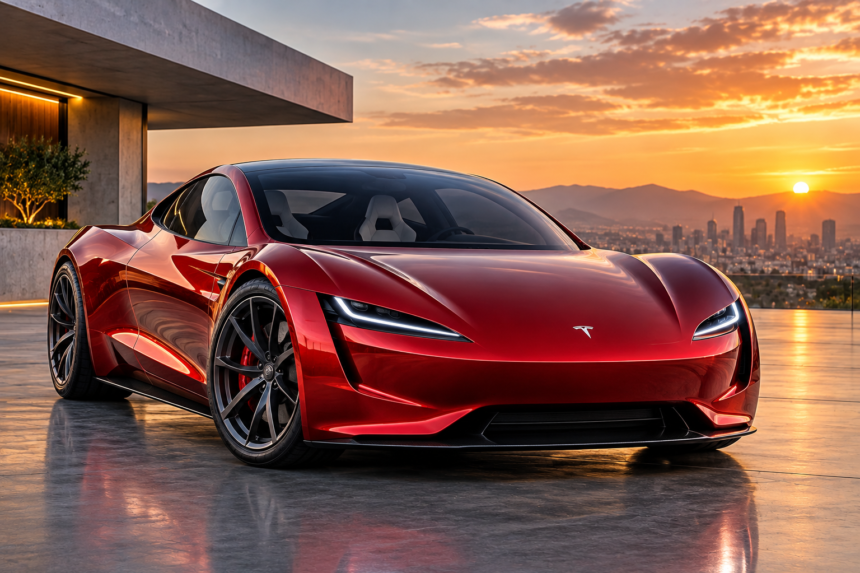
Tesla appears to be preparing to finally unveil its much-awaited second-generation Roadster electric sports car. Elon Musk’s EV company has indicated October 1 as the date for the upcoming reveal through a post on its official X account.
The new Roadster has been in development for almost a decade. Since its first announcement in 2017, Tesla’s all-electric performance car has generated considerable interest because of its ambitious performance claims and futuristic technology.
However, the October 1 event should not necessarily be viewed as the start of customer deliveries. Tesla has yet to confirm the final specifications, production timeline, pricing or delivery schedule for the electric sports car.
Tesla Roadster Reveal Date: What Has Tesla Announced?
Tesla recently posted a brief message on X saying “Go for launch”, accompanied by a graphic displaying “10.01”.
The post is widely understood as a reference to October 1, suggesting that Tesla plans to reveal the next-generation Roadster on that date.
The accompanying graphic has also attracted attention because it appears to reference the cold-gas thruster technology previously discussed for the Roadster. The proposed system has been linked to technology associated with Elon Musk’s SpaceX.
Tesla has not yet explained exactly how such a system would be integrated into a production Roadster or what capabilities it could provide. As a result, the thruster technology remains one of the biggest unanswered questions surrounding the car.
Why Has the Tesla Roadster Taken So Long?
Tesla first introduced the second-generation Roadster in November 2017. At the time, the company positioned the model as an ultra-high-performance electric sports car capable of challenging some of the world’s fastest performance vehicles.
Despite the excitement surrounding the unveiling, the Roadster’s development has encountered multiple delays. The originally expected launch timeline was repeatedly pushed back, leaving prospective customers waiting for further information.
The vehicle’s long development cycle has also been accompanied by a public exchange involving Musk and OpenAI CEO Sam Altman. Altman had previously spoken about waiting for his reserved Roadster, while Musk said that the reservation payment had been refunded.
These episodes have added to the uncertainty around the vehicle’s development and eventual production.
Could the New Roadster Have a Different Design?
One of the biggest questions ahead of the October reveal is whether Tesla will stick with the design shown in 2017.
Reports have suggested that Tesla could be working on a significantly revised or entirely different version of the Roadster compared with the original prototype.
If that is the case, the October 1 vehicle could look substantially different from the sports car displayed nearly nine years ago. Tesla has not released enough official information to determine which elements of the original design will survive.
A major redesign could also affect the car’s engineering, performance targets and manufacturing plans.
Tesla Roadster 2.0 Performance: What Was Promised?
When Tesla unveiled the second-generation Roadster in 2017, it announced some extremely ambitious performance figures.
The company claimed that the electric sports car would be capable of accelerating from 0 to 60 mph in under two seconds.
Tesla also previously claimed a top speed of more than 250 mph and a driving range of over 600 miles on a single charge.
If delivered as originally promised, those figures would put the Roadster among the most extreme performance-oriented electric vehicles.
Original Roadster Price
Tesla had initially announced a starting price of around $200,000 for the standard Roadster, while the Founder’s Edition was priced at $250,000.
However, these figures date back to the original 2017 announcement and should not be treated as the final pricing for the new production model.
Tesla has not yet revealed the updated price of the Roadster.
October Reveal Does Not Mean Immediate Deliveries
Even if Tesla officially unveils the Roadster on October 1, customers should not expect to receive the car immediately.
Elon Musk has previously indicated that production could begin 12 to 18 months after the vehicle’s reveal.
That means potential buyers could still face a significant wait following the unveiling. Tesla will need to provide more clarity regarding manufacturing capacity, production locations, final engineering and delivery plans before a reliable customer timeline can be established.
The company has also yet to confirm whether the production Roadster will match the previously announced performance figures or whether the proposed thruster system will actually make it into the final vehicle.
What to Expect From the October 1 Tesla Roadster Event
The upcoming event could answer several long-standing questions surrounding Tesla’s flagship electric sports car.
Among the details that enthusiasts will be watching closely are:
- Final exterior and interior design
- Acceleration and top-speed figures
- Real-world driving range
- Battery and powertrain specifications
- Production plans
- Expected pricing
- Customer delivery timeline
- Availability of the proposed cold-gas thruster system
- How the new car differs from the 2017 prototype
For Tesla, the October 1 reveal could represent an important milestone for a project that has remained in development for years.
Tesla Roadster 2.0: Key Takeaways
The second-generation Tesla Roadster has been one of the company’s most anticipated vehicles since its 2017 unveiling. While the October 1 announcement suggests that Tesla is finally ready to show its progress, several critical details remain unknown.
The biggest question is whether the production version will deliver the extraordinary performance Tesla originally promised—or whether the long development period has resulted in a substantially revised car.
Until Tesla officially provides specifications, pricing and production information, the original performance figures and delivery expectations should be viewed as previously announced targets rather than confirmed specifications.