
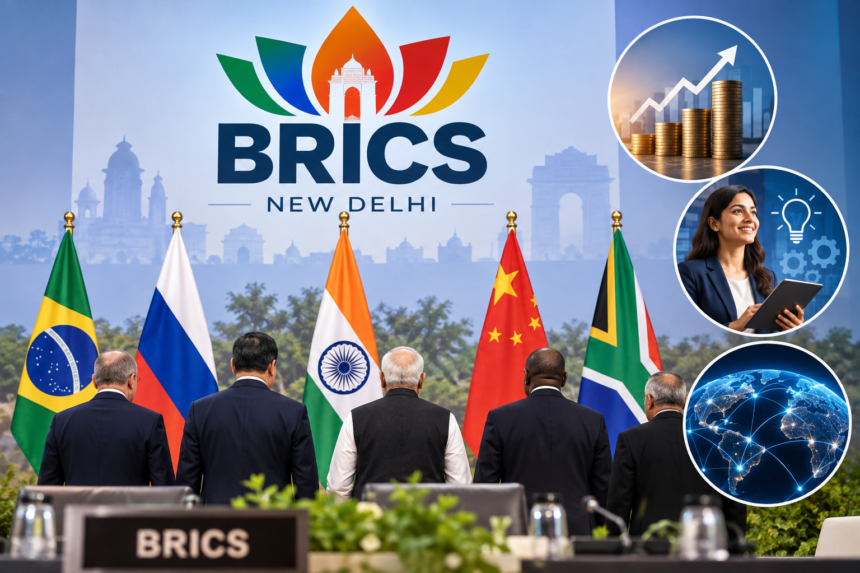
The 18th BRICS Summit in New Delhi has ended with an ambitious roadmap for the expanded bloc, as member countries and partner nations sought common ground on global trade, geopolitical tensions, financial reforms and emerging technologies.
Held under India’s chairship theme, “Building for Resilience, Innovation, Cooperation and Sustainability,” the summit concluded with the unanimous approval of the 140-point New Delhi Declaration.
The agreement reflects BRICS’ growing focus on strengthening the voice of the Global South while responding to challenges ranging from trade restrictions and economic sanctions to terrorism, artificial intelligence and reforms of international institutions.
Here are the five biggest takeaways from the BRICS Summit 2026.
1. BRICS Pushes Back Against Unilateral Tariffs and Sanctions
Trade protectionism emerged as one of the central economic concerns at the summit.
The New Delhi Declaration expressed concern over unilateral tariff and non-tariff measures that are inconsistent with World Trade Organization (WTO) rules. BRICS nations called for a stronger and more predictable global trading system.
Key economic messages included:
- Restore the WTO dispute system: Member states backed the revival of a fully operational and binding two-tier WTO dispute settlement mechanism.
- Opposition to unilateral sanctions: The declaration criticised unilateral and secondary economic sanctions that have not been authorised by the United Nations Security Council.
- Concerns over disguised protectionism: BRICS also opposed protectionist trade measures presented under the guise of environmental policies.
The message from New Delhi was clear: BRICS wants global trade rules to remain transparent, predictable and aligned with multilateral agreements.
2. BRICS Favors Local-Currency Payments Over a Common Currency
Despite continued speculation about a possible BRICS common currency, the summit did not make a unified currency its immediate priority.
Instead, leaders focused on improving the use of national currencies for cross-border trade and payments.
The bloc supported greater cooperation on local-currency settlements, which could help members reduce their reliance on established international payment and clearing systems.
The summit also highlighted the work of the BRICS Payment Task Force, which is examining ways to improve interoperability between domestic payment and financial messaging networks.
The objective is to make international transactions between BRICS economies faster, less expensive and more secure.
3. Stronger Stand Against Terrorism and Cross-Border Militancy
Counter-terrorism emerged as another important area of consensus, with the summit adopting firm language against terrorism and its financing.
A significant development for India was the declaration’s explicit reference to the April 2025 Pahalgam terror attack in Jammu and Kashmir. BRICS leaders condemned the attack and called for accountability for those responsible.
The bloc also reaffirmed its position against terrorism in all forms, stressing the need to prevent:
- Cross-border movement of terrorists
- Safe havens for terrorist organisations
- Terror financing and support networks
For India, the language represented an important diplomatic outcome, particularly on the issue of terrorism originating across borders.
4. BRICS Calls for Reform of the UN, IMF and World Bank
The New Delhi summit also highlighted growing demands from emerging economies for greater representation in global decision-making institutions.
BRICS members backed reforms designed to give developing and emerging economies a stronger voice within major international organisations.
UN Security Council Reform
Russia and China reiterated their support for a larger role for India and Brazil within the United Nations, including permanent representation on the UN Security Council.
IMF and World Bank Changes
BRICS leaders also called for reforms to the International Monetary Fund (IMF) and World Bank.
The proposed changes seek to increase the voting influence and leadership representation of Emerging Markets and Developing Economies (EMDEs).
The push reflects a broader Global South argument that today’s international financial institutions should better reflect the changing balance of the world economy.
5. Common Ground on West Asia and Artificial Intelligence
The summit also attempted to establish a common position on two major global issues: the conflict in West Asia and the rapid development of artificial intelligence.
Call for Gaza Ceasefire
On West Asia, the declaration called for an immediate and sustained ceasefire in Gaza, along with unrestricted humanitarian assistance.
BRICS also backed a two-state solution based on the 1967 borders and stressed the importance of respecting Lebanon’s territorial sovereignty.
The position demonstrated the bloc’s effort to find common diplomatic ground despite differences among individual member states.
A Global South Approach to AI
Artificial intelligence was another major area of focus.
BRICS endorsed an approach that views AI as an important tool for economic and social development across the Global South. At the same time, the bloc stressed the need for AI systems to be trusted, inclusive and energy-efficient.
Leaders also emphasised fair access to technological infrastructure, seeking to ensure that developing economies are not left behind in the global AI race.
BRICS Summit 2026: A Broader Global South Agenda
The New Delhi summit demonstrated how BRICS is attempting to evolve beyond an economic grouping into a broader platform for geopolitical, financial and technological cooperation.
From opposing unilateral trade restrictions and expanding local-currency payments to demanding reforms of global institutions and establishing positions on terrorism, Gaza and AI, the New Delhi Declaration laid out an extensive agenda for the expanded bloc.
The biggest takeaway from the 18th BRICS Summit is perhaps the group’s growing ambition to give emerging economies a stronger collective voice in shaping the rules of the international system.