
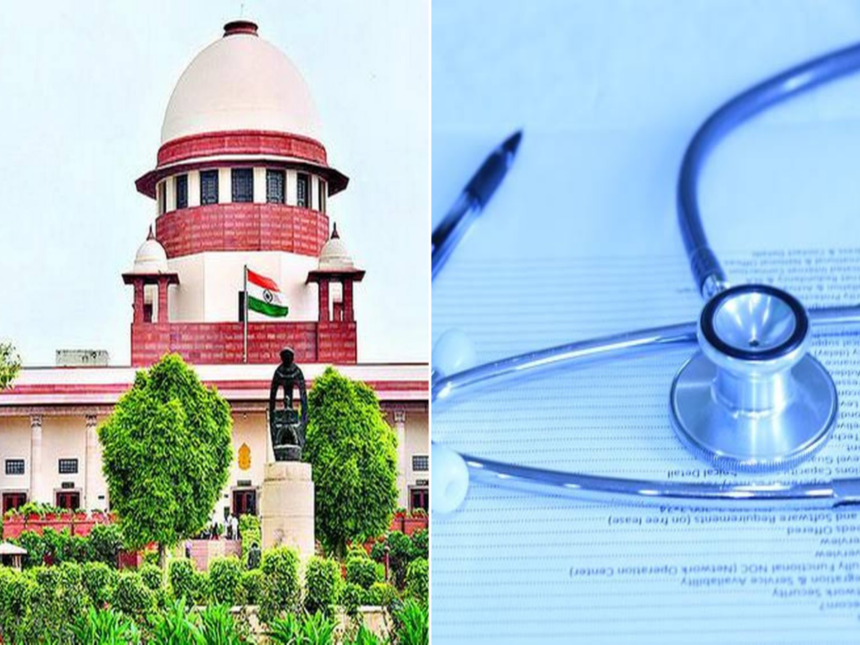
The Supreme Court has asked the Centre to prepare a comprehensive plan to strengthen and institutionalise the National Testing Agency (NTA), with a particular focus on technology, cybersecurity, infrastructure and examination security.
The court’s intervention comes amid continuing concerns over irregularities in high-stakes examinations, including the NEET-UG paper leak controversy, which raised questions about the NTA’s ability to securely conduct exams involving millions of candidates.
A bench comprising Justices PS Narasimha and Alok Aradhe sought details of the measures being taken to implement recommendations made by the K Radhakrishnan committee and the task force headed by Nandan Nilekani. Both panels were constituted to examine ways to improve India’s examination system.
Supreme Court Seeks Permanent Institutional Framework for NTA
During the hearing, the bench stressed that the NTA should develop into a strong and permanent institution instead of adopting temporary solutions whenever an examination-related problem arises.
The court highlighted the need for secure offices, confidential infrastructure, robust cybersecurity systems and dedicated operational divisions. It also referred to recommendations for creating multiple specialised verticals, including testing centres and central network operations.
The judges questioned whether the NTA currently has sufficient infrastructure, trained personnel and technological resources to manage examinations on the scale of NEET-UG.
The court indicated that India needs a professionally equipped examination institution capable of maintaining standards comparable to established bodies such as the Union Public Service Commission (UPSC).
The bench also pointed to the importance of preserving institutional knowledge. Frequent transfers of experienced officials, it observed, can result in valuable expertise being lost.
The Centre has therefore been asked to submit a roadmap covering the NTA’s infrastructure, workforce, technology systems and mechanisms for retaining institutional experience.
Technology to Play a Bigger Role in Examination Security
Technology emerged as another major area of concern during the hearing.
The government has already introduced several security measures for examinations, including GPS monitoring of question-paper transportation, sealed containers and CCTV surveillance. However, the Supreme Court indicated that technology needs to become part of a broader, integrated examination-security framework.
The reforms under consideration include wider adoption of computer-based examinations, technology-assisted supervision and stronger digital security mechanisms covering different stages of the testing process.
The objective is not simply to respond to individual incidents but to create an examination system that is secure by design and capable of handling large-scale tests efficiently.
NEET-UG Controversy Drives Renewed Scrutiny
The Supreme Court’s latest intervention comes after the NEET-UG controversy brought the functioning of the NTA under intense scrutiny.
With millions of students appearing for national-level examinations, even a single security failure can have consequences for a large number of candidates. The court’s focus, therefore, appears to be shifting from addressing individual irregularities to creating a stronger institutional framework for conducting examinations.
A permanent structure, modern technology and better-trained personnel could help improve reliability while reducing the risk of paper leaks and other examination-related disruptions.
RBI MPC Keeps Rate-Hike Option Open Amid Inflation Concerns
In a separate development, the Reserve Bank of India’s Monetary Policy Committee has indicated that interest-rate hikes could still be considered later in the financial year if inflationary pressures become broader and more persistent.
Minutes of the MPC’s August meeting showed that policymakers remain alert to the possibility of rising food, fuel and other input costs feeding into wider inflation and affecting inflation expectations.
The six-member committee, chaired by RBI Governor Sanjay Malhotra, unanimously decided to leave the benchmark repo rate unchanged at 5.25% during its August 3–5 meeting.
However, the discussions reflected increased caution around the inflation outlook. Elevated energy costs, geopolitical developments and weather-related uncertainties were among the factors that could create additional price pressures.
The RBI Governor and MPC members stressed the need to closely monitor whether these risks begin translating into sustained, broad-based inflation. If that happens, monetary policy could potentially turn tighter later in the year.