
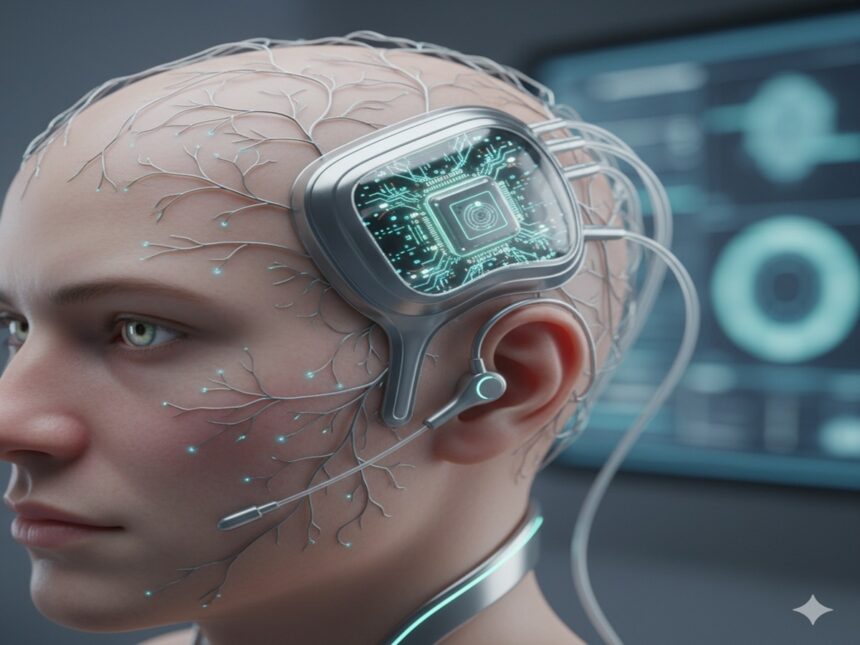
China is exploring a new type of brain-computer interface (BCI) that could potentially be implanted without the need to open a patient’s skull. Instead of conventional brain surgery, the experimental technology uses the body’s blood-vessel network to deliver the implant to the brain.
The approach is being developed by Shanghai-based start-up StairMed Technology in collaboration with researchers from the Chinese Academy of Sciences, according to reports by the South China Morning Post. If successful, the technique could make certain brain implants considerably less invasive and potentially shorten the implantation procedure to around 10 minutes.
However, the technology remains at an early experimental stage and has not yet entered human trials.
How Would the 10-Minute Brain Implant Work?
Unlike conventional implanted BCIs, the proposed Chinese system would not require surgeons to expose the brain by opening the skull.
Instead, doctors would introduce the device through a blood vessel in the neck and carefully guide it through the body’s vascular system towards a specific region of the brain. Once it reaches the intended location, the implant would be positioned and secured against the outside of the blood-vessel wall.
StairMed first revealed the programme in December. So far, researchers have tested the procedure in sheep, but human testing has yet to begin.
Therefore, the widely reported 10-minute implantation time is currently an experimental target, rather than a procedure that is already available to patients.
A Less Invasive Alternative to Traditional BCIs
Most implanted brain-computer interfaces require highly invasive surgery. Surgeons typically need to open the skull and place electrodes either directly into brain tissue or on its surface.
Neuralink, founded by Elon Musk, is one example of a BCI that uses a surgical implant positioned in the brain’s cortex.
The Chinese approach takes a different route. Researchers are attempting to use the body’s existing blood vessels as a pathway to reach the brain, potentially avoiding some of the trauma associated with conventional neurosurgery.
If the technology proves safe and effective, it could make BCI implantation easier and potentially reduce recovery time and surgical risks.
Another Chinese Team Is Testing a Vascular BCI
Researchers at Xuanwu Hospital, affiliated with Beijing’s Capital Medical University, are also investigating a similar concept involving the brain’s venous sinuses.
Chief physician Duan Wanru said his team has already begun its first human clinical study.
Duan said that a surgeon with several years of experience could potentially position the device in approximately 10 minutes. He also reported that no major safety concerns had emerged so far and suggested that the implant could potentially be removed within a month of implantation.
Separately, Nankai University reported completing what it described as the world’s first human trial of a blood-vessel-delivered BCI last year.
These developments are part of China’s broader push to establish itself as a major player in the rapidly developing field of neurotechnology.
China Wants a Strong Domestic BCI Industry
China is investing heavily in brain-computer interface research and development.
Beijing has reportedly set a goal of developing two or three internationally competitive BCI companies by 2030, signalling the government’s ambition to build a large domestic neurotechnology industry.
StairMed has already attracted substantial financial backing. The company says it raised more than 1.1 billion yuan over the past year, with major investors including Alibaba and Tencent.
What Can a Brain-Computer Interface Do?
BCIs are designed to detect electrical activity generated by the brain and translate those signals into commands that computers or other electronic devices can understand.
The technology could eventually have major applications for people with severe paralysis or neurological disabilities.
For example, a patient could potentially use brain signals to:
- Communicate without physically speaking or typing
- Control computers and other electronic devices
- Operate assistive technologies
- Interact with digital platforms
- Regain some degree of independence
StairMed co-founder Zhao Zhengtuo has suggested that the technology could eventually help people with paralysis achieve a level of independence closer to that enjoyed by people without disabilities.
Early Trial Shows Potential
StairMed has already demonstrated one possible application of its BCI technology.
In an earlier trial involving a surgically implanted BCI, a patient reportedly used the system to perform work related to China’s e-commerce platform JD.com, earning approximately 1,800 yuan per month.
While such demonstrations are promising, they do not yet establish that vascular BCIs can safely deliver the same results over long periods.
The Technology Still Faces Major Challenges
Despite the excitement surrounding less invasive brain implants, significant questions remain.
Animal experiments cannot determine whether a device will perform safely and reliably in humans over many years. Human clinical trials will need to establish whether doctors can consistently guide the implant to the correct location, keep it securely positioned and obtain useful brain signals without causing serious complications.
Long-term safety is particularly important because blood vessels are delicate structures, and any implant placed within or alongside the vascular system could potentially create medical risks.
China Isn’t Alone in Exploring Blood-Vessel BCIs
The concept of reaching the brain through blood vessels is not exclusive to Chinese researchers.
US-based Synchron has also developed a BCI designed for delivery through the jugular vein and has tested the technology in patients in Australia and the United States.
The growing interest in vascular implantation reflects a broader goal within the BCI industry: finding ways to make brain-computer technology less invasive, easier to implant and more accessible.
For now, however, China’s 10-minute brain implant remains an experimental concept. Its real potential will depend on the results of human trials and, most importantly, whether researchers can demonstrate long-term safety, stability and reliable brain-signal detection.