
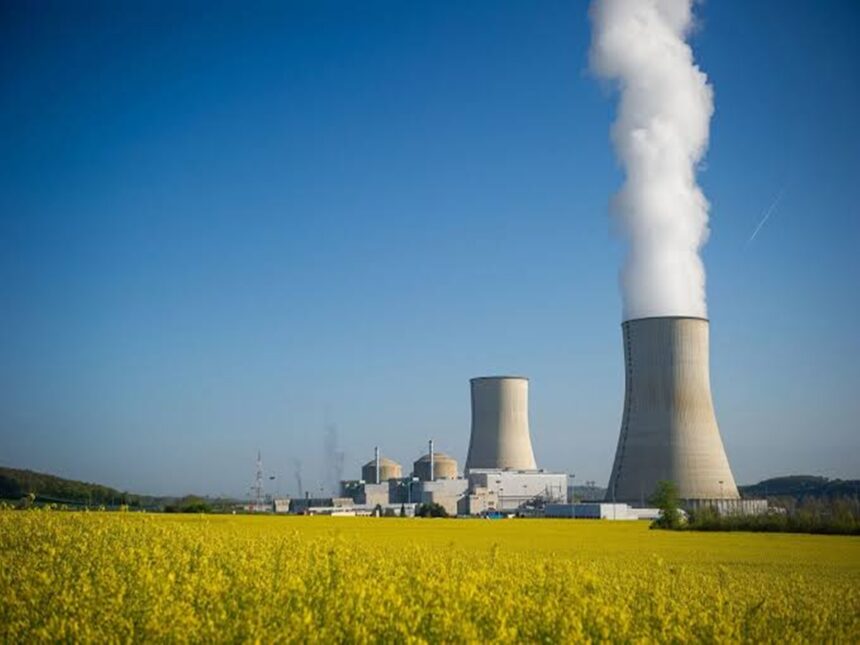
India Nuclear Energy: As India prepares to expand its nuclear power capacity to meet growing electricity demand and reduce carbon emissions, an important question is gaining attention: what happens to the radioactive waste produced by nuclear reactors?
Unlike conventional waste from coal-fired power stations, radioactive material cannot simply be discarded. It must be carefully segregated, treated, monitored and disposed of through regulated systems to protect people and the environment.
Much of this work takes place away from public attention. However, the government has recently provided details in Parliament about how India handles this largely invisible part of its nuclear energy programme.
According to information provided by the Department of Atomic Energy (DAE), Indian nuclear power plants generate approximately 0.15 cubic metres of radioactive solid waste per MW of installed capacity every year. The estimate includes waste generated during the operating period of a plant as well as during its eventual decommissioning.
For perspective, 0.15 cubic metres is equivalent to around 150 litres, or roughly the capacity of one and a half standard household bathtubs. The figure is calculated annually for every MW of generating capacity.
The DAE has also stated that information regarding the quantity and location of radioactive waste disposal is regularly submitted to the Atomic Energy Regulatory Board (AERB), India’s nuclear safety regulator.
As the country plans a larger role for nuclear energy, the question of waste management is likely to become increasingly important alongside reactor construction and electricity generation.
Not All Radioactive Waste Has the Same Risk
Radioactive waste is produced throughout the operation and maintenance of nuclear facilities. It can include contaminated filters, protective clothing, tools, equipment and other materials that come into contact with radioactive substances.
Additional waste is generated when a reactor reaches the end of its operating life and is dismantled during the decommissioning process.
However, radioactive waste is not a single category with the same level of danger. Different materials contain different amounts of radioactivity and therefore require different treatment and disposal methods.
Waste with higher radioactivity is subject to more stringent controls and requires longer-term management, while lower-level radioactive material can be handled through less intensive processes.
According to the government’s parliamentary response, radioactive waste generated by nuclear plants is broadly classified into three categories: gaseous, liquid and solid. Each category goes through a different management process.
How Is Radioactive Waste Treated in India?
Radioactive waste is not simply discarded immediately after being generated.
Instead, it first undergoes treatment based on its physical characteristics and level of radioactivity. Only after appropriate processing can it be considered for disposal.
Gaseous Waste
Gaseous radioactive waste is treated at its source before it is released. Any release must remain within limits established by nuclear safety regulations.
Liquid Waste
Liquid radioactive waste is processed using established purification techniques. The treatment method depends on the characteristics and radioactive content of the material.
Solid Waste
Solid radioactive waste is segregated according to its characteristics and undergoes processes designed to reduce its volume before disposal.
The government has emphasised that radioactive waste cannot be released into the environment unless it has been cleared, exempted or excluded from regulatory control under the applicable rules.
Facilities generating radioactive waste must obtain authorisation from the AERB. Such authorisations establish permissible discharge limits and specify approved disposal or release routes.
Where Is Solid Radioactive Waste Disposed Of?
For solid radioactive material, India uses specially designed disposal facilities located within controlled-access areas.
These can include stone-lined trenches, reinforced concrete trenches and tile-hole systems. The facilities are designed around a multi-barrier approach, in which several protective layers work together to prevent radioactive material from migrating into the surrounding environment.
The disposal areas are also subject to ongoing surveillance.
Monitoring systems, including bore wells around disposal facilities, are used to check the surrounding environment and detect any potential movement of radioactive material.
India, US and Finland Follow Different Nuclear Waste Strategies
India is not alone in dealing with the long-term challenge of radioactive waste. Countries with established nuclear industries have developed different approaches based on their reactor technologies, fuel cycles and national policies.
India, the United States and Finland all rely on regulation, monitoring and multiple safety barriers. However, their approaches to spent nuclear fuel differ significantly.
Spent nuclear fuel is the highly radioactive fuel removed from a reactor after it has been used. How countries deal with this material is one of the biggest differences between their nuclear waste strategies.
India Uses a Closed Fuel Cycle
India follows a closed nuclear fuel cycle. Under this approach, spent nuclear fuel is not automatically regarded as waste.
Instead, it is stored under regulatory supervision and subsequently reprocessed to recover potentially reusable materials such as uranium and plutonium.
The high-level radioactive material that remains after reprocessing requires long-term management. Reprocessing therefore plays an important role in India’s broader nuclear energy strategy.
The US Primarily Uses a Once-Through Approach
The United States largely follows a once-through fuel cycle for its commercial nuclear reactors.
Used nuclear fuel is generally stored at reactor locations. Initially, it is kept in water-filled pools to cool the fuel. It can later be transferred to heavily shielded dry-storage casks.
The US continues to rely on this interim storage approach while seeking a long-term permanent disposal solution.
Finland Is Building a Deep Underground Repository
Finland has taken a different approach by developing a permanent underground repository for spent nuclear fuel.
The facility, known as Onkalo, is located roughly 430 metres underground beneath the Olkiluoto area in stable bedrock.
The planned disposal system uses several protective barriers. Spent fuel will be enclosed in corrosion-resistant copper canisters, surrounded by bentonite clay and placed deep underground.
The combination of engineered and geological barriers is intended to isolate radioactive material from people and the environment over extremely long periods.
Although India, the US and Finland have adopted different strategies, their fundamental objective remains the same: keeping radioactive material safely contained and preventing harmful exposure.
Why Radioactive Waste Management Matters for India
The importance of nuclear waste management is expected to increase as India expands its nuclear energy programme.
Nuclear reactors produce electricity without direct carbon dioxide emissions during normal operation, making nuclear power an important part of discussions around low-carbon energy. But operating reactors also requires a comprehensive system for managing radioactive material throughout the plant’s entire lifecycle.
That includes collection, segregation, treatment, storage, monitoring, disposal and, where applicable, reprocessing.
India already has a regulatory framework governing radioactive waste management. The Safe Disposal of Radioactive Wastes Rules, 1987, require facilities that generate radioactive waste to obtain regulatory authorisation and follow procedures established by the AERB.
Nuclear Expansion Will Also Test Waste Management Systems
India does not have to build its radioactive waste management system from the ground up. Regulatory institutions, disposal facilities and established treatment practices already exist.
However, a significant expansion of nuclear power will increase the amount of radioactive material that must be managed over time.
For the public, radioactive waste may remain largely invisible. But as India increases its reliance on nuclear energy, the ability to safely handle the industry’s most enduring by-product will become just as important as building new reactors.
The success of India’s nuclear expansion will therefore depend not only on producing more low-carbon electricity, but also on maintaining strong safety standards and public confidence in the long-term management of radioactive waste.