
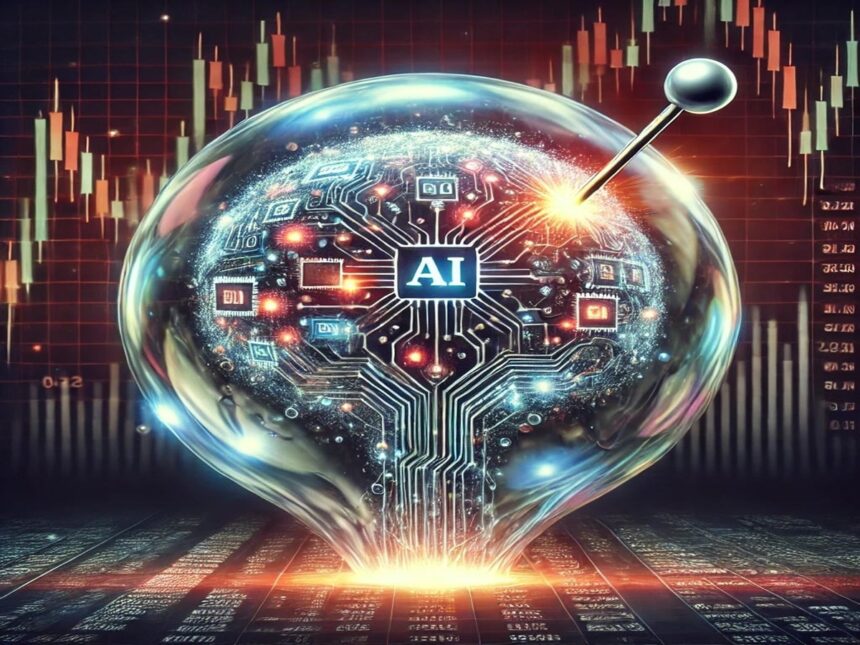
As investment in artificial intelligence reaches unprecedented levels, concerns about a potential AI bubble are becoming louder. Renowned investor Michael Burry, economist Dean Baker, and JPMorgan Chase CEO Jamie Dimon have all cautioned that the rapid surge in AI spending may not be sustainable.
Yet inside Silicon Valley, many investors see the situation differently. Instead of fearing an AI bubble, they argue that periods of excessive enthusiasm have historically played a crucial role in accelerating technological breakthroughs and building the infrastructure needed for future innovation.
Why Venture Capitalists Aren’t Afraid of an AI Bubble
For venture capital firms, high-risk investments are part of the business. Many believe that groundbreaking technologies rarely emerge without periods of intense investor excitement and aggressive funding.
According to Tomasz Tunguz, investor at Theory Ventures, technology revolutions often go hand in hand with speculative investment cycles. While some capital may eventually be lost, these investment waves help create the infrastructure and ecosystems that power future industries.
Similarly, Samir Kumar of Touring Capital believes transformational technologies would struggle to gain momentum if funding decisions were based only on cautious, rational investment strategies. He argues that although bubbles can create short-term excesses, they often deliver long-term economic and technological benefits.
AI Investment Is Reaching Record Levels
The optimism surrounding artificial intelligence is reflected in the enormous amounts of money flowing into the sector.
This week alone, reports indicated that OpenAI and Nvidia were nearing a massive $500 billion data center project in Ohio. Meanwhile, Amazon, Google, Meta, and Microsoft collectively invested $170 billion in capital expenditure during the second quarter, representing a 72% increase compared to the previous year.
Private investment is also accelerating rapidly. According to PitchBook, venture capital funding reached $413 billion during the first half of the year, already surpassing the total investments made throughout 2025.
Investor enthusiasm has become so intense that several startups with little or no commercial revenue are being valued in the tens of billions of dollars. In some cases, companies without a launched product have achieved valuations exceeding $30 billion.
The surge in wealth has even created unexpected side effects, including increased demand for luxury homes around San Francisco.
Why Investors Believe AI Growth Justifies the Spending
Unlike previous technology booms driven largely by expectations, today’s AI leaders are already generating extraordinary revenues.
OpenAI, currently valued at approximately $730 billion, is reportedly generating around $2 billion in monthly revenue.
Anthropic, valued at nearly $900 billion, is producing close to $4 billion every month.
At the same time, companies like Google and Meta say their AI models are already being used by hundreds of millions of people worldwide, reinforcing investor confidence that demand for artificial intelligence will continue expanding.
According to Susa Ventures investor Pratyush Buddiga, venture capital firms thrive during major technological shifts because these periods create opportunities capable of delivering exceptional long-term returns.
History Shows Bubbles Can Create Lasting Innovation
Financial historian William Quinn, co-author of Boom and Bust: A Global History of Financial Bubbles, believes that speculative investment cycles often leave behind valuable infrastructure even after markets cool.
He points out that many ideas once dismissed as unrealistic in Silicon Valley eventually transformed entire industries.
Although bubbles eventually burst, Quinn says they often last much longer than critics expect. Investors who stay on the sidelines waiting for a crash can miss years of exceptional gains before markets finally correct.
This explains why predictions of imminent bubbles frequently prove premature.
The Dot-Com Crash Still Shapes Silicon Valley Thinking
Many experienced investors continue to draw lessons from the dot-com bubble of the early 2000s.
Following the collapse, startup funding nearly disappeared for several years, making it extremely difficult for new businesses to survive.
However, companies that endured—including Amazon, PayPal, and eBay—grew into some of the world’s largest technology firms.
The boom also resulted in massive investments in fiber-optic infrastructure, much of which later enabled the rapid expansion of internet services and companies like Facebook.
For many venture capitalists, this demonstrates that even failed investment booms can create foundations for future economic growth.
Previous Tech Bubbles Didn’t End in Disaster
Since the dot-com era, Silicon Valley has experienced several investment waves that many believed would end badly.
These included:
- Mobile app startups with little or no revenue
- Billion-dollar “unicorn” companies
- Cryptocurrency investment mania
- The aggressive startup funding cycle of 2021
While many individual companies failed, none of these periods triggered a collapse comparable to the dot-com crash.
Charles Hudson of Precursor Ventures says one of the biggest lessons from 2021 was that investors who avoided the market entirely often missed valuable opportunities.
Instead of stepping away from AI, Hudson has chosen to focus on early-stage software companies building AI-powered applications.
He believes ignoring artificial intelligence altogether would be a risky strategy given the scale of the technological transformation underway.
Success in AI Won’t Necessarily Go to the First Movers
Battery Ventures investor Sudheendra Chilappagari says history suggests that today’s market leaders are not guaranteed to dominate forever.
He points to the early internet search wars, where companies like Infoseek were eventually overtaken by Yahoo, which was later surpassed by Google.
The AI industry, he argues, will likely experience multiple waves of innovation, creating fresh investment opportunities over many years rather than producing a single dominant winner.
Risks Could Still Trigger an AI Market Correction
Despite their optimism, investors acknowledge that significant risks remain.
Several factors could cool enthusiasm for artificial intelligence, including:
- Rising geopolitical tensions
- Competition from low-cost open-source AI models
- Regulatory pressure
- Public opposition to expanding AI infrastructure
- Safety and cybersecurity concerns
- Delays in generating returns on massive AI investments
These uncertainties mean investors must balance optimism with caution rather than assuming the current boom will continue indefinitely.
Venture Capital Is Becoming More High-Stakes Than Ever
According to Gradient Ventures investor Darian Shirazi, venture capital has become increasingly unpredictable during the AI era.
Traditionally, firms hoped one successful investment would eventually generate returns of $1 billion or $2 billion.
Today, AI startups have the potential to achieve valuations exceeding $50 billion, dramatically increasing both the rewards and the risks.
As Shirazi explains, if an investment succeeds in today’s AI market, the payoff could surpass anything venture capitalists have experienced before.
The Bottom Line
While concerns over an AI bubble continue to grow, many investors in Silicon Valley see today’s surge in funding as an essential part of technological progress rather than a warning sign.
History suggests that speculative investment cycles often leave behind valuable infrastructure, breakthrough innovations, and industry-defining companies—even if some businesses fail along the way.
Whether artificial intelligence ultimately becomes another market bubble or the foundation of the next technological revolution remains uncertain. But for many venture capitalists, the potential rewards are simply too significant to ignore.