
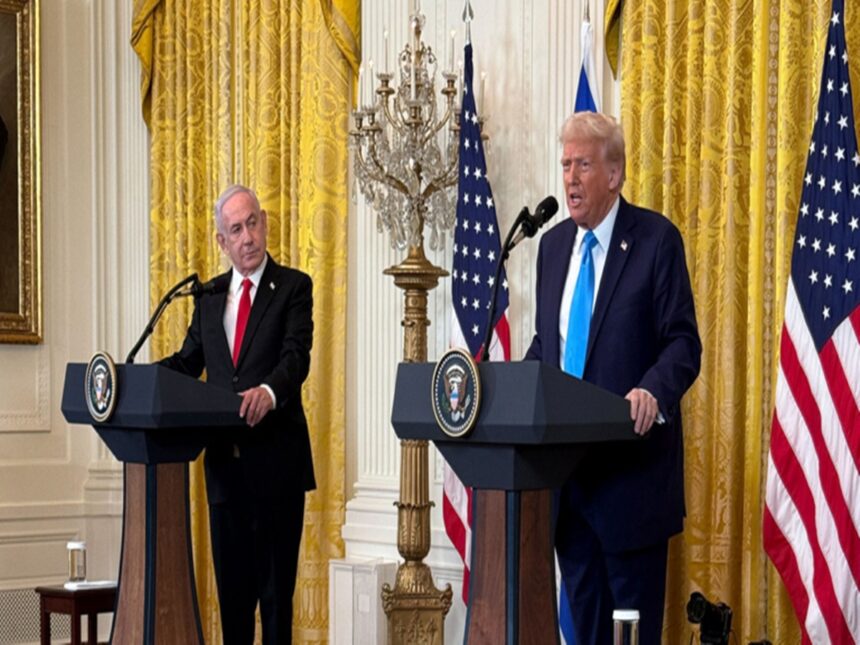
US President Donald Trump has announced what he described as a “historic” agreement under which Hamas would fully disarm and hand over governance of Gaza to a newly formed Palestinian technocratic administration. If successfully implemented, the proposal could mark one of the most significant diplomatic developments since the Israel-Hamas conflict began and lay the groundwork for Gaza’s long-term reconstruction.
However, the agreement is far from complete. According to reports, the roadmap requires phased implementation, reciprocal commitments from both Israel and Hamas, and independent verification before each stage can move forward.
Trump Announces ‘Historic’ Hamas Disarmament Deal
President Donald Trump revealed the development through a post on Truth Social, claiming that Hamas and other armed factions in Gaza had agreed to surrender their weapons.
Describing it as a breakthrough, Trump called the agreement a major step toward achieving lasting peace and security in the region.
US officials said the understanding followed months of sensitive negotiations involving mediators from Qatar, Egypt and Turkey, with implementation expected to begin in the coming weeks if all parties fulfil their commitments.
What Will Change Under The Proposed Agreement?
A key feature of the plan is that Hamas would no longer govern Gaza.
Instead, civilian administration and security responsibilities would be transferred to a newly proposed National Committee for the Administration of Gaza (NCAG), an independent technocratic body.
Unlike Hamas or the Palestinian Authority, the NCAG would focus on governance, public services and maintaining law and order, while operating under the principle of a single government, one legal framework and one recognised security authority across Gaza.
US officials say the new administration is intended to prioritise the welfare of Gaza’s civilians rather than political or military objectives.
How Will Hamas Disarm?
The proposed disarmament process is expected to take around 200 to 250 days and will be carried out in multiple phases.
The roadmap includes:
- Hamas police transferring their weapons to a newly formed Palestinian police force.
- Heavy weapons being decommissioned and placed in secure storage.
- Destruction of tunnels and weapons manufacturing facilities.
- Collection of small arms under Palestinian legal supervision.
- Other armed groups operating in Gaza also surrendering their weapons.
Each phase will only move forward after international monitors verify that agreed conditions have been fulfilled.
Once the process is complete, the new Palestinian administration and its police force would hold exclusive authority over all weapons inside Gaza.
International Force To Oversee Security Transition
The proposal also includes the deployment of an International Stabilisation Force.
Its responsibilities would include:
- Training the new Palestinian police force.
- Supervising weapons collection.
- Monitoring the transfer of authority.
- Acting as a security buffer between Israeli forces and Palestinian-controlled areas.
Officials involved in drafting the framework said the agreement follows a “zero trust” model because neither Hamas nor Israel fully trusts the other. Every phase will therefore require independent verification before progressing.
Israel’s Withdrawal Linked To Hamas Disarmament
The agreement proposes a gradual Israeli military withdrawal that would occur alongside Hamas’ verified disarmament.
As security responsibilities shift to the new Palestinian administration and the international force, Israel would progressively reduce its military presence in Gaza.
The proposal also calls for Israel to halt military operations and targeted strikes except in situations involving immediate security threats.
US officials said Washington coordinated closely with Israel during negotiations and expects all parties to honour the agreed commitments.
Hamas Signals It Still Has Reservations
Despite Trump’s announcement, Hamas indicated that important disagreements remain.
Senior Hamas official Ghazi Hamad acknowledged that negotiations had produced an agreement but insisted that the organisation would not begin disarming until Israeli forces withdrew from Gaza.
He also stated that any weapons handover would be supervised by the proposed technocratic administration rather than Israel.
These comments suggest differences remain over the timeline and sequencing of the agreement, even though negotiations have made significant progress.
Regional Mediation Played A Crucial Role
Diplomatic sources said Egypt, Qatar and Turkey played a central role in bringing the negotiations to this stage.
Egyptian intelligence officials reportedly led much of the mediation process, while multiple regional stakeholders worked to bridge differences between the parties.
US officials also claimed that although Iran encouraged Hamas to reject the proposal, the group ultimately chose to continue negotiations.
What The Agreement Could Mean For Gaza
If implemented successfully, the proposal would end Hamas’ control of Gaza for the first time since it took power in 2007.
The territory would instead be governed by a technocratic administration supported by international oversight, while reconstruction efforts and civilian governance move forward under a demilitarised framework.
Although the announcement represents a significant diplomatic milestone, the agreement still faces major political and security challenges before it can become a reality. Its success will ultimately depend on both sides fulfilling their commitments during the lengthy, carefully monitored implementation process.