
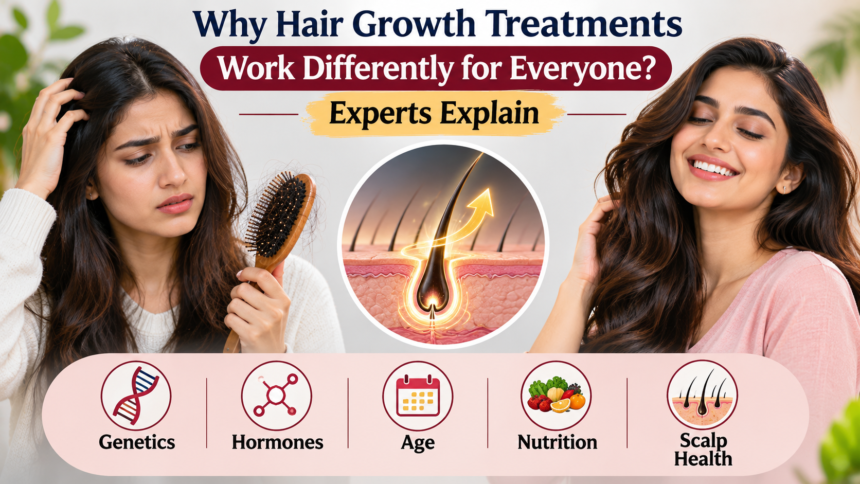
Have you ever wondered why a hair growth treatment delivers good results for someone else but makes little or no difference to your hair? The reason lies in the fact that hair growth is influenced by several biological factors, and every individual responds differently to treatment.
According to Dr. Rinky Kapoor, Clinician-Scientist & Research Mentor, hair regeneration is a complex biological process. Genetics, hormonal changes, age, nutritional status and scalp health all play an important role in determining how effectively a hair growth treatment works. This explains why the same treatment may produce different results in different people.
Why Do Hair Growth Treatments Produce Different Results?
Hair loss can occur for several reasons, including genetic factors, nutritional deficiencies and temporary hair-related conditions. Since the underlying cause varies from person to person, the treatment approach also needs to be different.
The condition of hair follicles, their stage in the growth cycle and the surrounding tissue environment can influence how the hair responds to a particular treatment. As a result, two people following the same hair growth routine may experience completely different outcomes.
Understanding the reason behind hair loss is therefore important before choosing a suitable treatment.
Does Increasing Growth Factors Lead to Better Hair Growth?
Researchers are increasingly examining how biological signalling pathways influence hair regeneration. A scientific commentary titled “Beyond Growth Factor Abundance: Why Hair Regeneration Needs Pathway-Oriented Design?”, published in Stem Cell Reviews and Reports, explores why increasing the concentration of growth factors alone may not be sufficient to improve hair regeneration.
The commentary was co-authored by Monalisha Debnath, Rinky Kapoor, Raji Patil, Varad Saptarshi and Debraj Shome.
Growth factors are chemical messengers that help cells communicate and regulate various biological activities. However, hair follicles respond to multiple signals simultaneously. Their response depends on several conditions, including the availability of receptors, the stage of the hair growth cycle, the surrounding tissue environment and the interaction between different signalling pathways.
This could also explain why treatments such as platelet-rich plasma (PRP) do not deliver consistent results for everyone. PRP-based treatments involve using growth factors to support tissue repair and regeneration. However, variations in preparation techniques and the level of growth-factor exposure can influence treatment outcomes.
The commentary suggests that the quantity of growth factors may not be the only factor responsible for these differences. The way hair follicles receive, process and respond to biological signals may also play an important role.
Why Is Personalised Hair Loss Treatment Important?
There is no single treatment that works for every type of hair loss. A dermatologist needs to examine the pattern of hair thinning, assess scalp health and identify the underlying cause before recommending an appropriate treatment.
The scientific commentary also highlights a pathway-oriented approach as a potential direction for future hair-regeneration therapies. Instead of simply increasing the amount of growth factors, researchers are exploring which biological pathways need to be activated, which cells should receive the signals and when the signals should be delivered.
It also discusses the possible use of advanced delivery systems, including hydrogels, scaffolds and engineered extracellular vesicles. These technologies could help regulate the location and timing of biological signal release. However, these approaches remain proposed directions for future research and are not established hair-loss treatments.
What Should You Keep in Mind Before Trying Hair Growth Treatments?
A treatment that works for a friend or family member may not necessarily produce the same results for you. Persistent hair fall or thinning should be evaluated individually rather than treated based on someone else’s experience.
Identifying the factors affecting your hair follicles and selecting treatment according to your specific condition are important steps towards managing hair loss.
Future research into hair regeneration may focus less on delivering higher quantities of growth factors and more on understanding which biological signals hair follicles need, how they respond to them and when those signals should be activated.