
India is home to countless historical landmarks, beautiful landscapes and culturally rich destinations. While popular tourist attractions continue to draw large crowds, several remarkable places across the country offer equally memorable experiences away from the usual travel routes.
From ancient architectural wonders and sacred temples to peaceful valleys and historic fortresses, these destinations reveal different sides of India’s heritage and natural beauty. Whether you enjoy exploring history, experiencing local traditions or discovering scenic landscapes, these nine destinations deserve a place on your travel bucket list.
Ancient Architectural Wonders and Historical Landmarks
1. Chand Baori, Rajasthan
Located in Abhaneri, Rajasthan, Chand Baori is one of the world’s largest and deepest stepwells. Built during the 9th century, this remarkable structure reflects the advanced water conservation techniques used in ancient India.
Associated with King Chand Raja, the stepwell extends more than 98 feet below ground level, with each storey descending approximately 12 feet. Its impressive geometric design and symmetrical steps make it an extraordinary example of traditional Indian architecture.
Beyond its visual appeal, Chand Baori served an important purpose in daily life. During periods of limited rainfall, stepwells provided communities with access to stored water. The structure highlights how architecture and practical needs were closely connected in ancient Indian society.
2. Ellora Caves, Maharashtra
The Ellora Caves in Maharashtra offer visitors an opportunity to explore India’s religious and architectural heritage. Recognised as a UNESCO World Heritage Site, the complex is known for its remarkable rock-cut temples and monasteries.
The site features 34 major cave monuments representing Hinduism, Buddhism and Jainism. Their presence within the same complex reflects the religious and cultural diversity of ancient India.
The intricate carvings, detailed sculptures and impressive architectural techniques make Ellora an important destination for history enthusiasts and travellers interested in India’s artistic traditions.
3. Hampi, Karnataka
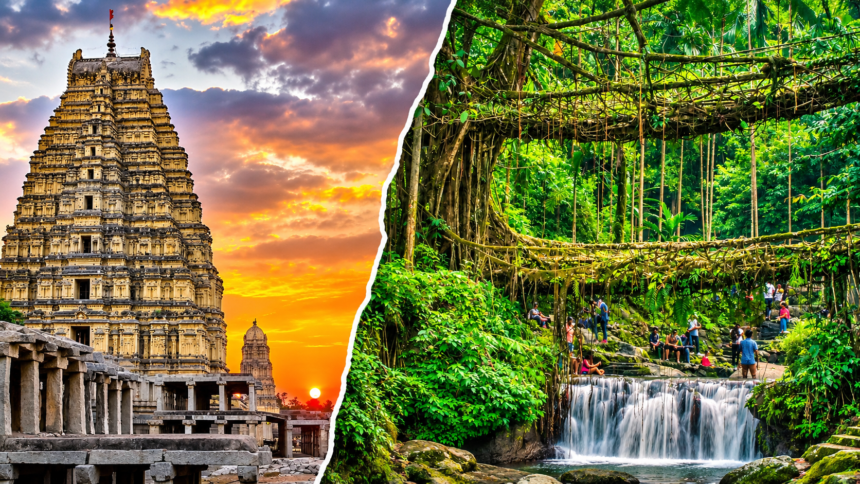
Hampi, a UNESCO World Heritage Site in Karnataka, offers a fascinating glimpse into the history of the Vijayanagara Empire. Surrounded by enormous boulders, rocky hills and banana plantations, the destination is known for its extensive collection of ancient ruins and temples.
One of its most recognised attractions is the Vitthala Temple, famous for its beautifully carved Stone Chariot. The Virupaksha Temple, which remains an active place of worship, is another important landmark.
Visitors can explore historical monuments, admire ancient sculptures and experience the peaceful surroundings of the Tungabhadra River.
Apart from its historical significance, Hampi also offers opportunities for rock climbing, coracle boat rides and watching picturesque sunsets. Its combination of natural scenery and architectural heritage makes it a distinctive travel destination.
Natural Wonders and Spiritual Retreats
4. Living Root Bridges, Meghalaya
The Living Root Bridges of Meghalaya are among India’s most unusual natural attractions. Found in the Cherrapunji region and other parts of the state, these bridges are created using the aerial roots of rubber fig trees.
Developed through traditional techniques practised by the Khasi and Jaintia communities, the bridges demonstrate a close relationship between people and nature.
One of the most remarkable examples is the double-decker living root bridge, which features two levels. According to local accounts, the additional level was developed because rising river water during certain seasons affected the original crossing.
These structures represent an extraordinary tradition of natural engineering and have been proposed for UNESCO World Heritage recognition.
5. Shatrunjaya Hills, Gujarat
Located in Palitana, Gujarat, Shatrunjaya Hills is an important Jain pilgrimage destination known for its magnificent collection of marble temples.
The sacred hill is home to more than 800 intricately designed temples constructed over approximately 900 years. Reaching the temple complex involves climbing around 3,500 steps, making the journey both physically demanding and spiritually significant.
At the summit, visitors are greeted by an impressive collection of temples featuring detailed marble carvings and traditional architectural designs.
The surrounding panoramic views and peaceful atmosphere add to the experience, making Shatrunjaya Hills an important destination for those interested in religious heritage and architecture.
6. Key Monastery, Himachal Pradesh
Situated in the remote Spiti Valley of Himachal Pradesh, Key Monastery is one of the region’s most striking religious landmarks. Standing at an altitude of nearly 13,600 feet, the monastery overlooks the dramatic Himalayan landscape.
Dating back more than 1,000 years, this Tibetan Buddhist monastery is recognised for its fortress-like structure and valuable collection of ancient murals, thangka paintings and religious manuscripts.
Its narrow passageways, traditional interiors and peaceful surroundings provide visitors with an insight into Buddhist monastic life.
The monastery also offers spectacular views of the Spiti River, rugged mountains and snow-covered Himalayan peaks, making it an appealing destination for travellers seeking natural beauty and spiritual experiences.
Temples, Cultural Heritage and Peaceful Communities
7. Meenakshi Amman Temple, Tamil Nadu
Located on the southern bank of the Vaigai River in Madurai, Tamil Nadu, the Meenakshi Amman Temple is one of the most celebrated examples of Dravidian architecture.
Dedicated to Goddess Meenakshi and Lord Sundareswarar, the historic temple complex is particularly famous for its towering gopurams, or gateway towers.
These structures are decorated with thousands of colourful sculptures depicting deities, mythological figures and traditional religious imagery.
Inside the temple, visitors can explore the impressive Hall of a Thousand Pillars and the sacred lotus pond.
The temple’s elaborate rituals, architectural details and deep religious significance offer a valuable introduction to South India’s cultural and artistic traditions.
8. Auroville, Tamil Nadu
Located near Puducherry, Auroville is an experimental township established in 1968 with the aim of promoting human unity and sustainable living.
The international community brings together residents from more than 50 countries, creating an environment focused on peaceful coexistence and shared values.
One of Auroville’s most recognised landmarks is the Matrimandir, a striking golden-domed structure surrounded by landscaped gardens. The building serves as a space dedicated to silent concentration and meditation.
Visitors can also explore sustainable architectural projects, organic farms and workshops showcasing traditional and contemporary craftsmanship.
Auroville offers a different kind of travel experience, allowing visitors to learn about environmentally conscious lifestyles, community living and spiritual development.
Coastal Fortresses and Maritime History
9. Murud-Janjira Fort, Maharashtra
Murud-Janjira Fort in Maharashtra is one of India’s most remarkable sea fortresses. Built on an oval-shaped rocky island in the Arabian Sea, the fort is known for its strong defensive architecture and long history of resisting military attacks.
Over the centuries, the fortress withstood repeated attempts at conquest by powerful forces, including the Marathas, Portuguese and British.
Its strategic location and impressive construction contributed to its reputation as a formidable maritime stronghold.
Today, Murud-Janjira Fort remains an important historical attraction, offering visitors an opportunity to explore its ancient structures and learn about the region’s maritime past.
The fort’s coastal setting and architectural significance make it a fascinating destination for travellers interested in Indian history.
Conclusion
India’s travel experiences extend far beyond its most visited monuments and tourist centres. From the ancient engineering of Chand Baori and the remarkable Living Root Bridges of Meghalaya to the peaceful surroundings of Key Monastery and the historic Murud-Janjira Fort, each destination offers something distinctive.
These nine places highlight the country’s architectural achievements, spiritual traditions, natural landscapes and cultural diversity.
For travellers looking to explore India from a different perspective, these destinations offer an opportunity to discover lesser-known experiences while connecting with the country’s rich history and heritage.