
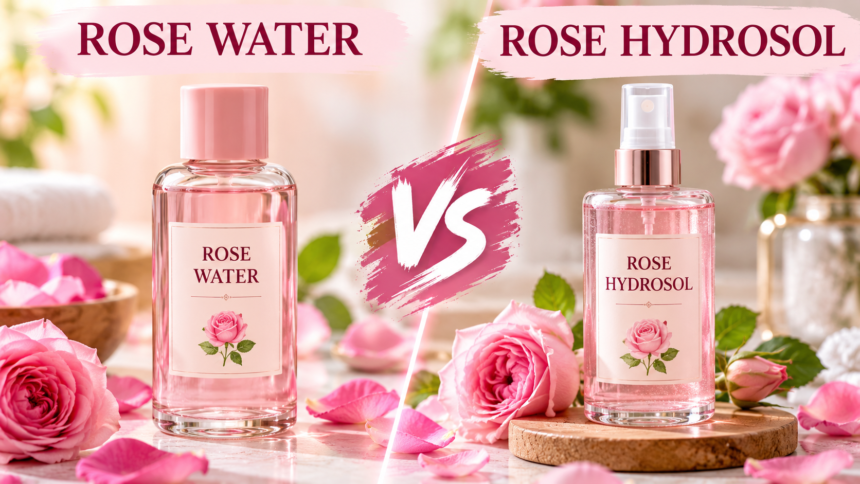
Rose-based skincare products are widely used in facial mists and toners because of their refreshing fragrance and hydrating properties. However, the terms rose water and rose hydrosol are often used interchangeably on product labels, making it difficult to understand what separates the two.
Although both products are associated with rose-based skincare, they can differ in their production methods, ingredients and composition. Understanding these differences can help you choose a product that suits your skin and daily skincare routine.
What Is the Difference Between Rose Water and Rose Hydrosol?
Rose hydrosol is the aromatic water produced during the steam distillation of rose petals, commonly from Rosa damascena. It contains water-soluble plant compounds and small amounts of volatile aromatic components that remain after the distillation process. This gives it its characteristic fragrance and makes it a popular ingredient in botanical skincare.
Rose water, on the other hand, is a broader product term. While some products sold as rose water are genuine rose distillates, others are made by combining water with rose fragrance, essential oils and ingredients that help disperse the oils throughout the formula.
As a result, the name alone does not confirm whether a product contains a pure rose distillate or a formulated mixture.
How Distillation Affects Rose Water and Rose Hydrosol
The production method plays an important role in determining the composition of a rose-based skincare product.
During steam distillation, steam passes through fresh rose petals and carries their volatile aromatic compounds. As the steam cools and condenses, it separates into two components: rose essential oil and aromatic water, known as rose hydrosol.
The hydrosol contains water-soluble plant constituents alongside small amounts of aromatic compounds. Depending on its composition, it may help refresh the skin and provide light hydration.
Some rose water products are instead prepared by mixing distilled water with rose oil or fragrance. Their final composition depends on the ingredients used, including any solubilisers or other additives. These formulations may provide a pleasant scent and a refreshing feel, but they are not compositionally identical to a genuine rose hydrosol.
Is Rose Hydrosol Purer Than Rose Water? How to Read the Label
A genuine, undiluted rose hydrosol is a botanical distillate. However, rose water is not necessarily synthetic or inferior, as some rose water products are also made through distillation. The distinction depends on the actual ingredients and manufacturing method rather than the product name alone.
When checking a label, look for the following ingredients:
- Rosa Damascena Flower Water: Indicates rose flower water and may identify a rose distillate.
- Water (Aqua) and Fragrance (Parfum): May indicate a formulated product containing added fragrance rather than a pure rose hydrosol.
- PEGs or Polysorbate-20: These ingredients can be used in formulations to help disperse or solubilise other ingredients.
- Alcohol: Its presence may affect the product’s feel and suitability for some skin types, depending on the type and concentration used.
The presence of these additional ingredients does not automatically make a product unsuitable for skincare. However, if you want a pure botanical distillate, check the complete ingredient list and look for a product that identifies rose flower distillate as its sole ingredient.
Rose Hydrosol vs Rose Water: Which Is Better for Your Skin?
The right choice depends on your skin type, fragrance sensitivity and skincare preferences.
| Feature | Rose Hydrosol | Synthetic or Reconstituted Rose Water |
|---|---|---|
| Main benefit | Refreshes skin and provides light hydration | Provides a refreshing scent and light hydration |
| Composition | Botanical rose distillate | May contain added water, fragrance and solubilisers |
| Suitable skin types | May suit sensitive, dry or reactive skin, depending on the formulation | May suit normal skin that tolerates its ingredients |
| Price | Often more expensive because of the distillation process | Often more affordable and mass-produced |
For people with sensitive or acne-prone skin, checking the complete ingredient list is particularly important. A pure hydrosol may be preferable if you want to avoid added fragrance, but botanical ingredients can also cause irritation in some individuals. A patch test before regular use is a sensible precaution.
Final Verdict
Rose water and rose hydrosol can both be used in skincare, but their composition and production methods may differ. Genuine rose hydrosol is obtained through distillation, while products marketed as rose water may contain either a botanical distillate or a mixture of water, fragrance and other ingredients.
If your priority is a pure, plant-derived product, look for a clearly labelled rose distillate and check the full ingredient list. Choosing according to your skin’s needs and fragrance tolerance is more useful than relying on the product name alone.